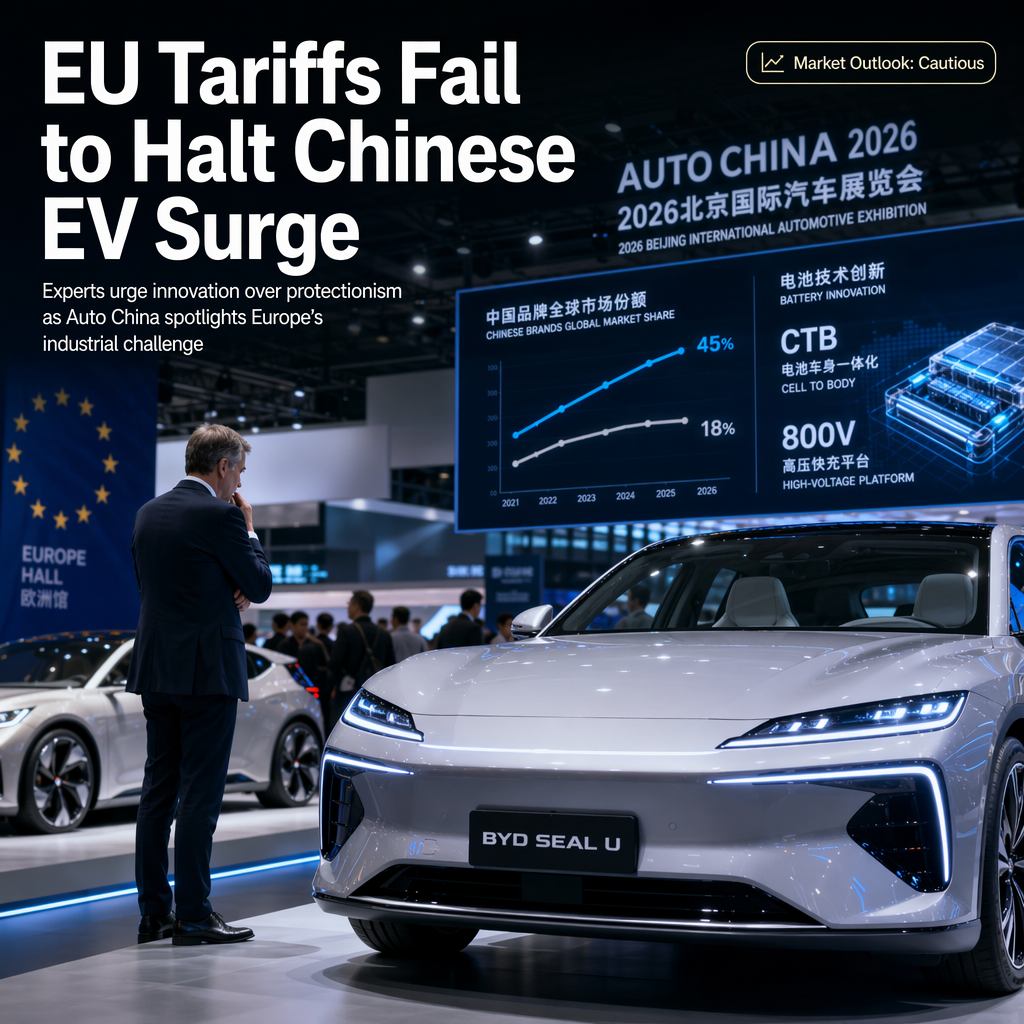
Europe's current approach to industrial competition with China, particularly in the automotive sector, is centered on the use of tariffs. However, experts argue that this strategy is inadequate for transforming the European Union into a leading industrial and technological power. At the 2026 Beijing International Automotive Exhibition (Auto China), European brands such as Volkswagen showcased concept vehicles like the Jetta X, highlighting ongoing innovation but also the increasing pressure from advanced Chinese electric vehicle (EV) manufacturers [1].
While tariffs may provide short-term protection for European industries, analysts and experts emphasize the necessity for a more comprehensive strategy. This includes increased investment in technological innovation, research and development, and the strengthening of supply chains to reduce reliance on China. Policies that encourage domestic manufacturing and partnerships with non-Chinese entities are also recommended. Philippe Le Corre, a professor of geopolitics, stated, "The EU's focus on tariffs is a defensive measure, not a long-term solution. To truly compete, Europe needs a proactive industrial policy that addresses its technological gaps and supports strategic sectors" [1].
Market analysis suggests that without significant innovation, European manufacturers risk losing market share both in China and globally. The rise of Chinese EVs, supported by government backing and efficient supply chains, presents a direct threat to European industry. Recent trade tensions have already resulted in Chinese retaliation against European firms such as Rheinmetall and Lafert [1].
Technical indicators point to the need for the European automotive sector to achieve advancements in battery technology and software integration to remain competitive. European EVs are currently priced higher than their Chinese counterparts, which benefit from economies of scale and lower production costs. Market experts advise investors to closely monitor EU policy changes and sectoral support measures, noting that sentiment remains cautious due to concerns over escalating tariffs and potential trade disruptions impacting profitability [1].
CONCLUSION
The European Union's reliance on tariffs is viewed as an insufficient response to the growing competitive threat from Chinese EV manufacturers. Experts and market analysts call for a broader, innovation-driven strategy to safeguard Europe's industrial future. Market sentiment is cautious, with concerns about trade tensions and the need for significant investment in technology and supply chains.