
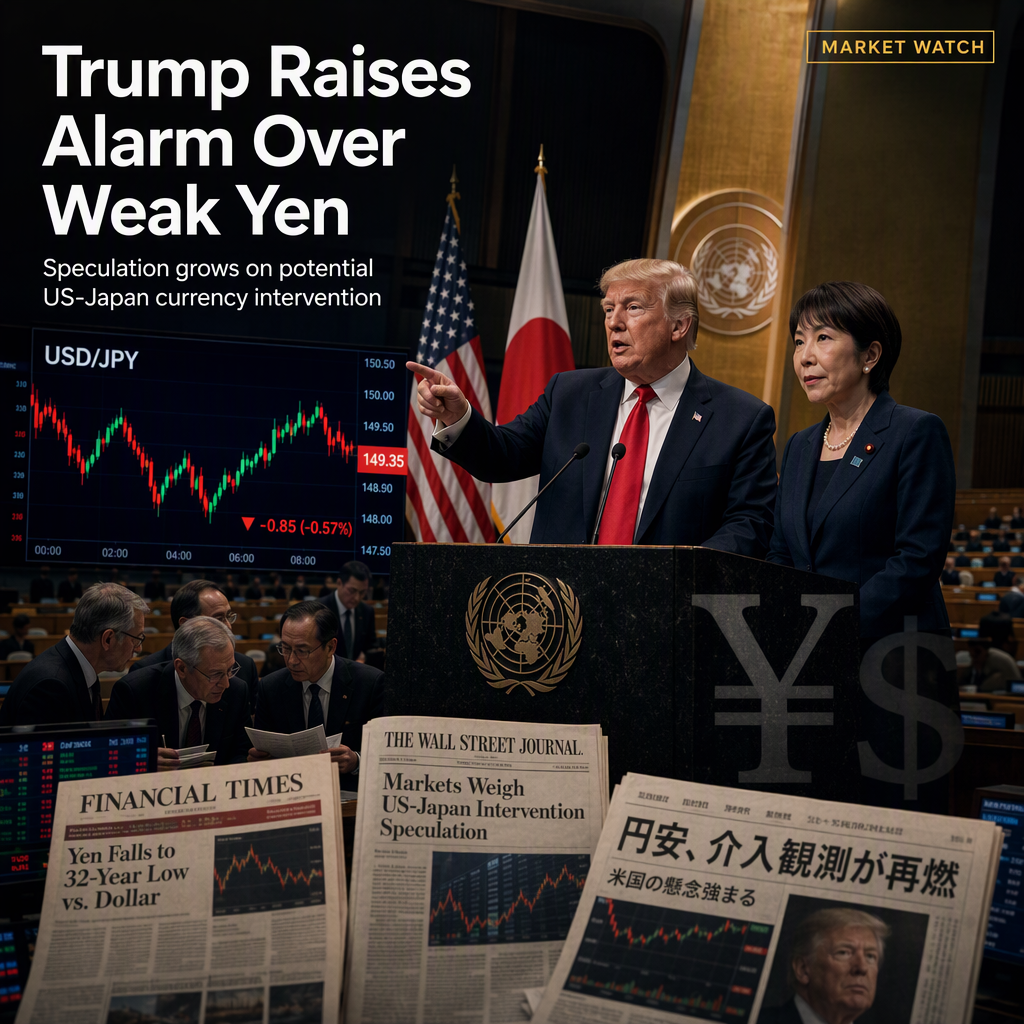
U.S. President Donald Trump raised concerns about the Japanese yen's weakness during a summit with Japanese Prime Minister Sanae Takaichi at the United Nations headquarters, elevating currency issues to the leaders' level and prompting speculation about potential policy shifts and increased American pressure on Tokyo's economic and fiscal policies [1][2]. Finance Minister Katayama confirmed that Trump expressed the weak yen was making trade difficult for the US, and further joint intervention with the US had not been ruled out, with both leaders affirming that stance [2]. Japan and the US previously conducted a joint yen-buying intervention in late July, and Trump's public remarks have made another joint operation more plausible [2].
The yen has recently hovered in the upper-156 range against the dollar, with the Bank of Japan (BoJ) conducting rate checks and revealing a $96 billion yen-buying intervention between July and August. The BoJ raised its policy rate to 1.25% on September 18, with Governor Ueda citing a shift in policy phase, while global bond sell-offs and rising oil prices have added complexity to the currency landscape [1][2]. USD/JPY closed just under 157.50 on Monday, holding most of Friday's drop from 159.00, with the pair dipping to 156.50 during the day and recovering [2]. Resistance is noted at the 50-day EMA near 158.00, and support at Monday's low near 156.50, with a bias for long positions above 156.50 aiming for 158.00 and then 159.00 [2].
Market participants are closely monitoring upcoming data releases, including Japan's Ministry of Finance figures on yen purchases between August 27 and September 28, which will clarify whether recent rate checks resulted in actual intervention [2]. Additionally, Japan's quarterly Tankan survey is forecast to show the large manufacturers' index at 25, up from 22, and Tokyo's Consumer Price Index (CPI) for September is expected at 2.4% YoY, up from 1.8%. These figures could support further BoJ rate hikes, especially if Tokyo's core inflation exceeds 2% [2].
The GBP/JPY cross-pair traded near the mid-point of the 207.50-211.00 range, settling at around 208.66, up 0.14%. Technical analysis indicates further consolidation, with resistance at 209.00 and support at 208.00. The Japanese yen was the strongest against the Australian dollar this week, with a -0.04% change, while its performance against other major currencies was mixed [3].
Market sentiment remains cautious, with traders and analysts debating the possibility of a 'new Plaza Accord' and watching for announcements from both governments regarding future currency cooperation or intervention [1].
CONCLUSION
President Trump's public concern about the weak yen has heightened speculation of coordinated US-Japan intervention and policy shifts, leading to increased market volatility and cautious sentiment. Key upcoming data releases and policy signals from both countries will be closely watched for further direction. The yen's trajectory remains uncertain, with technical and fundamental factors influencing its near-term outlook.