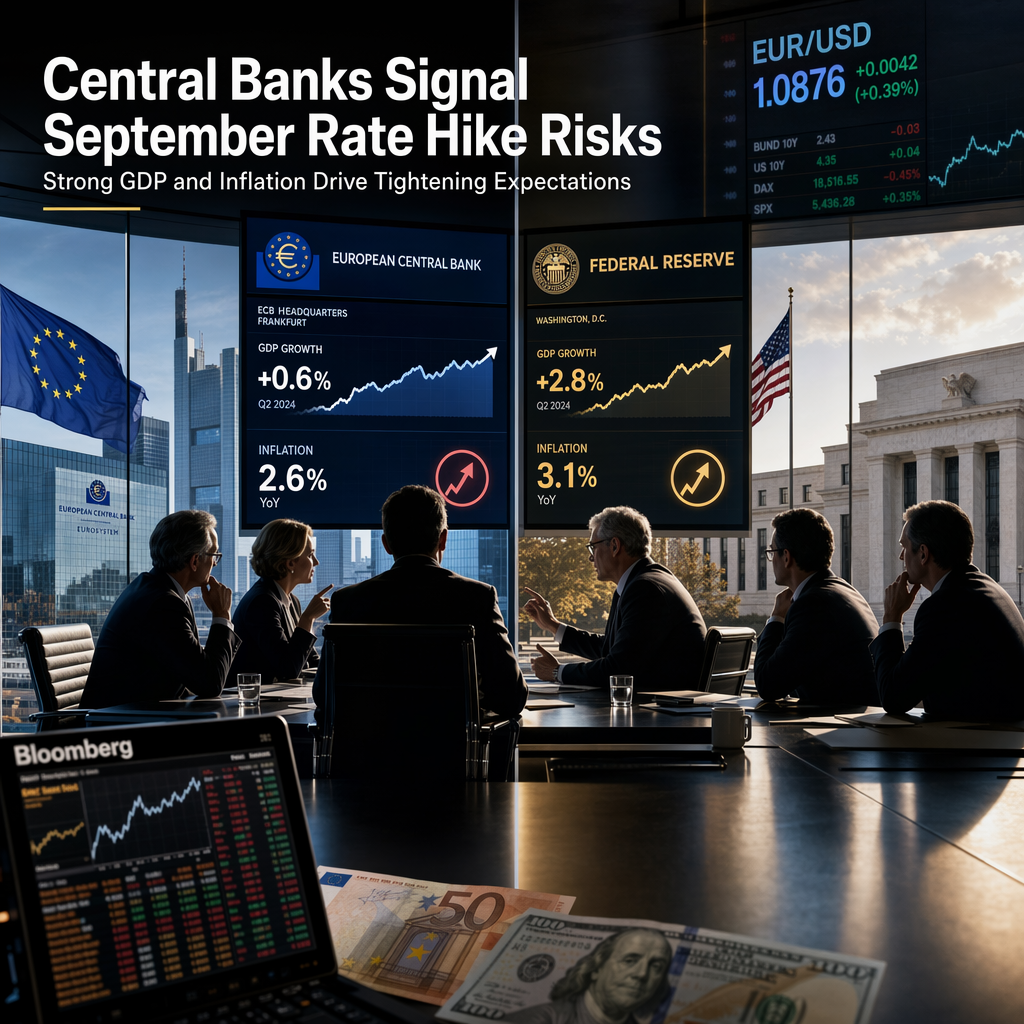
Recent developments in both the Eurozone and United States central banking landscapes have heightened expectations for potential rate hikes in September. According to Brown Brothers Harriman’s Elias Haddad, the EUR/USD currency pair is consolidating after a rally triggered by stronger-than-expected Eurozone Q2 GDP growth, which came in at 0.4% quarter-on-quarter, doubling expectations and marking a broad-based recovery across major economies [1]. This robust economic activity, coupled with inflation remaining above target, reinforces the case for the European Central Bank (ECB) to resume raising rates in September. However, Haddad notes that market pricing already implies nearly 90% odds of a 25 basis point rate hike at the September 10 meeting, limiting further upside for the Euro [1]. The ECB projects real GDP growth to average 0.8% in 2026, but warns that renewed energy supply disruptions could pose downside risks to incomes, spending, and investment [1].
Meanwhile, Nordea’s Kirsti Sunde Midttun reports that the Federal Reserve (Fed) kept its target range at 3.50–3.75%, but the decision was marked by three hawkish dissents, with Beth Hammack, Lorie Logan, and Neel Kashkari all preferring a 25 basis point hike at this meeting [2]. The Committee reiterated that inflation 'remains elevated relative to the Committee's 2 percent goal,' and emphasized its commitment to delivering price stability [2]. The cautious tone of the press conference and unchanged statement provided limited guidance, but market reactions included moves in US government bonds and a weaker US Dollar, reflecting some skepticism about the Fed's ability to control inflation [2]. Midttun maintains expectations for a September hike, noting that three dissents in the same direction indicate the Committee's likely trajectory [2].
Both central banks are facing elevated inflation and strong economic data, which are supporting the case for further tightening. However, market pricing and investor sentiment suggest that the upside for the Euro may be limited, and confidence in the Fed's inflation control remains uncertain [1][2]. Forward-looking statements from both sources indicate continued expectations for rate hikes in September, with risks skewed to the downside in the Eurozone due to potential energy disruptions, and persistent inflation concerns in the US [1][2].
CONCLUSION
Both the ECB and Fed are signaling a high likelihood of rate hikes in September, supported by strong GDP and persistent inflation. While market pricing already reflects these expectations, investor confidence in inflation control remains mixed, and further upside for the Euro appears limited. The market impact is medium, as central bank actions and economic data continue to shape investor sentiment.