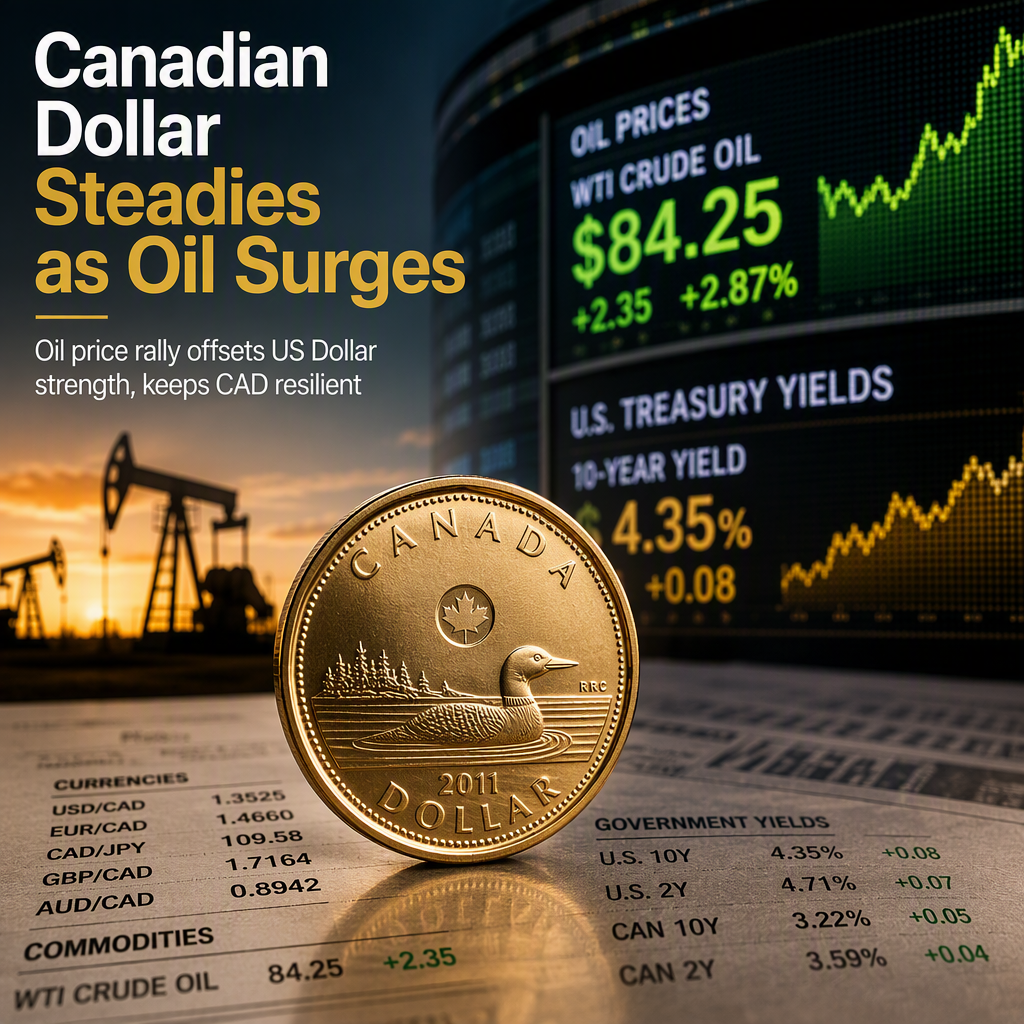
The Canadian Dollar (CAD) remained resilient on Tuesday, with USD/CAD trading little changed around 1.3874, a level last seen in early June, as rising long-term US Treasury yields supported the US Dollar (USD) while elevated Oil prices underpinned the commodity-linked CAD [1]. The benchmark 10-year US Treasury yield approached 4.75%, and the 30-year yield surpassed 5.30%, marking its highest level since 2007. These higher yields contributed to a modest recovery in the US Dollar from two-month lows recorded on Monday, with the US Dollar Index (DXY) up 0.10% at 99.67 [1].
Oil price movements continue to be a key driver for USD/CAD. West Texas Intermediate (WTI) crude Oil traded around $84.25 per barrel after a 3.15% gain on Monday, holding near its highest level in over two weeks [1]. Analysts at Commerzbank emphasized that the Canadian Dollar's performance has been closely linked to oil prices in recent months, a trend they expect to persist unless the Strait of Hormuz remains open on a sustained basis [1].
On the inflation front, data released on Monday showed Canada’s Consumer Price Index (CPI) accelerated to 3.0% year-over-year in July from 2.8% in June, keeping inflation concerns in focus [1]. However, this data did not significantly alter market expectations for the Bank of Canada (BoC). Economists at TD Securities noted that core inflation measures appeared less benign than in previous months, but they believe the BoC can remain patient, waiting for more clarity on the growth outlook beyond Q2. TD Securities reiterated their expectation that the BoC will keep rates on hold through 2026 [1].
In the US, recent weaker economic data have led traders to reduce expectations for a Federal Reserve (Fed) rate hike at the September meeting. Nonetheless, energy-driven inflation risks mean the possibility of a rate increase later this year remains [1].
CONCLUSION
The Canadian Dollar has shown resilience, supported by strong oil prices despite firmer US Treasury yields and a modestly stronger US Dollar. Inflation data and analyst commentary suggest the Bank of Canada is likely to maintain its current policy stance, while market participants remain attentive to energy-driven inflation risks and potential future moves by the Federal Reserve.