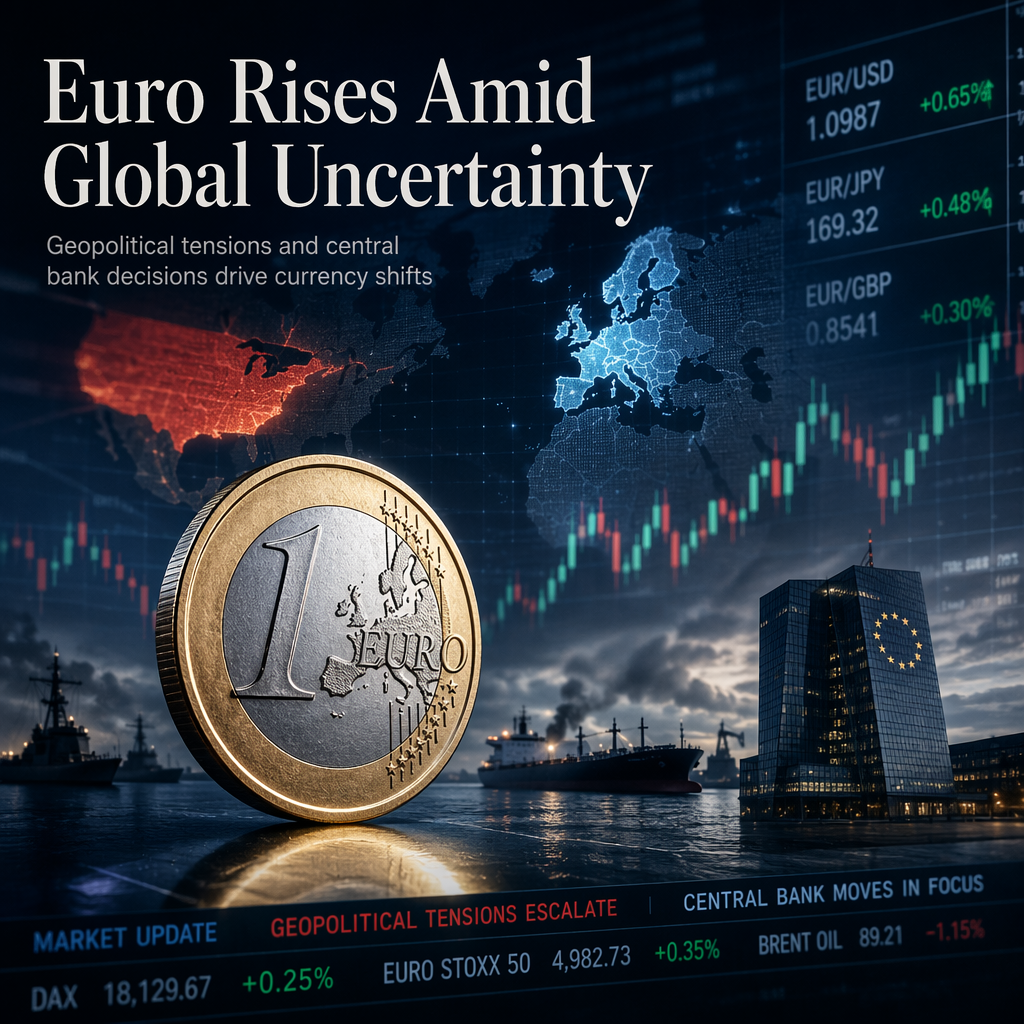
The Euro gained ground against the US Dollar, with EUR/USD trading around 1.1380 during Asian hours on Friday, following modest losses the previous day [1]. This movement occurred despite escalating geopolitical tensions in the Middle East, specifically after Yemen’s Iran-backed Houthi group attacked two Saudi oil tankers in the Red Sea, prompting the US to conduct its 13th consecutive night of military strikes on Iran [1]. US President Donald Trump warned of 'major military punishment' for both the Houthis and Iran if attacks continue, indicating he is close to deciding on a massive, unprecedented military operation against Iran [1].
The heightened tensions have raised concerns about a potential oil-driven inflation spike, which in turn has fueled expectations that the US Federal Reserve might resume raising interest rates [1]. According to the CME FedWatch tool, money markets are currently pricing in a 35.8% chance of a Fed rate hike this month and an 82.1% probability of at least a quarter-point hike in September [1].
Simultaneously, trade concerns have intensified after reports that the United States plans to impose new tariffs ranging between 10% and 12.5% on imports from major trading partners, including at least 10% on imports from the European Union, in an effort to rebuild trade barriers following a recent Supreme Court ruling [1]. These tariffs are structured to remain compliant with existing US-EU trade agreements [1].
On the monetary policy front, the European Central Bank (ECB) Governing Council reaffirmed its commitment to bringing inflation down to its 2% medium-term target but cautioned that high uncertainty persists and the full inflationary impact of the energy shock has yet to materialize [1]. After a 25-basis-point rate hike in June, the ECB opted to hold its key interest rates steady, keeping the deposit facility, main refinancing, and marginal lending rates at 2.25%, 2.40%, and 2.65%, respectively [1].
CONCLUSION
The Euro's recent gains against the US Dollar reflect a complex interplay of geopolitical tensions, inflation expectations, and central bank policy decisions. While the ECB remains cautious and holds rates steady, market participants are closely watching the potential for further Fed rate hikes and the impact of new US tariffs. Ongoing uncertainty in both geopolitical and economic arenas continues to shape currency market dynamics.