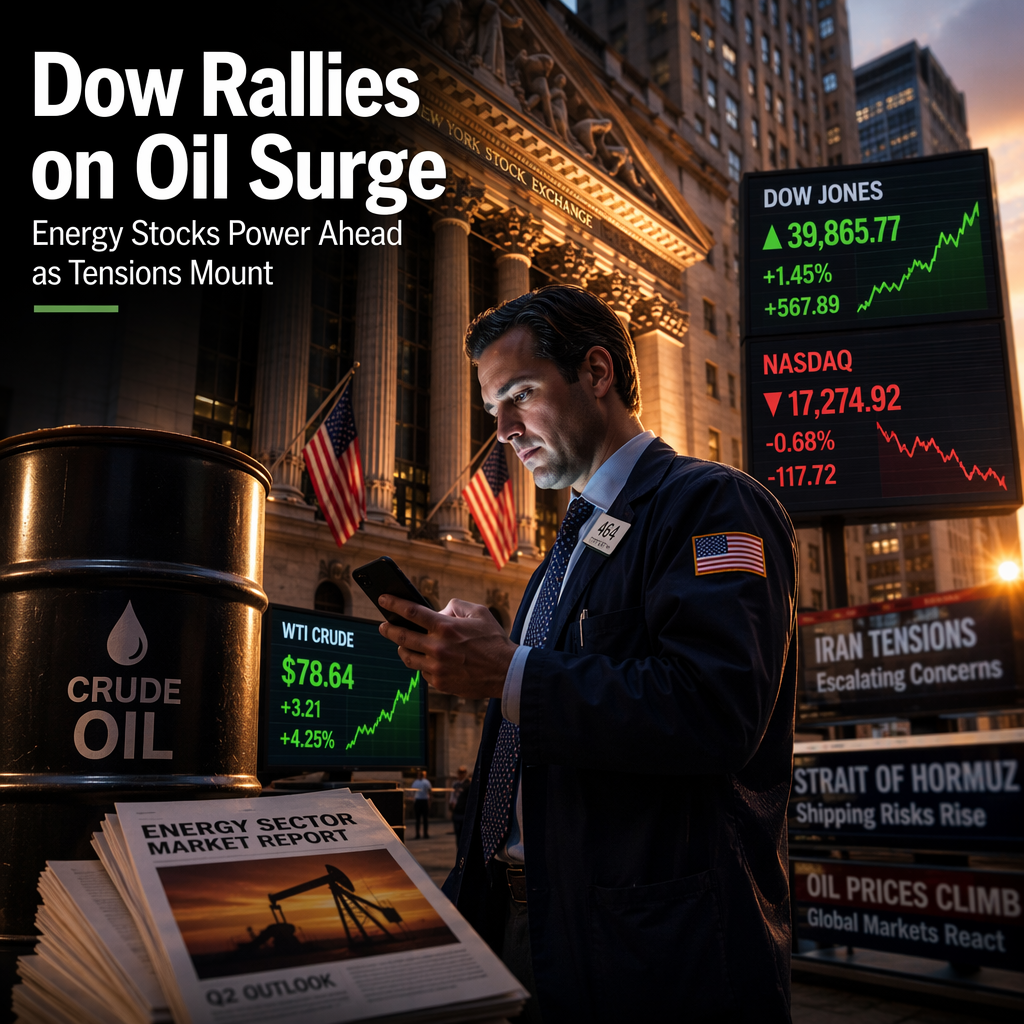
The Dow Jones Industrial Average traded near 52,400 on Wednesday, rising approximately 200 points and positioning itself for a second consecutive daily gain. In contrast, the S&P 500 remained flat, and the Nasdaq slipped into negative territory. The Dow's performance was attributed to its composition, which is more heavily weighted toward energy, staples, and industrials—sectors that are perceived as relative safe havens amid escalating geopolitical tensions and rising input costs [1].
The market session was dominated by macroeconomic headlines and earnings reports, as the US economic calendar was largely empty until Thursday. Overnight, US forces conducted an eleventh consecutive round of strikes on Iran, with Secretary of State Marco Rubio stating that Tehran is not serious about negotiations and pledging continued American protection for shipping through the Strait of Hormuz. Former President Trump escalated rhetoric by promising that for every ship attacked in the waterway, an Iranian bridge or power plant would be destroyed. In response, Tehran reportedly increased its strike capabilities along the Strait, further heightening tensions [1].
These developments had a direct impact on energy markets, with West Texas Intermediate crude oil trading above $86.00 and Brent crude above $93.00 after briefly surpassing $95.00. Both benchmarks were up around 2%, reaching levels last seen in mid-June. The rise in energy prices weighed more heavily on the Nasdaq, which is more exposed to growth stocks sensitive to higher input costs and interest rates, while the Dow benefited from its sector composition [1].
Earnings season continued to provide optimism, with approximately 88% of early S&P 500 reporters beating profit estimates. Notable beats from 3M (MMM) and General Motors (GM) on Tuesday continued to buoy cyclical stocks. The market's focus shifted to after-hours reports from Alphabet (GOOG), Tesla (TSLA), ServiceNow (NOW), Texas Instruments (TXN), and International Business Machines (IBM), with particular attention on order books and capital-spending guidance. IBM's report was highlighted as especially significant for the Dow, given its price-weighted influence and the recent volatility following a mid-July profit warning that erased about a quarter of the company's value in a single session [1].
CONCLUSION
Geopolitical tensions and rising oil prices drove a divergence among US equity benchmarks, with the Dow Jones outperforming due to its sector composition. While earnings optimism persists, the market remains focused on upcoming reports from major technology and industrial firms, particularly IBM, as investors seek clarity on future capital spending and order flows.