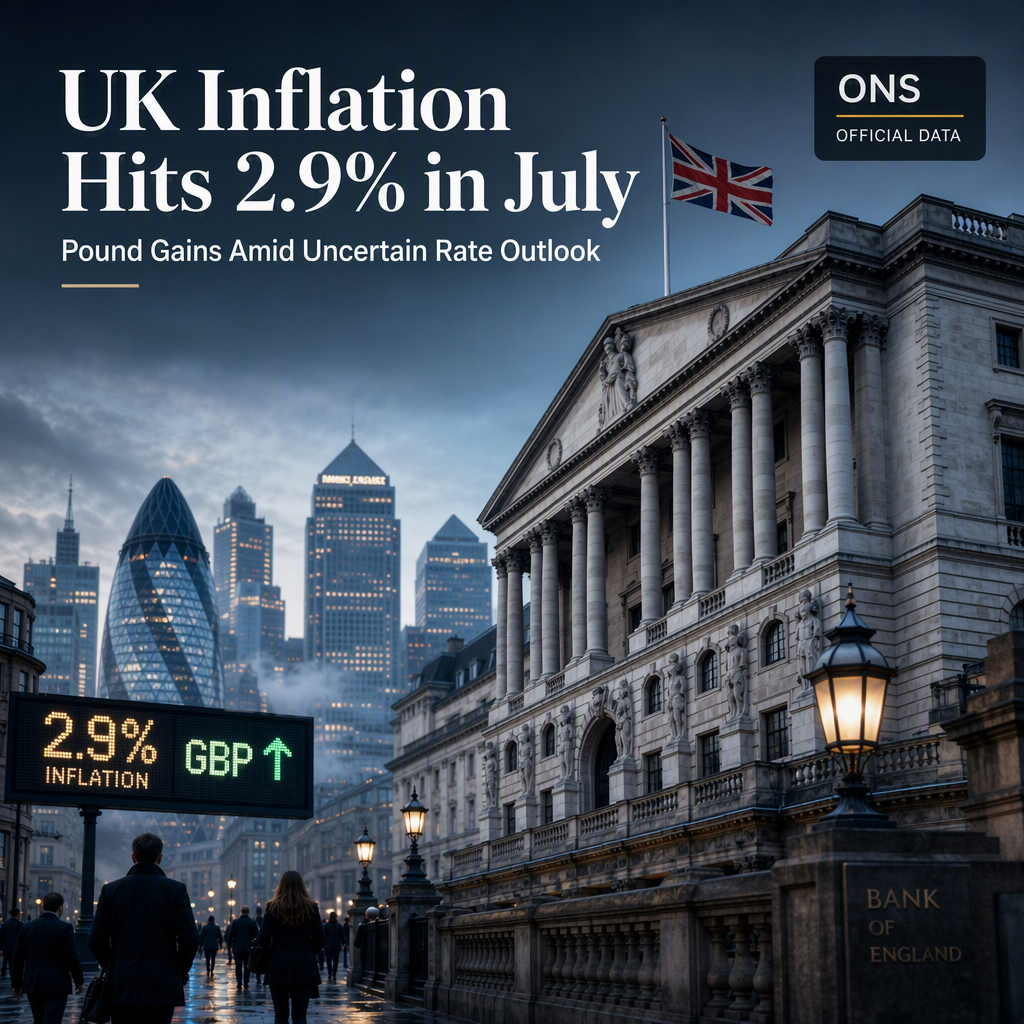
The United Kingdom's Consumer Price Index (CPI) inflation accelerated to 2.9% year-over-year (YoY) in July, up from 2.6% in June, matching market expectations according to data released by the Office for National Statistics (ONS) [1][2][3]. The increase was attributed to a sharp rise in gas prices following an adjustment in the household energy price cap [1]. Core CPI, which excludes volatile food and energy items, remained steady at 2.6% YoY, hotter than the forecast of 2.5% [1][2][3]. On a monthly basis, headline CPI rose 0.3% in July, compared to 0.1% in June, in line with consensus [1][2]. Source 3 reports the monthly CPI as 0.35, slightly higher than other sources [3].
The British Pound (GBP) responded with modest gains against the Euro (EUR), US Dollar (USD), and Japanese Yen (JPY), but remained within established trading ranges and showed limited reaction overall [1][2][3]. The EUR/GBP cross traded around 0.8555, paring earlier gains, while GBP/USD hovered above 1.3550, below resistance at 1.3570 [1][2]. Against the JPY, GBP traded near its day's low at 215.70, as the Yen outperformed major peers [3].
Market expectations for Bank of England (BoE) policy remain mixed. Money market pricing suggests City economists project one BoE rate hike by year-end, potentially lifting the Bank rate from 3.75% to 4.0% [1]. However, ING analysts see little impetus for the BoE to hike rates this year, citing a 'cool' jobs market and minimal wage pressures [2]. TD Securities expects the BoE to stay on hold, noting that wage growth measures are consistent with the BoE's inflation target and that labour market dynamics are limiting second-round inflation pressures [3].
Technical analysis indicates a mildly bearish bias for EUR/GBP, with price action capped below key moving averages and neutral momentum [1]. The Pound's reaction to the inflation data was limited, and broader market sentiment remains cautious as traders reassess central bank rate expectations [2][3].
On the Eurozone front, ECB chief economist Philip Lane stated that Eurozone inflation at 3% remains too high, and markets are pricing in a 90% to 94% chance of a 25 basis points hike at the September ECB meeting [1]. Meanwhile, the Japanese Yen strengthened, with markets confident in a potential 25 basis points rate hike by the Bank of Japan in September [3].
CONCLUSION
UK inflation rose to 2.9% in July, in line with expectations, prompting only modest gains in the Pound and limited market reaction. Despite the uptick in inflation, analysts remain divided on the likelihood of a Bank of England rate hike, with some expecting rates to stay on hold due to subdued wage pressures and a cool jobs market. The market impact is medium, as traders await further signals from central banks and economic data.