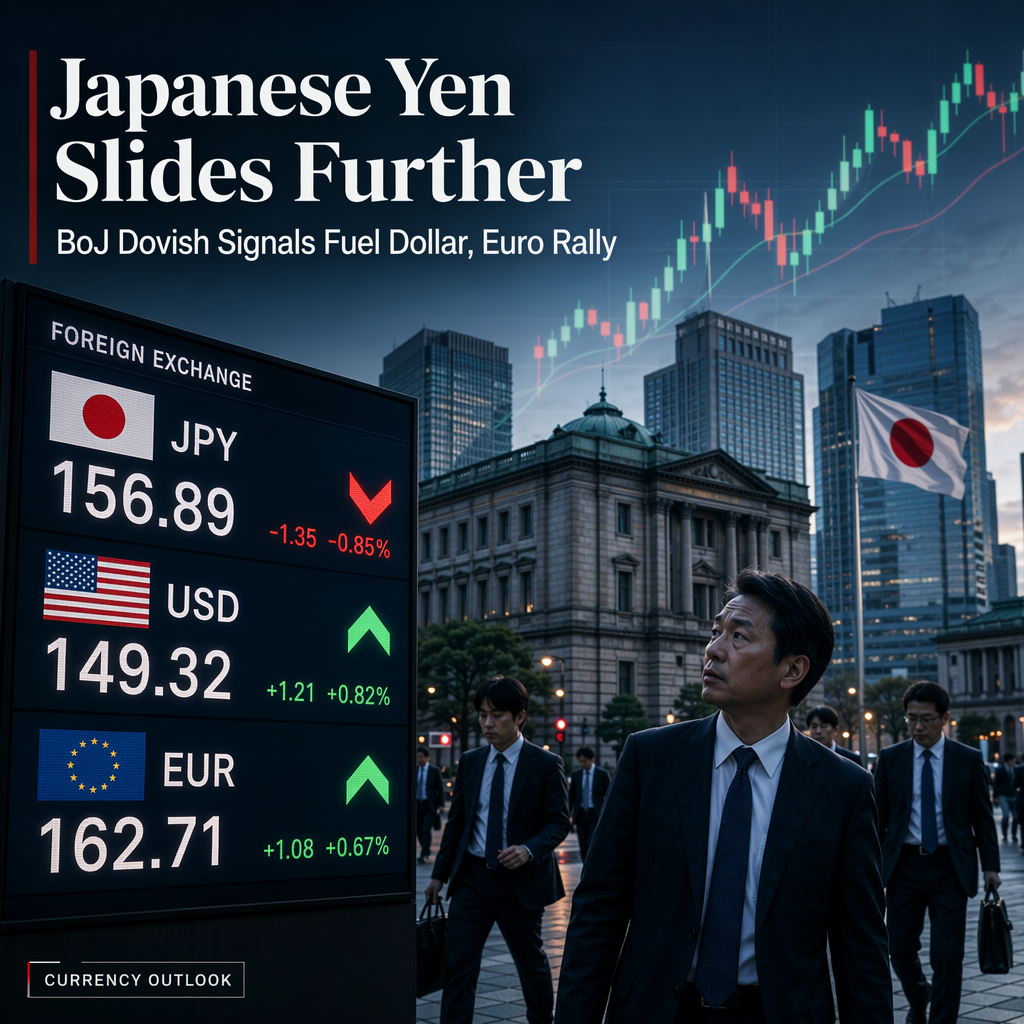
The Japanese Yen (JPY) underperformed against major currencies on Wednesday, with the Euro (EUR) trading 0.1% higher near 185.20 against the Yen during the European session [1]. The Yen was the weakest against the New Zealand Dollar, as shown in a comparative table of percentage changes among major currencies [1]. The US Dollar (USD) also appreciated against the Yen for the fourth consecutive day, with USD/JPY trading at 162.26, though it remained capped below the resistance area of 162.40 [2].
The Yen's weakness persisted despite Japan’s Growth Strategy Minister Minoru Kiuichi clarifying that the government is not encouraging a low-interest rate environment as part of its fiscal expansion policy, stating, 'there’s absolutely no truth to reports suggesting that the government is encouraging low interest rates as part of its fiscal expansion policy' and 'Tokyo is not easing fiscal discipline' [1]. On the monetary policy front, Bank of Japan (BoJ) member Toichiro Asada reiterated that he is not against hiking interest rates but emphasized the need for demand-driven inflation, noting that such economic forces are not strong enough yet to justify raising rates [1][2].
Geopolitical tensions also influenced market sentiment, as a new round of US strikes on Iran in response to alleged attacks on vessels near the Strait of Hormuz hurt risk appetite and provided some support to the safe-haven US Dollar [2]. Technical analysis indicates that USD/JPY faces resistance at 162.41 (June 6 high), with the next major resistance at the 40-year high of 162.85. Initial support is seen at 161.70, with key support at 160.50 [2].
On the Euro side, investors faced uncertainty due to mixed signals from European Central Bank (ECB) officials regarding inflation. ECB policymaker Fabio Panetta highlighted ongoing upside risks to Eurozone inflation due to uncertainty in the Strait of Hormuz, while Pierre Wunsch suggested that any inflation surprise before the July meeting could influence policy [1].
CONCLUSION
The Japanese Yen continued to weaken against both the Euro and US Dollar, driven by dovish signals from BoJ officials and ongoing geopolitical tensions. Despite government reassurances about fiscal discipline, the lack of demand-driven inflation in Japan and mixed signals from the ECB contributed to market uncertainty. The overall market sentiment remains cautious, with the Yen under pressure and key resistance levels in focus for USD/JPY.