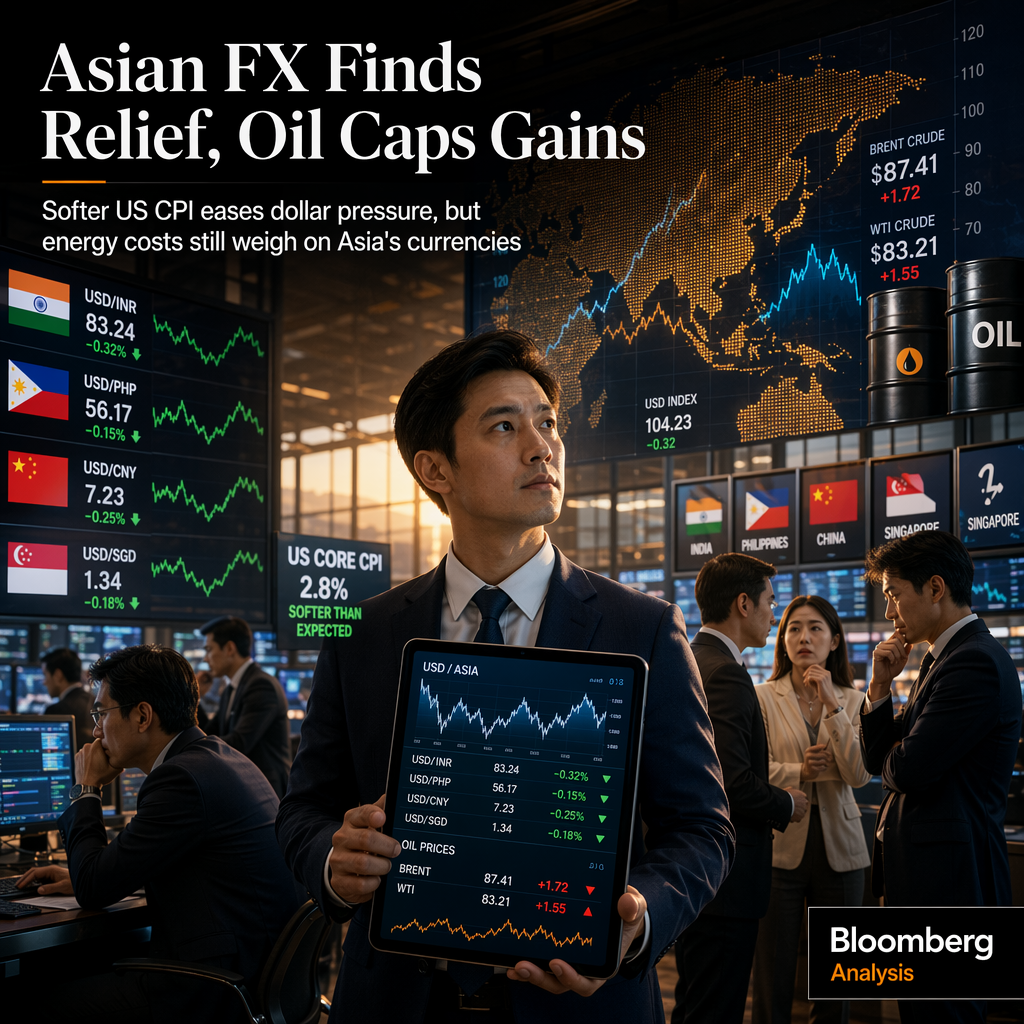
OCBC analysts Sim Moh Siong and Christopher Wong report that Asian foreign exchange (FX) markets are expected to trade with a better tone following a softer-than-expected United States (US) core Consumer Price Index (CPI) print, which has reduced near-term Federal Reserve (Fed) hike expectations and pressured the US dollar (USD) [1]. This development offers Asian currencies some relief after a recent risk-off move, but the impact is uneven across the region [1].
The analysts note that elevated oil prices continue to provide support for USD/Asia pairs, particularly affecting currencies with greater sensitivity to energy costs and external balances. Specifically, the Indian Rupee (INR) and Philippine Peso (PHP) are likely to remain pressured, with India's wider goods trade deficit further weighing on the INR [1]. In contrast, the Renminbi (RMB) and Singapore Dollar (SGD) are expected to remain relatively stable due to their lower oil sensitivity and stronger policy anchors [1].
Overall, while the softer USD momentum is beneficial for Asian FX, persistently high oil prices may cap the extent of gains for regional currencies. The relief from USD weakness is not uniform, and currencies with higher energy import dependence and trade deficits face continued challenges [1].
CONCLUSION
The softer US core CPI has eased immediate pressure on Asian FX markets, but high oil prices continue to limit gains, especially for energy-sensitive currencies like INR and PHP. RMB and SGD are expected to remain stable due to stronger policy anchors and lower oil sensitivity. Market participants should remain cautious as uneven relief persists across the region.