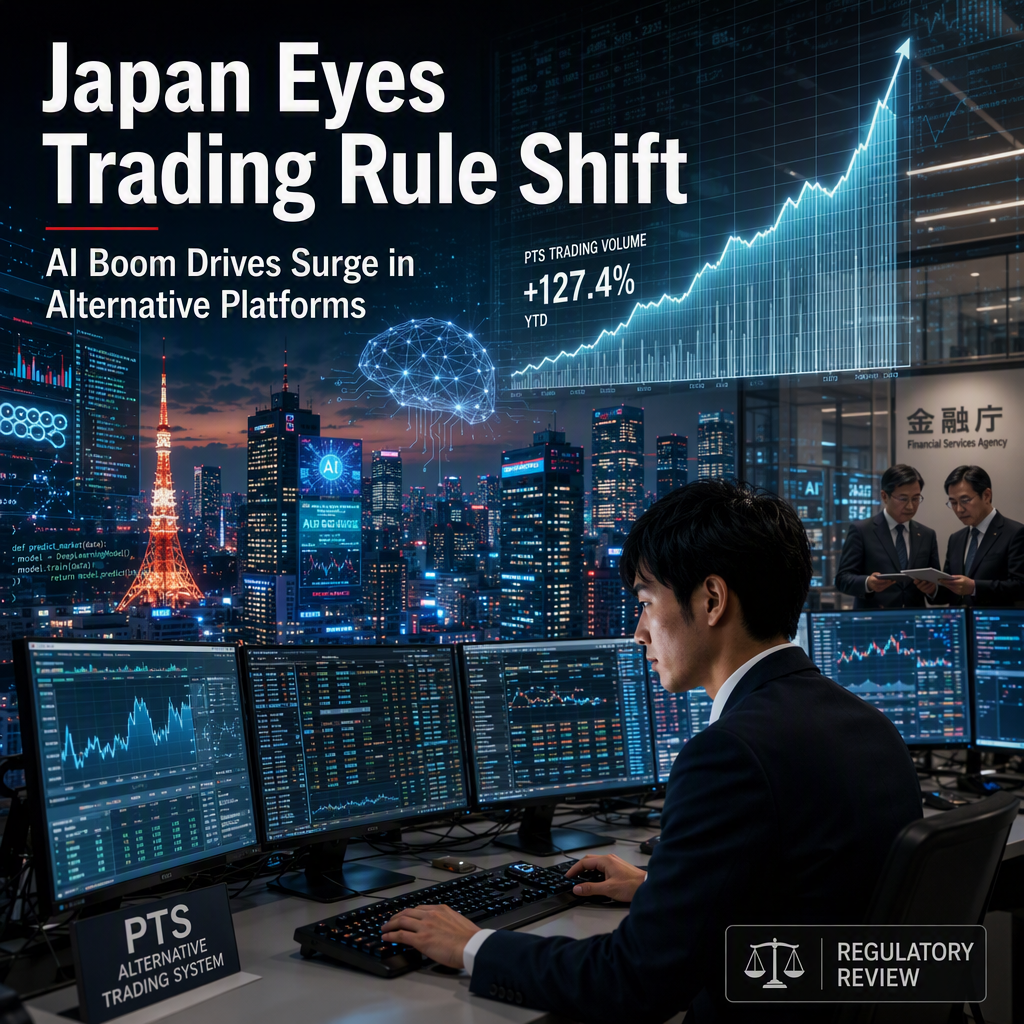
Japanese financial authorities are considering revising the rule that separates proprietary trading systems (PTS) from full-fledged securities exchanges, in response to a significant increase in trading volumes on these alternative platforms [1]. The Financial Services Agency has actively encouraged the growth of PTS to reduce the concentration of trading at the Tokyo Stock Exchange, and the recent surge in activity—attributed to the AI boom—has prompted regulators to evaluate whether the current cap, which prevents PTS from becoming full-fledged exchanges, remains appropriate [1].
The existing cap is intended to keep PTS platforms distinct from traditional exchanges, but as trading volumes continue to rise, this distinction is becoming less relevant. Authorities are now considering relaxing or redefining the rule to better reflect the evolving market landscape [1]. An official familiar with the discussions stated, "We are closely monitoring trading volumes and market dynamics. If the proprietary trading systems continue to grow at this pace, it may be necessary to review the existing framework and ensure market stability" [1].
The increased activity on PTS is largely driven by the AI boom, which has heightened demand for faster and more flexible trading venues. Market participants highlight that PTS offer advantages in speed and efficiency, making them particularly attractive to institutional investors seeking to capitalize on rapid price movements [1].
While no specific financial values, dates, or ticker symbols are provided, the article underscores the regulatory review process and the positive market sentiment surrounding the growth of PTS platforms. Authorities are focused on balancing innovation with the need to maintain fair and stable market conditions as trading volumes continue to climb [1].
CONCLUSION
Japanese regulators are considering changes to proprietary trading system rules in response to surging volumes fueled by the AI boom. The review aims to support innovation while ensuring market stability, signaling a potentially more flexible regulatory environment for alternative trading platforms.