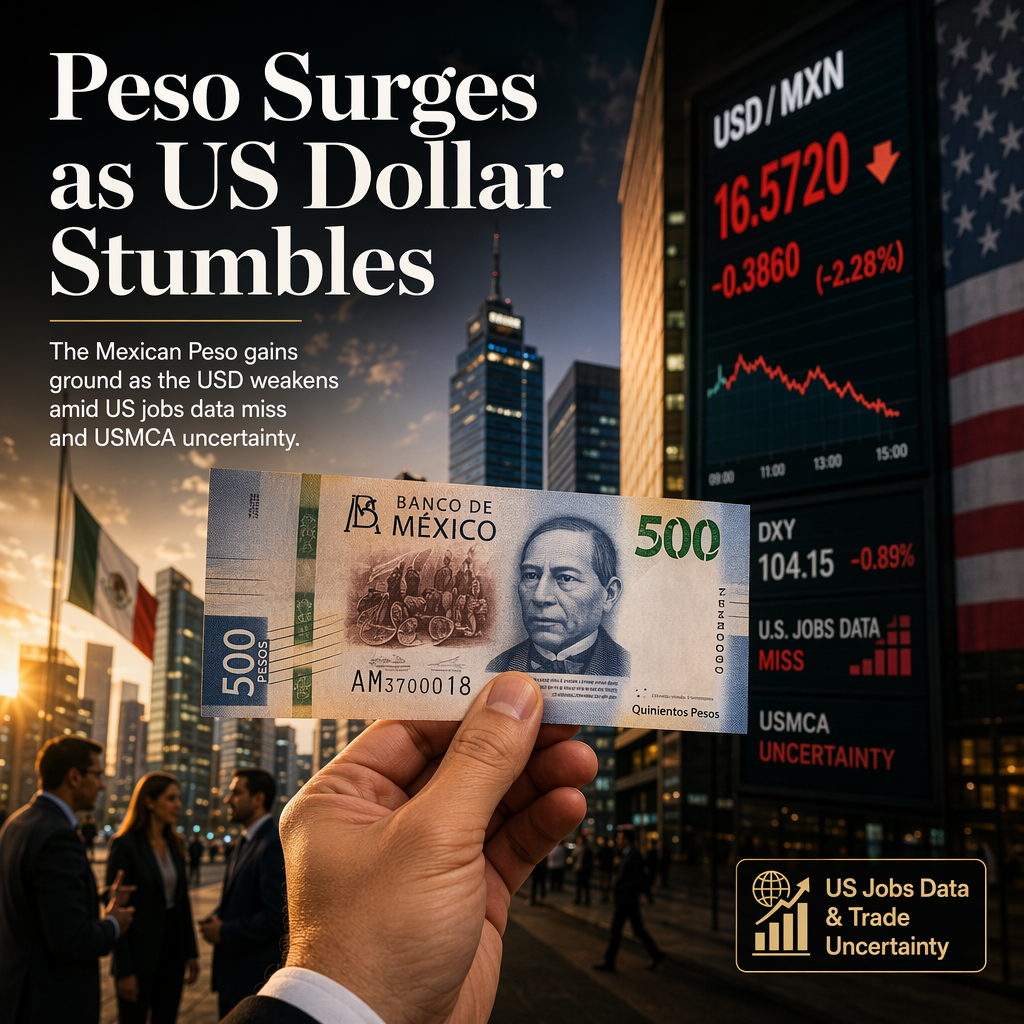
The Mexican Peso appreciated against the US Dollar, driven by weaker-than-expected US employment data and speculation of foreign exchange intervention by Japanese authorities. At the time of reporting, the USD/MXN exchange rate stood at 17.48, marking a 0.43% decline in the US Dollar's value against the Peso [1]. The US Bureau of Labour Statistics reported that June Nonfarm Payrolls fell from 129,000 to 57,000, significantly below forecasts. Additionally, previous months' figures for May and April were revised downward by a combined 74,000 jobs [1]. Despite the weak jobs data, the US unemployment rate edged lower from 4.3% to 4.22%, a change attributed to a decrease in labor force participation [1].
The US Dollar Index (DXY), which measures the currency against a basket of six others, dropped 0.55% to 100.85, reflecting broad-based weakness in the Greenback [1]. In Mexico, market attention was also drawn to news that US President Donald Trump does not intend to extend the USMCA free trade agreement. Economy Minister Marcelo Ebrard confirmed that the US opted not to extend the deal, meaning it will now be subject to annual reviews for the next ten years instead of a long-term extension [1]. According to a Bloomberg article cited in the report, intraregional trade under USMCA surpassed $1.6 trillion in 2024, up from $1 trillion in 2020, highlighting the agreement's economic significance [1].
On Wednesday, the three countries had the opportunity to sign a 16-year extension to the USMCA, but the US administration instead signaled a desire for changes to the deal negotiated six years ago [1]. US auto industry officials responded by urging a quick resolution to restore duty-free trade with Canada and Mexico, warning that tariffs put them at a disadvantage compared to Japanese and South Korean competitors [1].
Federal Reserve officials also made public statements. Mary Daly of the San Francisco Fed noted ongoing strength in the US economy and attributed rising prices to tariffs and oil shocks, describing current monetary policy as 'slightly restrictive.' Fed Chair Kevin Warsh stated that inflation expectations had decreased slightly over the past four weeks but emphasized that the central bank remains focused on 'price stability.' Money markets are currently pricing in a 66% probability of a rate hike at the September 16 meeting, with investors expecting nearly 17 basis points of tightening [1].
CONCLUSION
The Mexican Peso's gains were fueled by disappointing US jobs data and uncertainty surrounding the future of the USMCA trade agreement. Market participants are closely watching US monetary policy and trade developments, with the potential for further volatility in the USD/MXN pair as these issues evolve.