
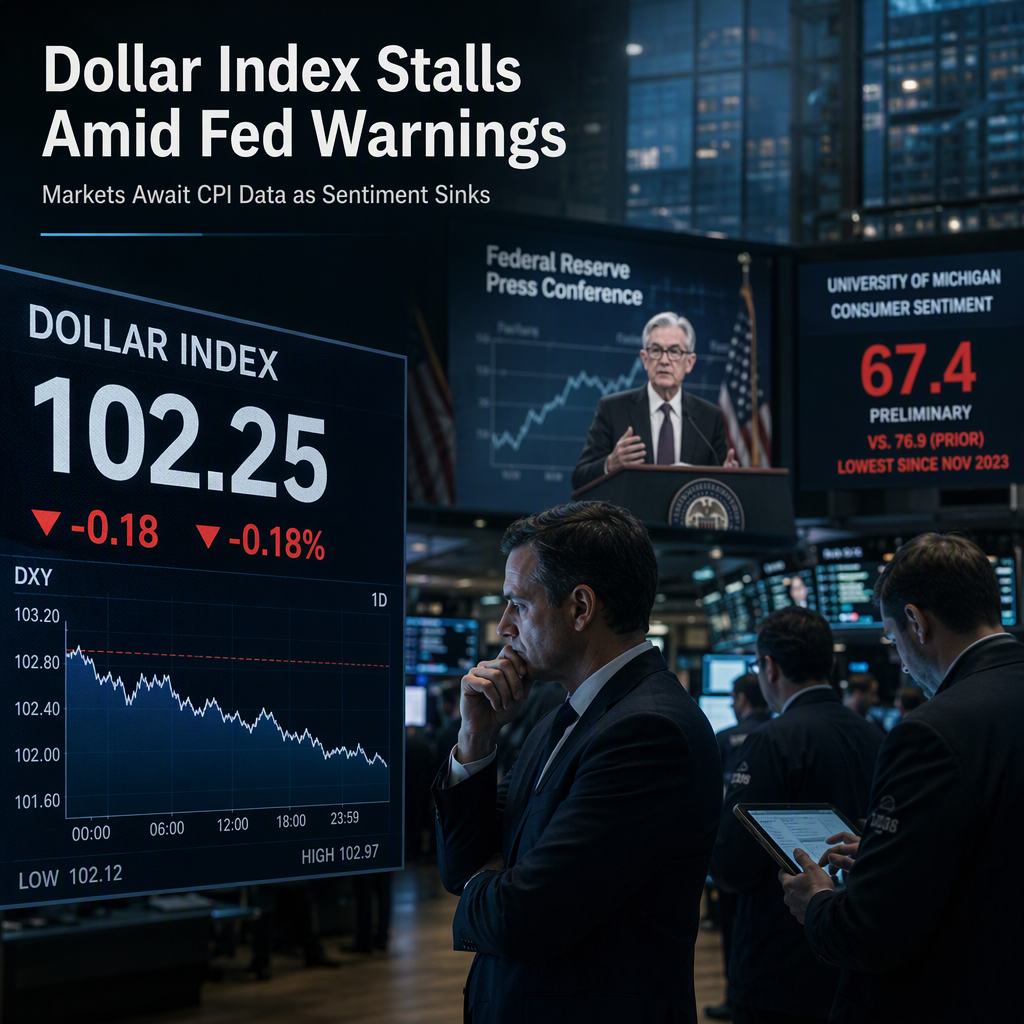
The Dollar Index has failed to reclaim its highest level since April 2025, trading near 102.25 and making lower highs in each session since Wednesday, despite persistent hawkish commentary from Federal Reserve officials and a spike in the 10-year Treasury yield to its highest since 2002 on Monday [1]. Fed Governor Waller stated on Thursday that more rate hikes are needed but do not have to occur at consecutive meetings, while St. Louis Fed President Musalem suggested rates should rise over the next six to nine months [1]. The minutes from the September 15-16 Fed meeting, released Wednesday, indicated that most officials expect another rate hike by year-end, aligning with the median projection of 4.1% for the end of 2026, which implies one more quarter-point hike from the current 3.75%-4.00% [1].
Market expectations, as reflected in futures, put the probability of a rate hike at nearly 20% for October 28 and close to 70% for December 9, suggesting that investors are heeding Governor Waller's comments about the timing of hikes [1]. The Dollar Index had previously climbed in tandem with the two-year Treasury yield through September, but the two-year yield fell from 4.84% on Monday to 4.75% on Thursday, while the 10-year yield retreated toward 5.25% [1].
On the consumer front, the preliminary University of Michigan survey released Friday showed sentiment at 46.3, missing the 47.6 forecast and marking the second-lowest reading in the survey's history. The gauge of current conditions hit a record low, and households raised their year-ahead inflation expectations to 4.7% and five-year expectations to 3.5%—a measure Fed Governor Waller is closely monitoring for signs of entrenched inflation [1]. Despite these weak consumer indicators, the Dollar Index barely moved, with most of Friday's rise attributed to a Canadian jobs report showing 68.3K job losses, which pushed USD/CAD to an 18-month high. The Canadian dollar comprises 9.1% of the index, and this data had a greater impact than the US consumer sentiment report [1].
Looking ahead, the US Consumer Price Index (CPI) for September is due on Wednesday, October 14, at 12:30 GMT. Headline CPI is forecast to rise 0.6% month-over-month, with the annual rate expected to reach 3.6% from 3.4%. Core CPI (excluding food and energy) is forecast to rise 0.2% after 0.3% previously, for a 2.5% year-over-year increase. The September Fed minutes revealed that some officials view a hike as insurance against persistent inflation, while others see it as a measure to prevent energy costs from spreading into other prices. A core reading of 0.3% or higher could reignite bets on an October rate hike [1].
CONCLUSION
Despite hawkish signals from the Fed and record-low consumer sentiment, the Dollar Index has stalled, with market participants awaiting the upcoming CPI data for clearer direction. The market currently sees a higher probability of a rate hike in December rather than October, and future moves will likely hinge on inflation readings and evolving Fed commentary.