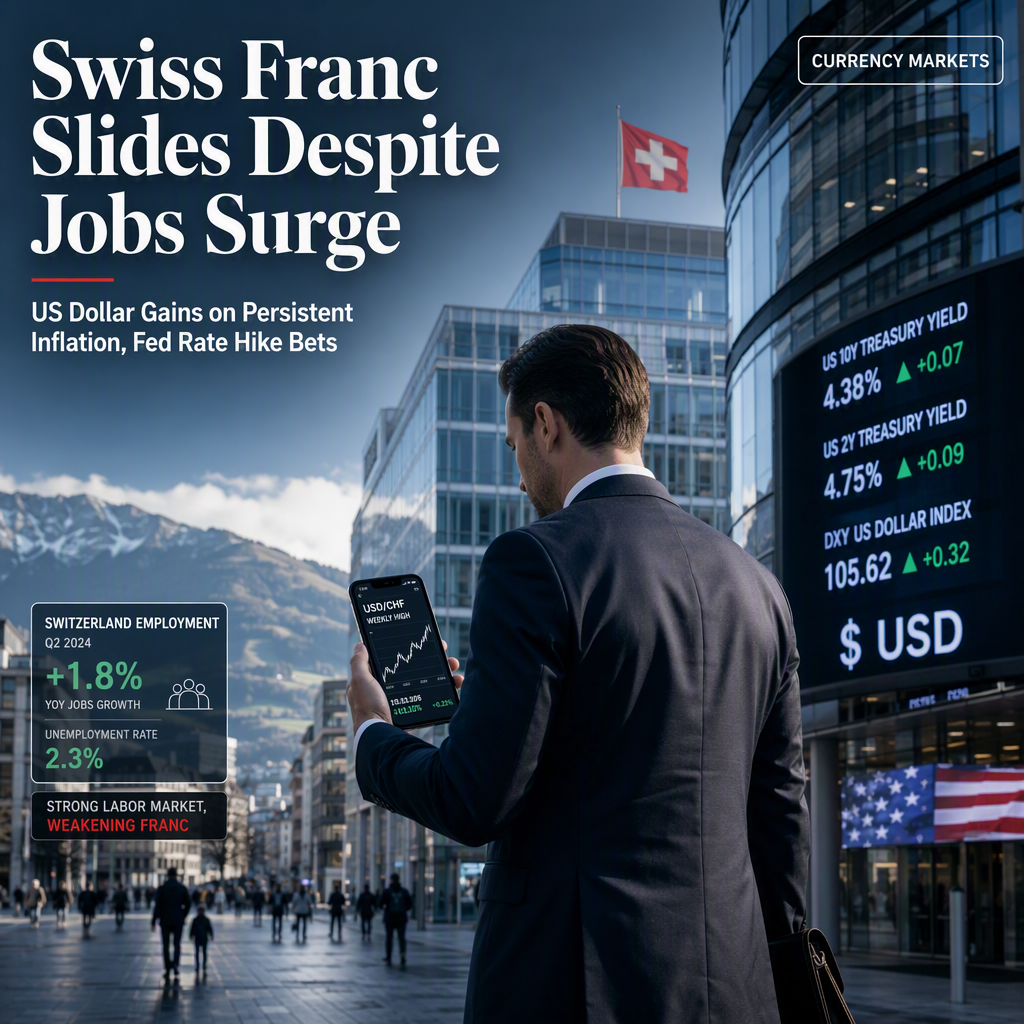
On Thursday, the Swiss Franc (CHF) remained on the defensive against the US Dollar (USD), despite the release of stronger Swiss employment figures by the Swiss Federal Statistics Office. The USD/CHF pair traded near its weekly high at 0.8063 during the early European session, reversing the mild pullback seen late Wednesday [1].
Swiss employment, excluding agriculture, increased by 2% to 5.968 million in the second quarter, up from 5.537 million in the previous three months. Job vacancies also rose by 2,600 to 98,700 in the three months to June, with 33.9% of companies reporting difficulties in recruiting qualified workers. These data points indicate a tightening labor market, which typically would be bullish for the Swiss Franc as companies may need to offer higher wages to attract talent [1]. However, the impact on the currency was muted, and CHF continued to drift lower [1].
Meanwhile, the US Dollar remained moderately bid, supported by the US Personal Consumption Expenditures (PCE) Price Index released on Wednesday, which confirmed persistent price pressures. This has increased expectations for further Federal Reserve rate hikes. Deutsche Bank analysts noted that while the probability of a September Fed hike rose slightly from 36% to 37%, the more significant change was in the pricing of hikes by next June, with 42 basis points now expected (+3.7bps on the day). This shift led to a rise in 2-year Treasury yields, up 3.6bps to 4.21% [1].
The Swiss employment data, which is generally considered bullish for CHF, failed to provide support, as broader market dynamics favored the USD due to ongoing US inflation concerns and shifting rate hike expectations [1].
CONCLUSION
Despite robust Swiss employment growth and a tightening labor market, the Swiss Franc failed to gain traction, overshadowed by persistent US inflation and rising expectations for Federal Reserve rate hikes. The USD/CHF pair remains near weekly highs, reflecting the market's preference for the US Dollar amid global economic uncertainties. The muted reaction to Swiss data underscores the dominant influence of US monetary policy on currency markets.