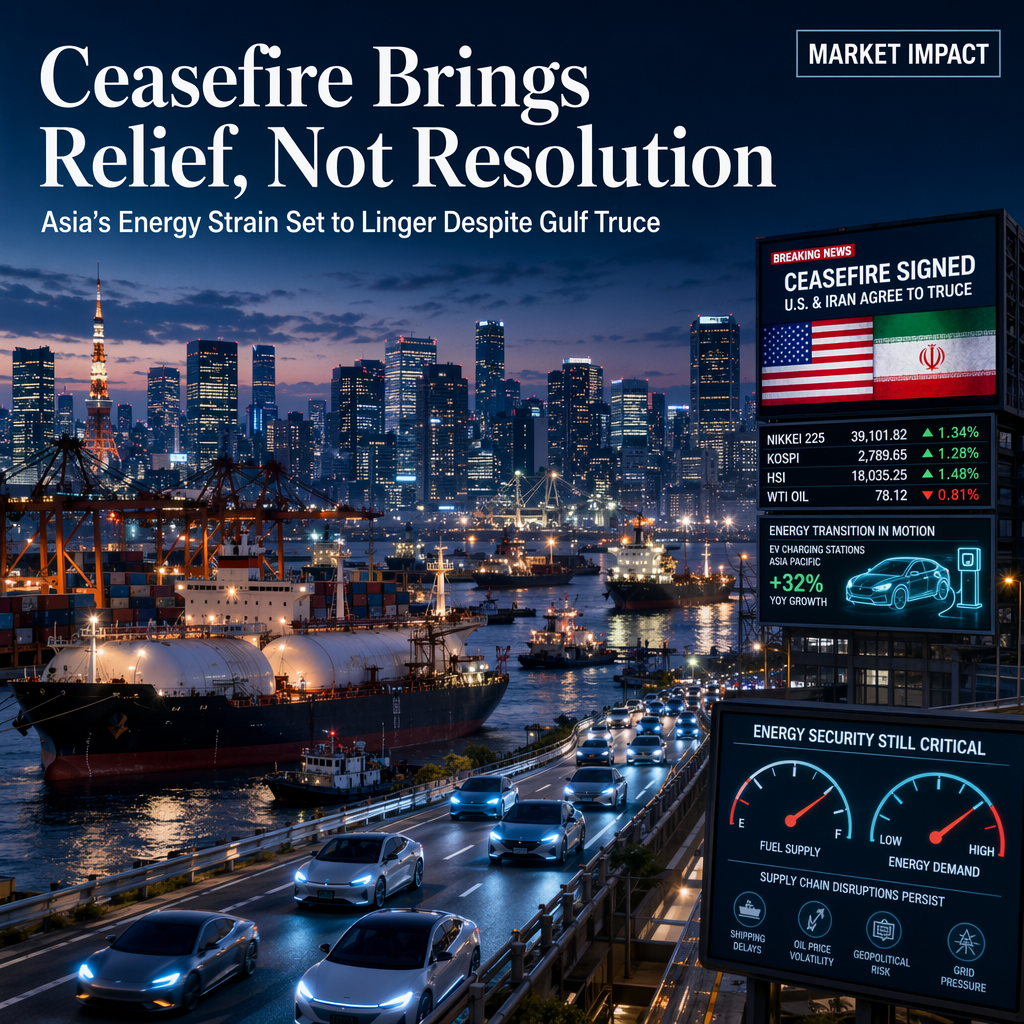
The United States and Iran have signed a preliminary agreement to end the 3-1/2 month-old war in the Persian Gulf, as announced by U.S. President Donald Trump. This development brings relief to global markets, particularly in Asia, which has been grappling with inflation and energy shortages due to the conflict [1]. While the ceasefire has eased tensions that persisted for nearly four months, the situation remains uncertain, especially as intensive negotiations over Iran's nuclear program are only just beginning and significant gaps remain between the two countries [1].
Despite the potential reopening of the Strait of Hormuz—a critical chokepoint for global energy supplies—Nikkei Asia reports that it will likely take months for energy shortages in Asia to return to pre-conflict levels. The normalization of energy prices is expected to be gradual, hindered by the time-consuming process of clearing mines laid by Iran, resuming vessel operations, and repairing damaged infrastructure [1].
The ceasefire coincides with the onset of summer in Asia, a period of peak energy demand. Governments, businesses, and consumers are expected to endure ongoing supply constraints in the near term. In response to the crisis, some Asian countries, such as India, are witnessing early signs of structural shifts, including increased sales of electric vehicles. It remains to be seen whether these trends will persist once energy prices stabilize [1].
Equity markets across Asia have responded positively to the ceasefire, with Japanese and South Korean stocks reaching record highs. However, central banks in countries like Indonesia are facing challenges in defending their currencies, such as the weakening rupiah, highlighting the uneven impact of the conflict's aftermath on the region's economies [1].
CONCLUSION
The preliminary ceasefire between the U.S. and Iran has brought immediate relief to Asian equity markets, but the region's energy supply and inflation challenges are expected to persist for months. While some structural shifts, such as increased electric vehicle sales, are emerging, the long-term impact will depend on the normalization of energy markets and ongoing geopolitical negotiations.