
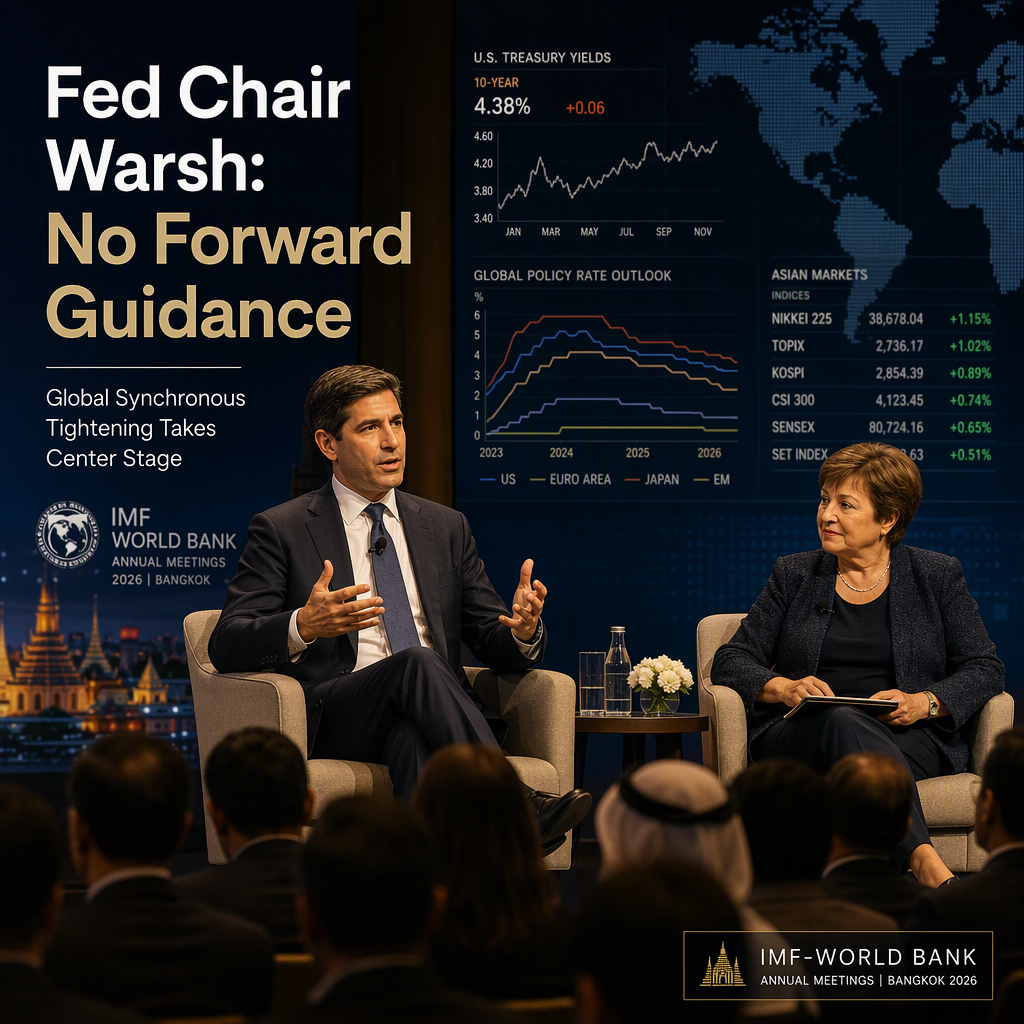
Federal Reserve Chairman Kevin Warsh declined to provide any indication regarding a potential interest rate hike at the upcoming central bank meeting later this month, emphasizing his opposition to forward guidance and stating, "I don't prejudge meetings. I don't believe in saying now what I might do at the meetings that we have in the balance of this year" [1]. Warsh's comments came during a fireside chat with IMF Managing Director Kristalina Georgieva at the IMF-World Bank Annual Meetings in Bangkok on October 16, 2026 [1].
Warsh highlighted a "synchronous tightening" of monetary policy by central banks globally, noting that "there's no free riders" and that each central bank is acting under its own mandate, but the result is a coordinated effort to combat inflation [1]. He described the current environment as a "common fight on prices" [1].
Following Warsh's remarks, Asian stock market indexes and U.S. Treasury yields remained largely stable, indicating a muted immediate market reaction [1]. According to CME Fed Watch data, traders assign a 72.3% probability that the Fed will keep rates unchanged at the October 27-28 meeting, while the majority anticipate a 25 basis point hike in December [1]. The Fed last raised rates to a range of 3.75% to 4% in the previous month, marking its first hike since 2023 [1].
On the topic of artificial intelligence, Warsh described it as "probably the most consequential change to the U.S. and the global economy in my lifetime," expressing optimism about its long-term benefits for productivity and wealth, but cautioning that the path will be "very bumpy" and that near-term effects on jobs remain uncertain [1]. Warsh concluded, "I want you to hear from me optimism, but optimism leavened by the seriousness of purpose" [1].
CONCLUSION
Fed Chair Warsh's refusal to offer forward guidance signals a shift in communication strategy, leaving markets to interpret data rather than rely on explicit signals. While the immediate market reaction was muted, traders are largely expecting no rate change in October but anticipate a possible hike in December. Warsh's comments on AI underscore both optimism and caution regarding its economic impact.