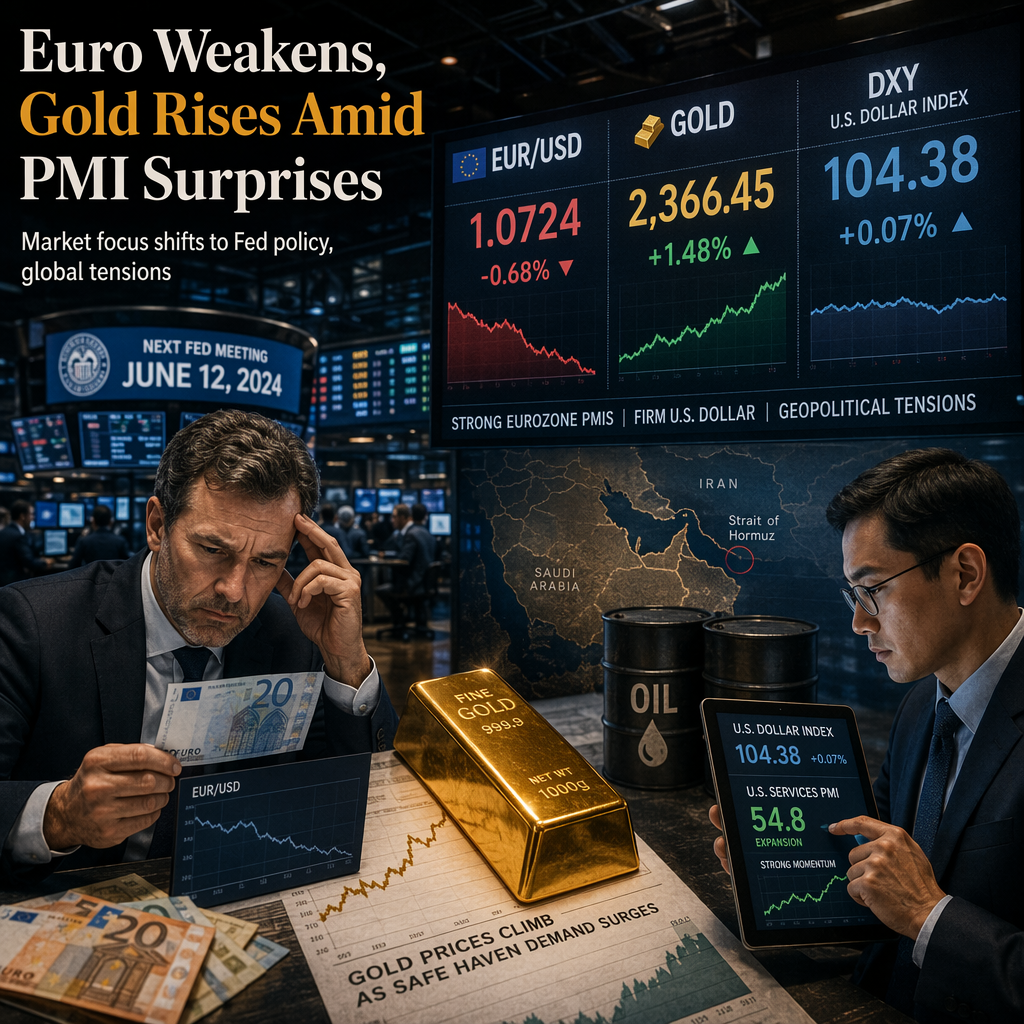
On Friday, the Euro fell against the US Dollar, with EUR/USD trading near 1.1370, despite stronger-than-expected Eurozone business-activity data. Germany’s preliminary HCOB Composite PMI rose to 51.2 in July from 49.5, surpassing expectations of 49.8 and returning to expansion territory. The Eurozone Composite PMI also increased to 51.9 from 50.0, beating the 50.3 forecast, while the Manufacturing PMI advanced to 52.0 and Services PMI jumped to 51.6 from 49.4, indicating a return to expansion in the services sector [1].
Meanwhile, the US Dollar Index (DXY) remained firm, trading near 101.50 and poised to end the week with gains of over 0.60% [1][2]. US business activity was mixed: the S&P Global Manufacturing PMI eased to 53.8, missing the expected 54.5, while the Services PMI surged to 53.6 from 51.2, exceeding the 51.0 forecast. The strong US services reading may support US Treasury yields and limit further declines in the Greenback [1][2].
Gold (XAU/USD) drifted higher, trading at $4,065, up 0.38%, despite the firm US Dollar. The advance in gold was attributed to a decline in US Treasury yields, with the 10-year benchmark note dropping three basis points to 4.667%. Easing oil prices also contributed to gold’s gains, as West Texas Intermediate (WTI) fell 3.83% to $88.79, though it was set to finish the week with gains of over 8.50% [2].
Geopolitical developments included reports that Pakistan and Iran are exploring renewed US-Iran negotiations under a China-backed initiative, which contributed to a sharp decline in oil prices and reduced some safe-haven demand for the US Dollar. However, significant obstacles to negotiations remain, and the last tranche of geopolitical news has not changed the situation in the Gulf War [1][2].
Looking ahead, investors are focused on the Federal Reserve’s July 28–29 meeting, where the Fed is expected to maintain its target range at 3.50%–3.75%. There is a 59% chance of the Fed standing pat, with a 41% chance of a 25-basis-point rate hike. For the September meeting, the odds of a rate increase are at 84% according to Prime Terminal data [1][2]. The meeting will not include new economic projections or an updated dot plot, making the policy statement and Chair Kevin Warsh’s press conference key for market direction [1].
CONCLUSION
Despite robust Eurozone PMI data, the Euro weakened against a firm US Dollar, while gold prices edged higher on softer US yields and easing oil prices. Market attention now turns to the upcoming Federal Reserve meeting, with expectations for rates to remain unchanged but a significant chance of a hike in September. The interplay of strong US services data, geopolitical developments, and central bank policy remains central to market sentiment.