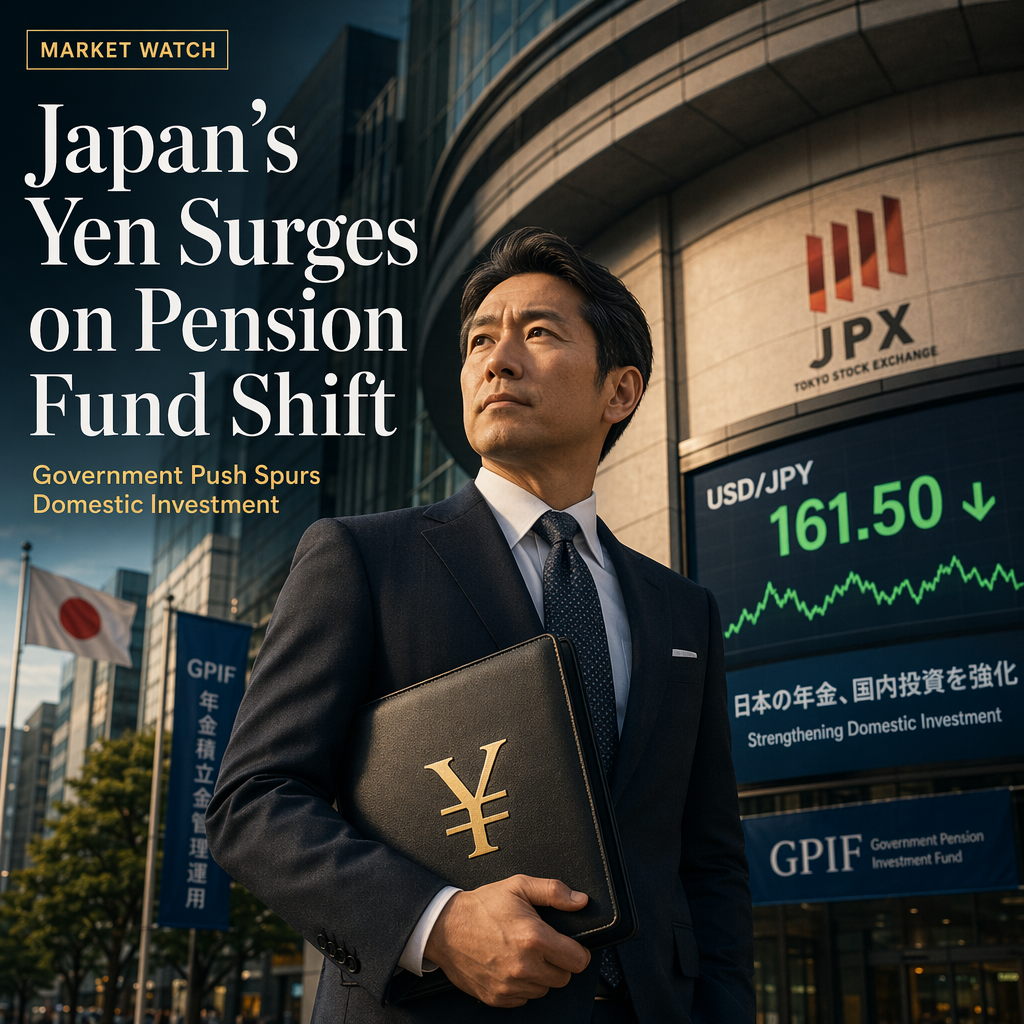
The Japanese Yen (JPY) rose against the US Dollar (USD), with the USD/JPY pair falling to around 161.50 during early European trading hours on Friday [1]. This appreciation followed reports that Japan's government is encouraging pension funds, including the Government Pension Investment Fund (GPIF), to make 'substantially greater investments in Japanese financial assets,' according to Finance Minister Satsuki Katayama and Reuters [1]. Analysts noted that this initiative could provide more robust support to the Yen than direct currency intervention [1].
Market sentiment toward the US Dollar was also affected by reduced expectations for a Federal Reserve rate hike. Traders lowered their bets on a rate increase, with the probability of a 25 basis point hike at the July meeting dropping to 24.6% from 31% in the previous session, though still higher than 18.2% a week ago, as per the CME FedWatch tool [1]. For the September policy meeting, the chance of a hike decreased to 62.3% from 66.6% on Wednesday, but was up from 54.1% a week earlier [1]. New York Fed President John Williams commented that he does not anticipate a sustained rise in energy prices for the remainder of the year, despite renewed hostilities in the Middle East [1].
The Yen's value is influenced by several factors, including Bank of Japan policy, the differential between Japanese and US bond yields, and risk sentiment among traders [1]. The Bank of Japan's gradual unwinding of its ultra-loose monetary policy in 2024 has recently provided some support to the Yen [1].
CONCLUSION
Japan's push for pension funds to invest more heavily in domestic assets has strengthened the Yen, with analysts suggesting this could be more effective than direct intervention. Reduced expectations for US rate hikes have also weighed on the Dollar, contributing to the Yen's gains. The market impact is medium, as investors monitor both Japanese policy shifts and US Federal Reserve decisions.