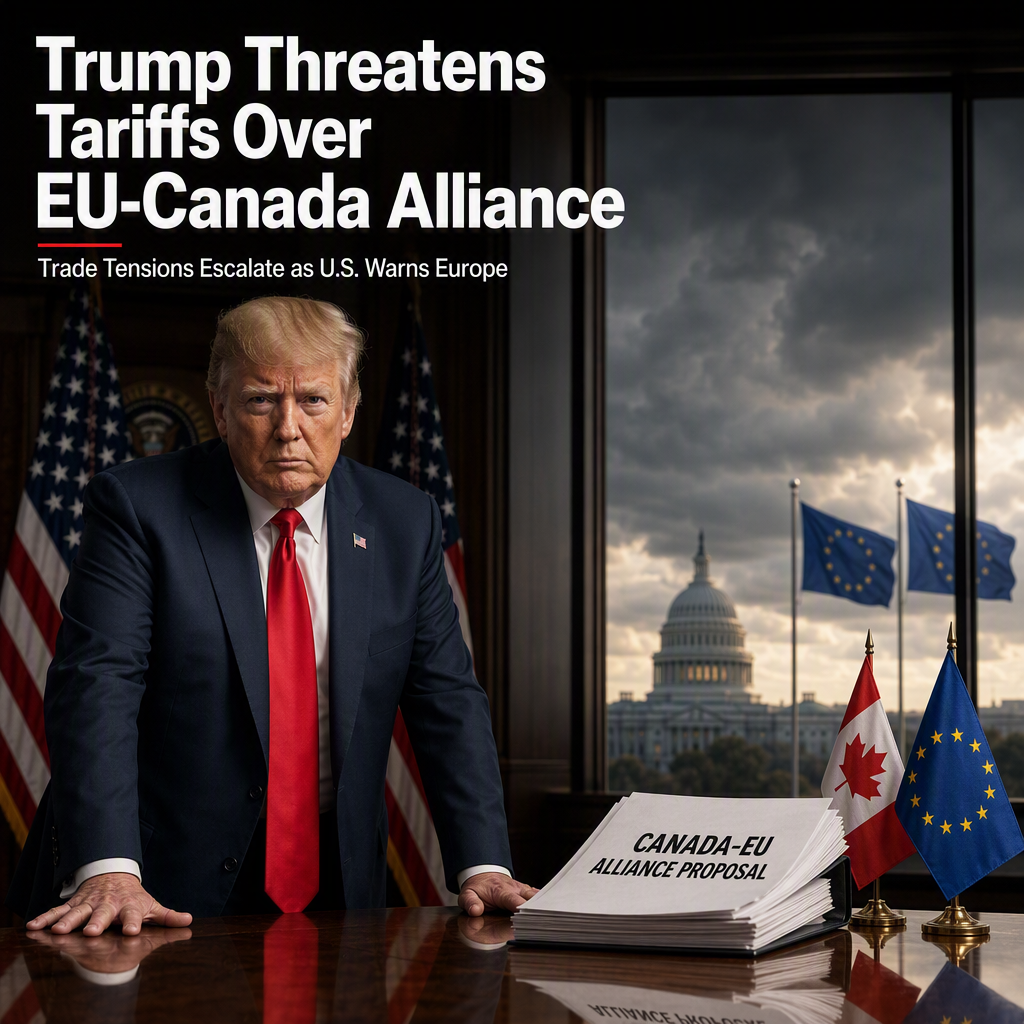
President Donald Trump dismissed the idea of Canada becoming an associate member of the European Union as 'laughable' and warned that the United States could impose 'very heavy tariffs' on Europe if he perceives the move as hostile or made with 'bad intention' [1]. Trump stated, 'If they do that, if I think it's at all a hostile act, I will put very serious tariffs or stop trading with Europe on many things,' emphasizing the potential for significant trade retaliation [1].
These comments were made in the context of ongoing trade tensions between the U.S. and Canada, following the collapse of U.S.-Canada trade talks the previous month, which had already led to a series of reciprocal tariff measures between the two countries [1]. Trump also described Canada as a 'terrible trade partner' during his remarks [1].
The proposal for Canada to become the EU's first associate member was put forward by European Commission President Ursula von der Leyen, who, alongside Canadian Prime Minister Mark Carney, suggested moving beyond the existing CETA trade agreement toward an 'Alliance for the Future.' This partnership would focus on cooperation in manufacturing, technology, defense, energy, critical minerals, artificial intelligence, cybersecurity, and the Arctic [1]. Carney has pledged to double Canada's non-U.S. trade over the next decade and is seeking a 'unique alliance' with the EU, not full membership [1].
On the same day, the Trump administration escalated a separate trade dispute with Canada by signing a presidential memorandum to identify Canadian-origin products that could be removed from or made unavailable for purchase through the federal civilian procurement system, citing Canadian barriers to American companies in government contracts [1].
The EU's proposal for associate membership would require approval from EU member states, and historically, the EU has been hesitant about flexible alliances without a defined legal status [1].
CONCLUSION
President Trump's strong opposition to Canada's potential associate membership in the EU and his threat of heavy tariffs on Europe signal heightened trade tensions. The market impact is likely to be significant, given the possibility of new tariffs and the ongoing disputes between the U.S., Canada, and Europe. Stakeholders should closely monitor developments as both the EU and Canada pursue deeper economic ties.