
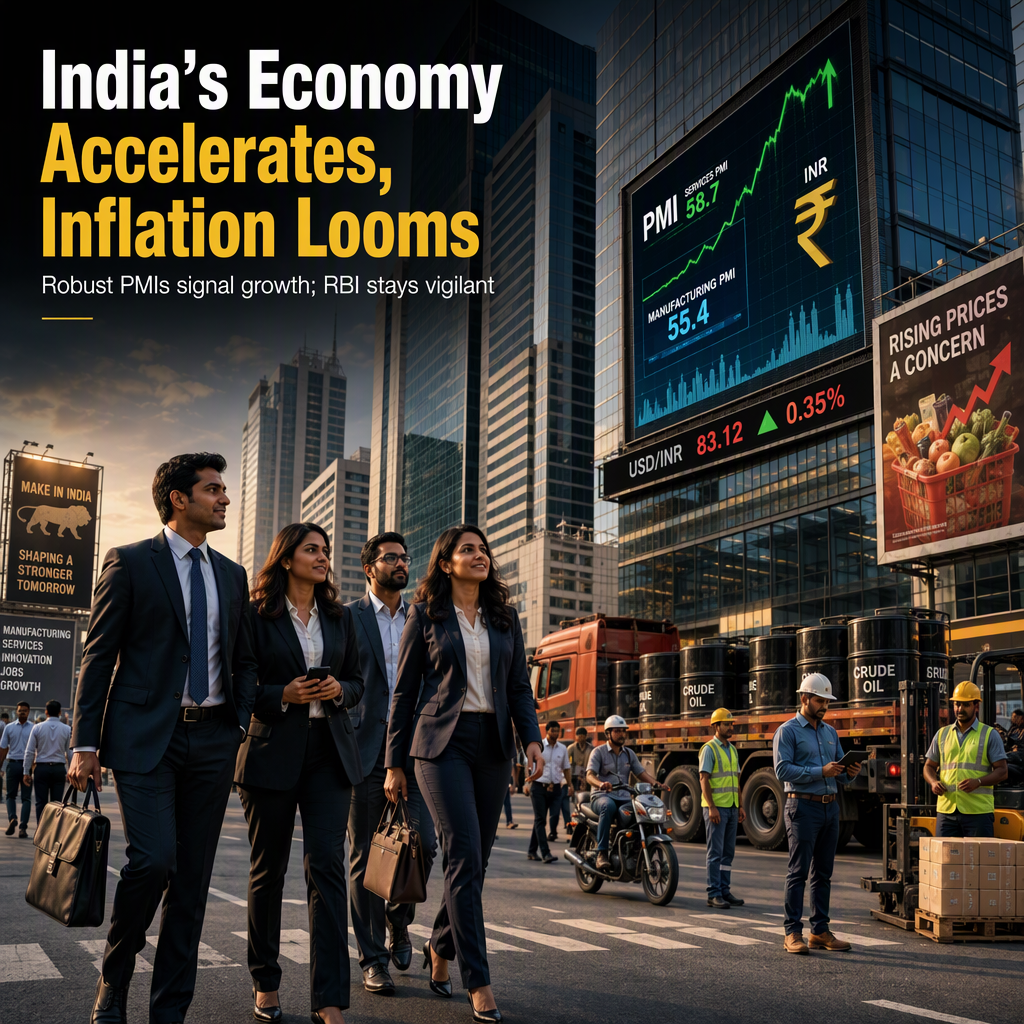
According to Commerzbank's India section, the September flash Purchasing Managers' Indexes (PMIs) indicate a stronger end to Q3 economic activity, with both manufacturing and services indices remaining well above the 50-neutral threshold, signaling expansion [1]. The manufacturing PMI rose to 55.7 in September from 52.8 in August, marking its highest level in seven months, driven by robust domestic demand and notable growth in electronics, pharmaceuticals, and food products [1]. The services PMI increased to 55.8 from 54.1 in August, reaching a three-month high, with transportation and software services contributing to the uptick in new business growth, although new export orders lagged behind manufacturing [1].
Despite the positive growth momentum, elevated input and output prices—especially in manufacturing—continue to pose upside risks to inflation [1]. Year-to-date Consumer Price Index (CPI) inflation has averaged 3.8%, which is below the Reserve Bank of India's (RBI) FY2026-2027 forecast of 5.0% [1]. However, persistent cost pressures and higher global crude oil prices suggest that the RBI will likely maintain a cautious, wait-and-see approach, as policymakers monitor for potential second-round effects on inflation [1].
In the foreign exchange market, the USD/INR pair rose 0.2% to 95.93, supported by broad US dollar strength and foreign portfolio outflows [1]. Foreign investors were net sellers of USD 338 million in equities and USD 134 million in bonds so far this week [1]. Despite these outflows, RBI Deputy Governor Poonam Gupta stated there is a "fair case" for INR appreciation, citing factors such as stretched valuations in foreign markets, stronger domestic bank balance sheets, and the potential inclusion of Indian bonds in global indices as supportive for the rupee [1].
CONCLUSION
India's September PMIs highlight resilient economic growth but also underscore persistent inflation risks, particularly in manufacturing. The RBI is expected to remain cautious, with market participants closely watching inflation dynamics and capital flows. Despite recent portfolio outflows, some policymakers see potential for INR appreciation due to supportive domestic and external factors.