
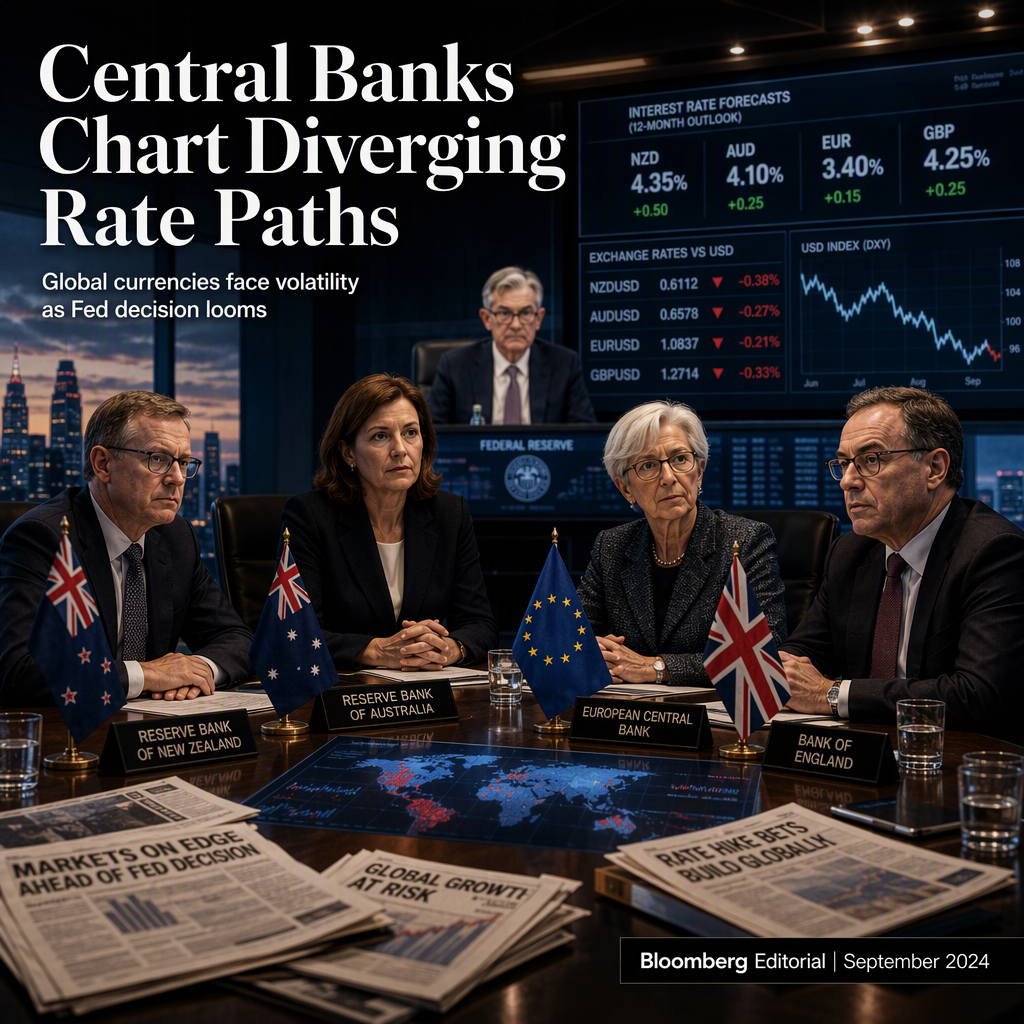
Major central banks are at the center of market attention as expectations for interest rate hikes diverge across the New Zealand Dollar, Australian Dollar, Euro, and Pound Sterling. The New Zealand Dollar (NZD/USD) has stabilized near its lowest level since late June after five consecutive weekly declines, with markets now pricing an 80% chance that the Reserve Bank of New Zealand (RBNZ) will raise its Official Cash Rate (OCR) to 3% from 2.75% on October 28. This is a significant increase from the roughly one-in-three chance immediately after the September 2 hike. The RBNZ's own projections had previously indicated a pause in October and a hike in December, but recent stronger-than-expected GDP data and comments from Governor Breman about inflation risks have shifted market expectations. However, analysts note that a hike alone may not support the Kiwi if the US Federal Reserve also raises rates on the same day, as the Fed is expected to move its range to 3.75%-4.00%, maintaining the interest rate gap between the two countries [1].
In Australia, the Reserve Bank of Australia (RBA) is widely expected to raise rates by 25 basis points from 4.60% to 4.85% on September 29, which would be the highest level since 2008. Money markets are pricing in a 100% probability of this move, and ANZ analysts anticipate a split vote among policymakers. The Australian Dollar (AUD/USD) has held above 0.70 but remains under pressure, with technical indicators suggesting persistent downside risk. Traders are also awaiting upcoming inflation data and the August trade balance for further direction [2].
The Euro (EUR/USD) has slipped back to its late-July low near 1.1350 after European Central Bank (ECB) President Lagarde pushed back against expectations for faster rate hikes, emphasizing a measured approach in response to the ongoing energy shock. Eurozone inflation was 3.2% in August, with energy prices up 14.3% year-over-year, and the ECB's projections see inflation averaging 3.0% this year. Futures currently price about a 60% chance of another ECB hike on October 29, the day after the Fed's decision. Lagarde highlighted that rising long-term interest rates in Europe are already contributing to tighter financial conditions, potentially reducing the need for further ECB action [3].
The Pound Sterling (GBP/USD) edged higher as Bank of England (BoE) Deputy Governors Ramsden, Breeden, and Lombardelli indicated a possible need for a rate hike if inflation pressures persist. The BoE held its Bank Rate at 3.75% on September 17 by a 6-3 vote, but if the three deputies join the hawkish camp in November, a hike could occur. Despite these signals, the Pound's reaction was muted, as markets remain focused on the upcoming US data releases, particularly the core Personal Consumption Expenditures (PCE) price index and Nonfarm Payrolls, which are expected to influence the odds of a Fed move more than BoE commentary in the near term [4].
Across all four currencies, the US Federal Reserve's upcoming decisions and key US economic data are seen as pivotal, with the potential to overshadow local central bank actions and drive further volatility in currency markets.
CONCLUSION
Central banks in New Zealand, Australia, the Eurozone, and the UK are signaling varying degrees of hawkishness, but market sentiment remains cautious as traders await key US economic data and the Federal Reserve's next move. Despite rising expectations for rate hikes in several regions, the dominant influence of US monetary policy continues to shape currency market dynamics. The coming weeks are likely to see heightened volatility as central bank decisions and economic releases unfold.