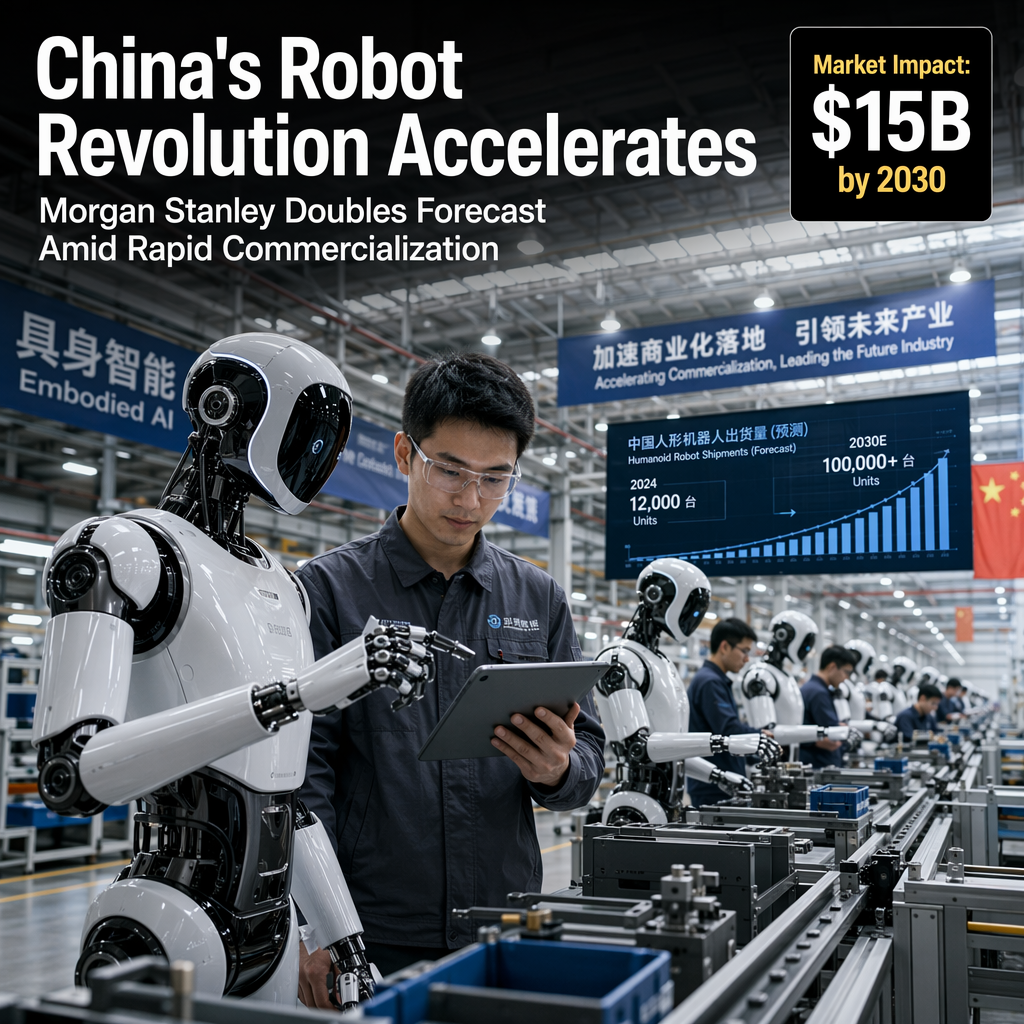
Morgan Stanley has significantly increased its forecast for China's humanoid robot shipments, citing a faster-than-expected shift from demonstration to commercial deployment in the industry [1]. On June 24, the bank projected 50,000 units would ship in China this year, nearly double its previous estimate of 28,000 units, which itself was twice the initial January forecast of 14,000 units [1]. The bank expects the market to reach $2 billion in 2026 and expand to $15 billion by 2030, with annual shipments forecast to hit 446,000 units by then. These figures exclude prototypes, pre-order trials, and internal-use robots [1].
Sheng Zhong, equity analyst at Morgan Stanley, attributed the rapid adoption to commercial verification, policy support, and supply-chain feedback [1]. Beijing has prioritized the development of 'embodied AI'—artificial intelligence embedded in physical systems—over the next five years, directing local governments to subsidize startups with land and office space and ordering banks to provide favorable lending terms [1].
Last year, global humanoid robot shipments totaled about 13,000 units, with Chinese companies occupying the top five positions by shipments. American competitor Figure AI ranked seventh, and Tesla was ninth. Tesla CEO Elon Musk stated that sales of the Optimus humanoid robot would not begin until the end of 2027 [1].
Joe Ngai, senior partner and chairman of McKinsey Greater China, described humanoid robotics as the 'next big frontier' for investors, highlighting China's rapid tech development and widespread industrial automation [1]. Morgan Stanley's supply chain research indicated faster commercialization, particularly in factories, logistics, unmanned retail stores, and interactive commercial services. The bank identified Shanghai-listed Leaderdrive as a major beneficiary, raising its 12-month target price to 464 yuan ($68) [1].
CONCLUSION
Morgan Stanley's upgraded forecast underscores China's accelerating leadership in humanoid robotics, driven by robust policy support and rapid commercialization. The market is expected to grow substantially, presenting significant investment opportunities, especially for domestic manufacturers and related supply chain companies. The positive outlook signals high market impact and strong investor interest in China's robotics sector.