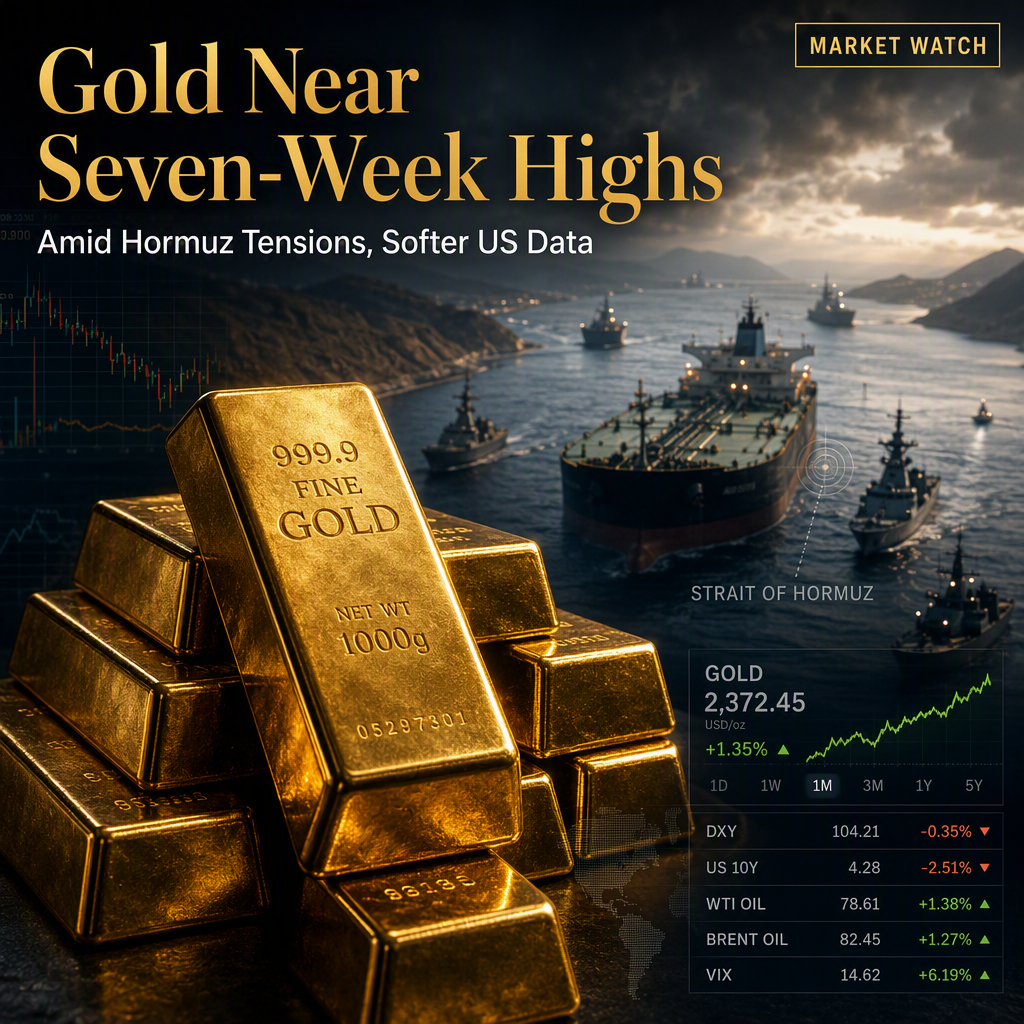
Gold (XAU/USD) extended its rally on Thursday, trading around $4,260 and holding near a seven-week high following a 4% spike on Wednesday. The precious metal's strength was attributed to a softer US Dollar and retreating Treasury yields, which reinforced gold's recovery. Notably, gold climbed in tandem with crude oil, diverging from its typical inverse relationship with the commodity [1].
Geopolitical tensions contributed to the risk premium, as uncertainty persisted over the reopening of the Strait of Hormuz. Iranian Deputy Foreign Minister Kazem Gharibabadi stated that the agreement would not automatically reopen the waterway. A senior Gulf official estimated a 50% chance of Iran and Oman reaching a deal by Friday. Meanwhile, US Vice President JD Vance described negotiations with Iran as 'messy,' and Reuters reported that the proposal could give Tehran control over inbound traffic—a scenario Washington has repeatedly rejected [1].
On the economic front, US data releases were mixed. Initial Jobless Claims came in at 199,000, below the 202,000 consensus, while Challenger Job Cuts eased to 33,400 from 45,800, indicating a cooling labor market driven by slower hiring rather than increased layoffs. These softer employment figures have reduced the likelihood of a Federal Reserve rate hike in September, providing a tailwind for gold, which does not yield interest [1].
Looking ahead, the market is focused on Friday's Nonfarm Payrolls report, with a Reuters survey forecasting an 80,000 gain in July after June's 57,000, and the Unemployment Rate expected to remain steady at 4.2% [1]. Technical analysis shows XAU/USD trading at $4,253, maintaining a bullish near-term bias above key moving averages, though the Relative Strength Index at 72 signals overbought conditions that could limit immediate upside. Resistance is seen at $4,276 and $4,304, with support at $4,248 and $4,232 [1].
CONCLUSION
Gold's rally to near seven-week highs is underpinned by geopolitical uncertainty in the Strait of Hormuz and softer US labor data, which have reduced expectations for a Fed rate hike. Technical indicators suggest a bullish structure, though overbought conditions may temper further gains in the short term. The upcoming Nonfarm Payrolls report remains a key catalyst for market direction.