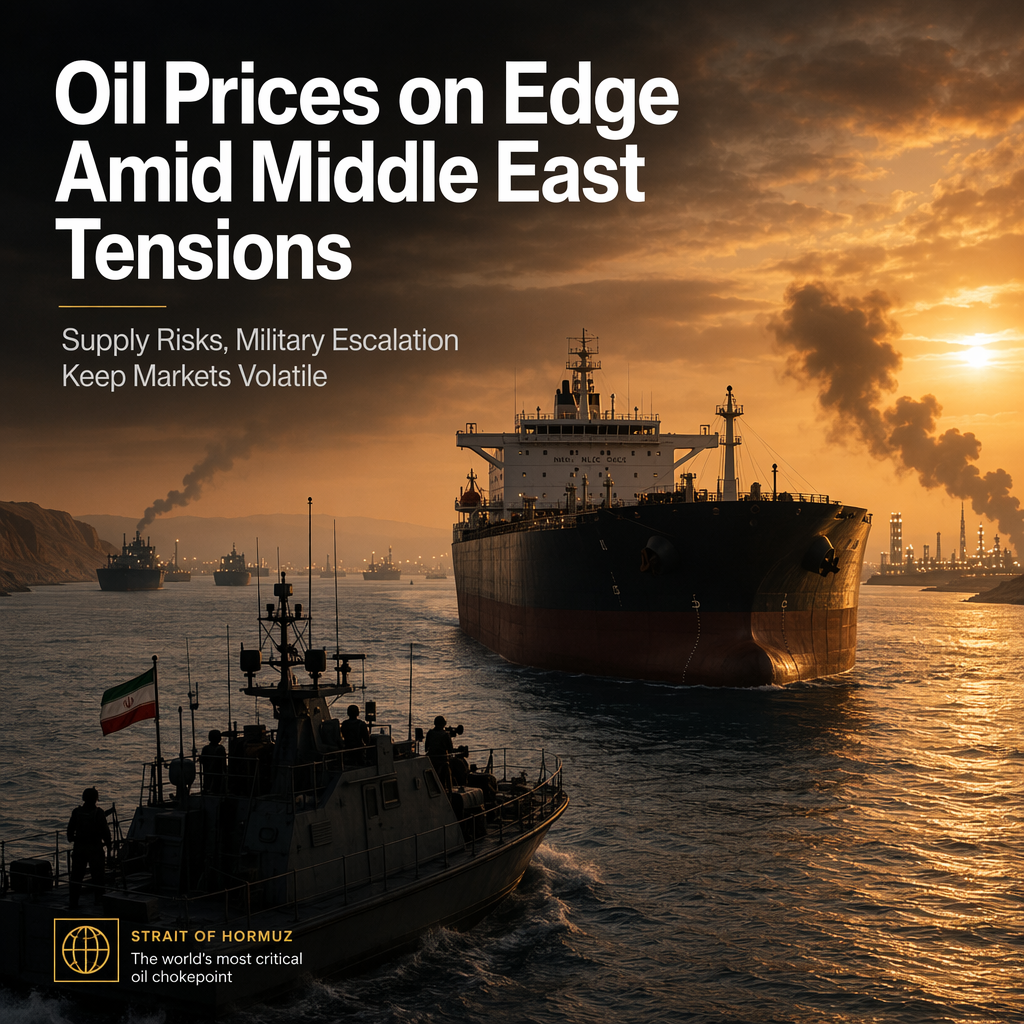
Recent developments in the Middle East have heightened geopolitical risks around key oil supply routes, with analysts from OCBC warning that a deeper conflict could push oil prices back above USD100 per barrel and revive market volatility [1]. The deaths of three US soldiers in Iran-linked attacks have increased the risk of a broader conflict, while shipping through the Strait of Hormuz has already slowed significantly [1]. Additionally, Yemen's Iran-backed Houthi group announced an immediate maritime blockade of Saudi Arabia in the Red Sea, further threatening alternative supply routes and potentially tightening Middle East oil supplies [1][2].
West Texas Intermediate (WTI), the benchmark US crude oil price, is currently trading with a negative bias around the $81.80 region, just below its highest level since June 12, which was touched on Monday [2]. Hopes for a diplomatic resolution to the US-Iran conflict have undermined crude oil prices, but ongoing supply disruptions are helping to limit the downside for the commodity [2]. Technical analysis indicates that WTI faces immediate resistance at the 38.2% Fibonacci retracement level of $82.34, with further upside targets at $87.17 (50.0% retracement) and $92.00 (61.8% retracement) [2]. On the downside, support is seen at the 200-period moving average of $76.61 and the 23.6% retracement at $76.37, with a deeper pullback potentially exposing the cycle low around $66.72 [2].
OCBC analysts note that markets are still priced for contained risks, but a larger escalation could trigger higher market volatility, erode the appeal of FX carry trades, and support a renewed USD rally, as higher energy prices would bolster the USD and keep the Federal Reserve focused on inflation [1]. For context, Brent crude reached $126 per barrel in late April, about 40% above current levels [1].
Momentum indicators for WTI suggest that bullish momentum is moderating, with the Relative Strength Index easing toward a neutral 58.55 and the MACD slipping below zero, warranting caution before positioning for further near-term appreciation [2].
CONCLUSION
Geopolitical tensions and supply disruptions in the Middle East are keeping oil prices volatile and near recent highs, with analysts warning of the potential for a significant price spike if the situation escalates further. While hopes for diplomatic resolution are capping gains, technical and fundamental risks remain elevated, suggesting continued market sensitivity to developments in the region.