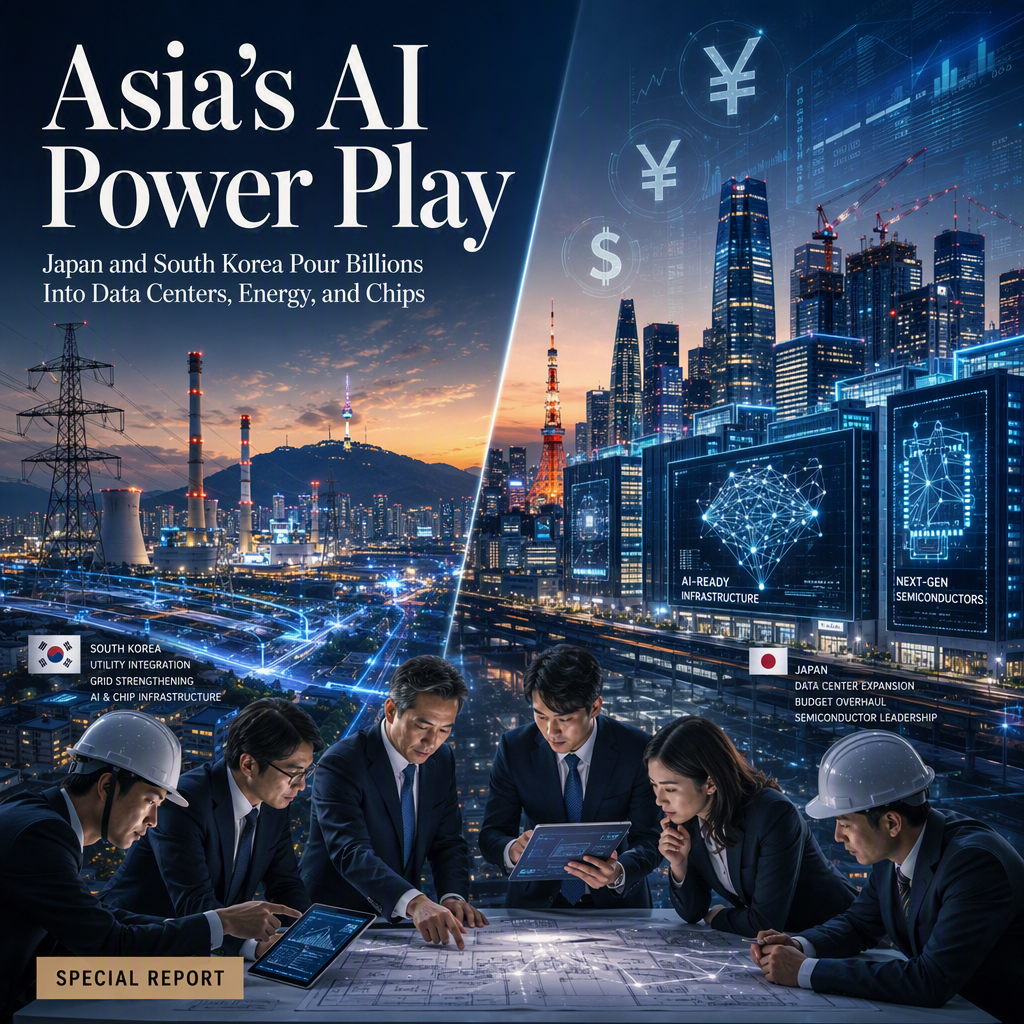
South Korea has announced plans to integrate five public power companies by October 2027, aiming to streamline operations and accelerate investments to meet the surging energy demands driven by the country's expanding artificial intelligence and chipmaking sectors [1]. President Lee Jae Myung's economic growth strategy prioritizes investment in semiconductors, physical AI, and large AI data centers, with the government seeking to ensure stable energy supply for these high-growth industries through efficient resource allocation and corporate restructuring [1]. While no specific financial figures or market analysis were provided regarding the scale of investment or projected energy demand, the initiative underscores Seoul's recognition of the critical importance of energy infrastructure for sustaining its leadership in semiconductor manufacturing and AI development [1].
In Japan, a Nikkei survey reveals that plans for artificial intelligence data centers are set to more than quadruple the country's capacity by 2033, with total investment projected to reach $60 billion [2]. NTT, one of Japan's largest telecommunications companies, is targeting 2 gigawatts of data center capacity by fiscal 2033 [2]. This expansion is expected to elevate Japan into the global upper ranks for AI data center capacity, enhancing its competitiveness with the U.S. and China and moving it closer to technological self-sufficiency [2]. Market analysts note that the surge in AI-focused data centers will require significant capital expenditure and could impact related sectors such as semiconductors, memory chips, and insurance for data center operations [2]. The rapid pace of development may also provoke public backlash, but supporters argue that the $60 billion commitment will strengthen Japan’s economic security and technological leadership [2].
Japan's fiscal 2027 budget requests have reached a record high, including 12.17 trillion yen ($78 billion) under an uncapped framework for growth investment in areas such as AI and space [3]. This represents a significant shift in fiscal policy, with funds earmarked for sectors like artificial intelligence and space development [3]. The increase in budget requests comes amid rising debt costs and unspecified defense items, raising concerns about swelling government expenditures and potential fiscal tensions [3].
According to [2], Japan's investment in AI data centers is expected to drive innovation and ripple effects across related industries, while [3] highlights the government's uncapped spending approach as a major policy shift. South Korea's utility integration, as reported in [1], is part of a broader effort to overhaul public corporations to support high-growth sectors, though no concrete financial figures were disclosed.
CONCLUSION
Japan and South Korea are making bold moves to support their AI and semiconductor industries, with Japan committing $60 billion to data center expansion and $78 billion in uncapped growth investment, and South Korea restructuring its utilities to meet rising power demands. These initiatives signal high market impact and a positive outlook for technological competitiveness, though Japan faces fiscal concerns amid record budget requests. Both countries are positioning themselves for leadership in AI and semiconductor infrastructure.