
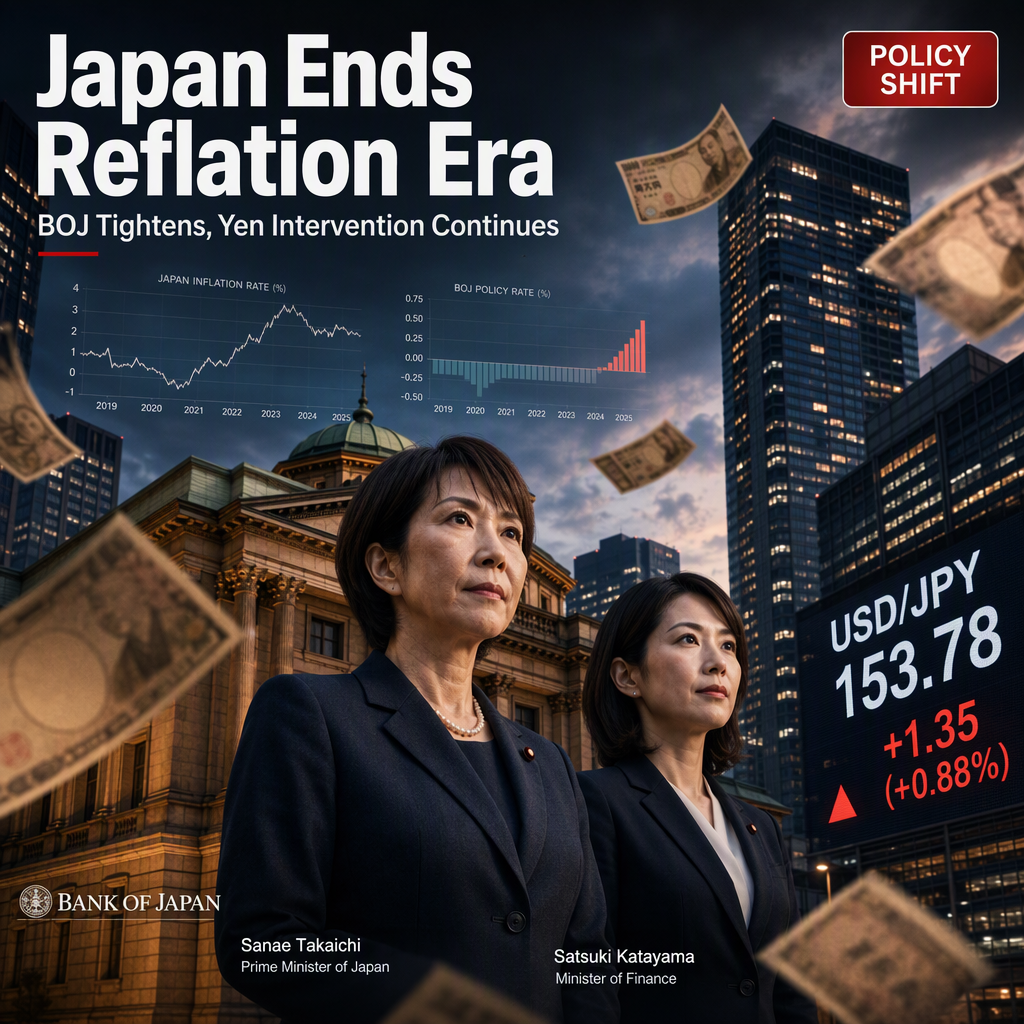
Japan's government, under Prime Minister Sanae Takaichi, has declared a unified stance that the era of reflationary policy is over, according to Finance Minister Satsuki Katayama. Katayama emphasized this position in an interview, expressing support for the Bank of Japan's (BOJ) recent shift away from accommodative monetary policy and its efforts to combat inflation and yen weakness [1].
The BOJ has recently signaled a departure from its long-standing easy monetary stance, including a rate hike to 1.25%. BOJ Governor Kazuo Ueda described this as a shift in the policy phase, marking a clear move away from aggressive reflationary measures [1]. In support of the yen, the BOJ conducted a rate check that lifted the currency to the upper-156 range against the dollar, after it had touched 158 as markets assessed the pace of further tightening. Additionally, the Japanese government disclosed a $96 billion yen-buying intervention during July and August to stabilize the currency [1].
Economist Bessent noted that there are expectations for further government action to strengthen the yen, reflecting persistent concerns about currency weakness and inflationary pressures [1]. Market participants are closely monitoring key price levels, with support for the yen near 156 and resistance at 158, as well as the broader implications of the BOJ's technical policy adjustments for future trading sentiment [1].
These developments underscore the government's and BOJ's commitment to addressing currency depreciation and rising prices, while sending a clear signal to markets that the period of accommodative policies has concluded [1].
CONCLUSION
Japan's government and central bank have formally ended their reflationary policy era, taking concrete steps such as a rate hike and large-scale yen interventions to address inflation and currency weakness. Market participants are now focused on the yen's trading range and the potential for further policy actions, signaling heightened market sensitivity to BOJ moves.