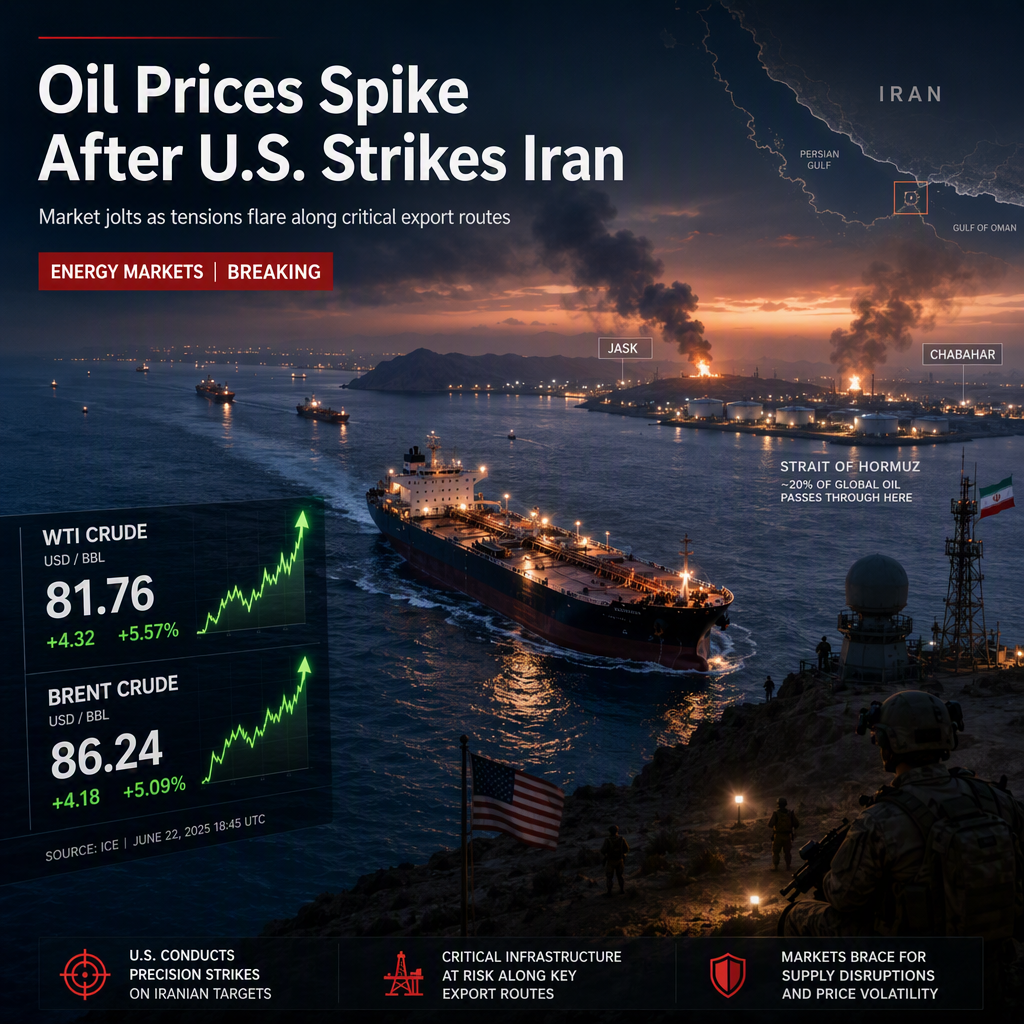
Crude oil prices experienced a sharp upward movement following fresh explosions in southern Iran, with West Texas Intermediate (WTI) surging from below $87.50 to just under $89.00 in a rapid sequence, before settling above $88.00. Brent crude followed suit, reaching near $93.50 [1]. This price action was triggered by confirmation from Central Command that American forces began striking Islamic Revolutionary Guard Corps targets at 16:00 GMT, in response to recent attempted attacks on commercial shipping in the Strait of Hormuz and on American personnel in the region [1].
The market had already reacted to initial wire reports of the strikes, repricing crude oil before the official statement was released. According to reporting sourced to three United States officials, the president had been considering a Central Command plan for limited strikes inside the strait, aimed at preventing Iran from rebuilding radar and missile capabilities used to threaten shipping. The market interpreted the campaign as having a stated objective but no announced end date, which led to a swift repricing rather than a gradual build-up through the afternoon [1].
The scope of the strikes marked a significant escalation compared to previous actions. While Sunday's operation targeted two rocket launchers on Larak Island and was described as limited and precise, Tuesday's strikes spanned the length of Iran's southern coast, with reported targets at Bandar Abbas, Minab, Qeshm, and Sirik inside the strait, as well as Jask, Konarak, and Chabahar beyond it. Notably, Jask serves as Iran's terminal on the Gulf of Oman, and Chabahar is the country's only ocean port outside the Persian Gulf, both critical for Iranian oil exports. Targeting these locations impacts export capacity rather than just transit capacity, raising the stakes for global oil supply [1].
Despite the escalation, there is currently no damage assessment available, and no reporting confirms an actual reduction in oil supply. The market's reaction appears to be based on the perceived direction of events rather than concrete evidence of supply disruption. The partial retracement from session highs reflects the market's reassessment of the difference between intentions and actual shortfalls. Additionally, Iran's parliament speaker warned that if Iran is barred from exporting through the Persian Gulf, no other producer will export either, signaling potential for further escalation [1].
CONCLUSION
Crude oil prices spiked sharply after U.S. strikes on Iranian targets, reflecting market concerns over potential disruptions to export capacity. However, with no confirmed supply losses or damage assessments yet, the market's reaction is driven by uncertainty and the risk of further escalation. The situation remains fluid, with traders closely monitoring developments for any concrete impact on oil flows.