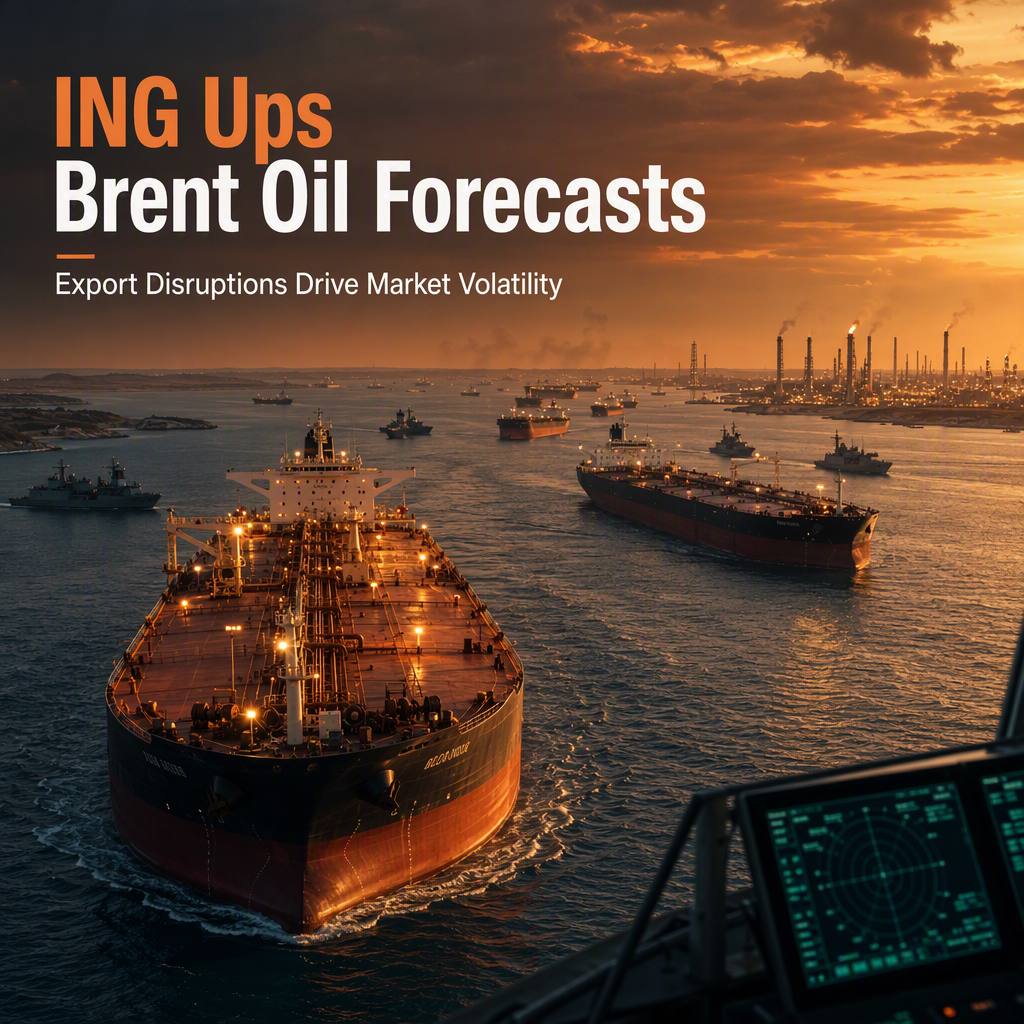
ING’s Warren Patterson has revised oil price forecasts higher, citing persistent tightness in Brent and refined product markets as Persian Gulf exports remain at approximately half of pre-war levels [1]. The base case scenario projects Brent crude averaging $80 per barrel in the fourth quarter, an increase from ING’s previous forecast of $74 per barrel [1]. This scenario assumes a stalemate in the region until shortly before the November US mid-term elections, followed by a limited stabilization agreement that could include military de-escalation and potential sanctions relief. Persian Gulf oil flows are expected to stay near 50% of pre-war levels in October, then recover to about 90% by December, including bypass volumes [1].
Three scenarios are outlined for Brent prices into year-end. The pessimistic case anticipates further disruptions to both Hormuz and bypass routes, keeping year-end flows at 50% of pre-war levels and pushing Brent to an average of $104 per barrel in the fourth quarter [1]. Conversely, the optimistic scenario envisions a September agreement that restores Persian Gulf oil flows to pre-war levels by year-end, resulting in Brent averaging $75 per barrel in the fourth quarter [1].
US officials estimate Persian Gulf oil flows at around 10 million barrels per day, while shipping trackers report figures between 4 and 8 million barrels per day, with recent estimates trending higher [1]. ING assumes Hormuz flows of approximately 5 million barrels per day, and total Persian Gulf oil exports, including pipeline bypass volumes, are roughly 50% of pre-war levels [1]. Tracking these flows remains challenging due to vessels switching off transponders during transit, which can materially distort daily estimates [1].
Market implications are significant, as the revised forecasts reflect heightened uncertainty and potential volatility in Brent prices depending on geopolitical developments and the timing of any US–Iran agreement [1].
CONCLUSION
ING’s updated Brent oil forecasts highlight the impact of ongoing Persian Gulf export disruptions, with price scenarios ranging from $75 to $104 per barrel depending on regional developments. The market faces elevated uncertainty and volatility, with recovery in oil flows and prices contingent on geopolitical agreements and stability in the region.