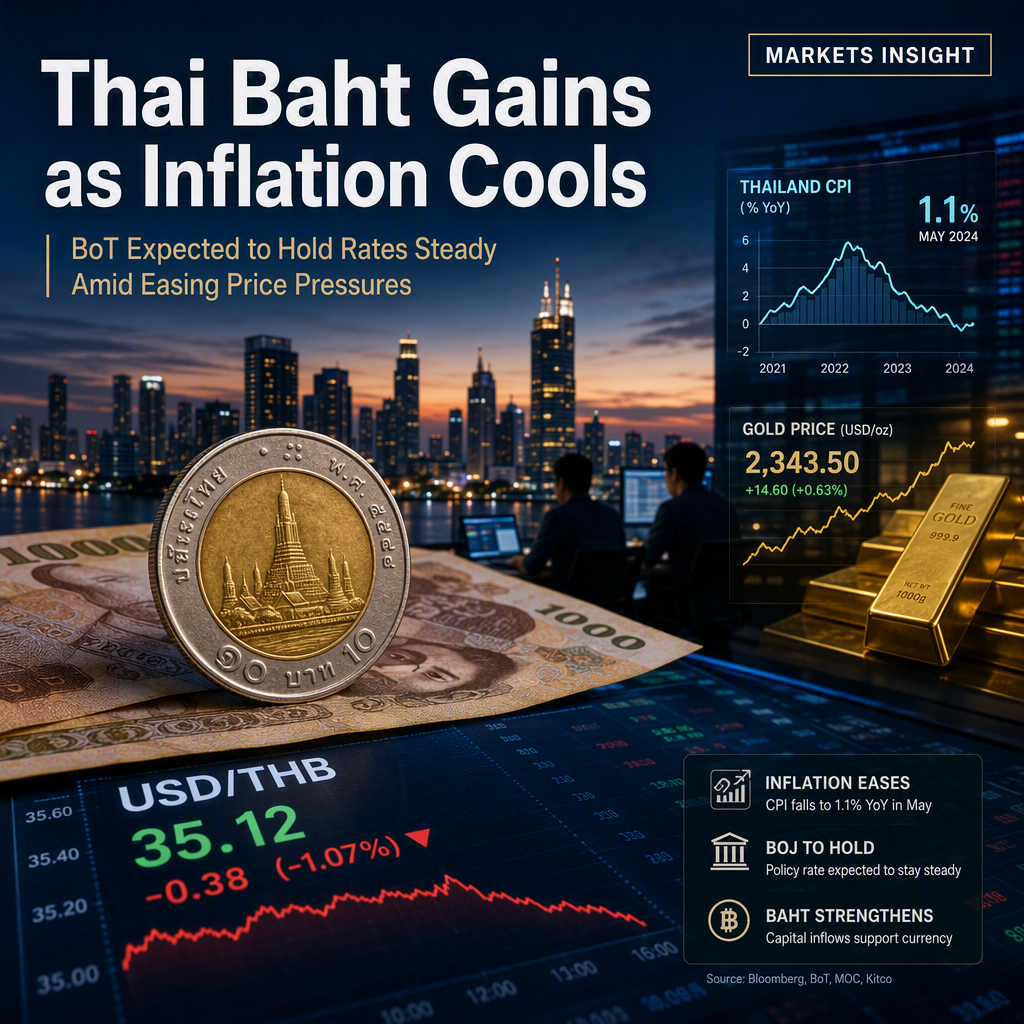
Thailand's July Consumer Price Index (CPI) rose 2.0% year-on-year, coming in below the Bloomberg consensus of 2.4% and down from 2.4% in June, marking the lowest reading since March. This softer inflation print was mainly attributed to lower retail fuel prices. Core CPI averaged 0.8% for the first seven months of the year, which is below the government's full-year core inflation forecast of 1.5% [1].
Given the manageable inflation backdrop, the Bank of Thailand (BoT) is expected to maintain its policy rate at 1% through the end of the year. BoT Assistant Governor Don Nakornthab indicated that inflation remains under control and could fall short of earlier expectations due to subdued demand-side pressures. As a result, there is little impetus for the BoT to adjust monetary policy at this time [1].
In foreign exchange markets, the Thai Baht (THB) strengthened, with USD/THB falling 0.2% to 33.00, its lowest level since June 22. The THB has appreciated over the past four sessions, supported by rising global gold prices. However, despite this recent strength, the Baht remains the third worst-performing Asian currency this year, having declined 4.5% against the US dollar year-to-date, compared to an average decline of 1.9% for Asian currencies excluding Japan [1].
CONCLUSION
Thailand's softer-than-expected inflation and subdued demand have reinforced expectations that the Bank of Thailand will keep rates unchanged at 1% for the remainder of the year. While the Thai Baht has recently strengthened, it continues to underperform most regional peers year-to-date.