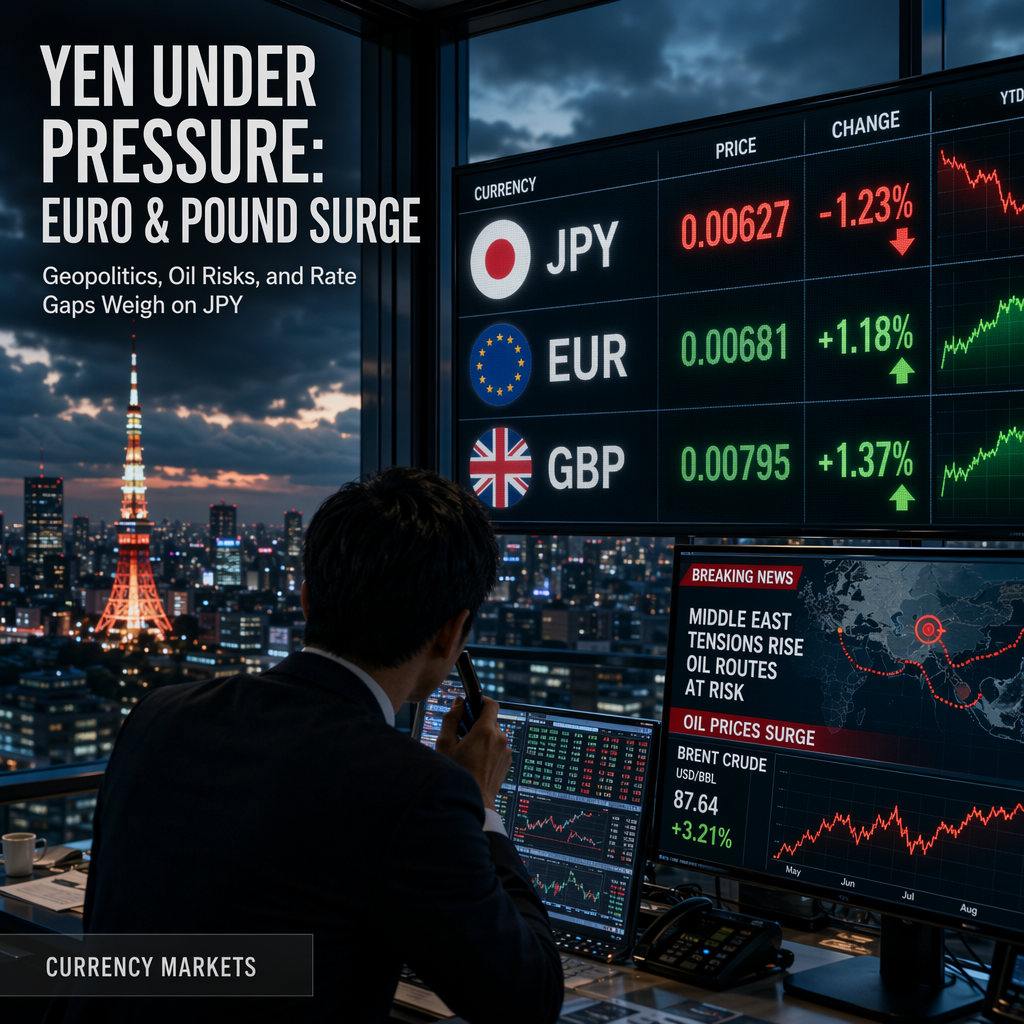
The Japanese Yen (JPY) continued to underperform against both the Euro (EUR) and the British Pound (GBP) on Wednesday, as geopolitical tensions and wide interest rate differentials weighed on the currency. The EUR/JPY pair pulled back from intra-week highs just above 185.60 but remained 0.5% higher on the week, maintaining a near-term bullish trend for the Euro [1]. Meanwhile, the GBP/JPY cross climbed to a fresh weekly top around the 217.70 region, staying close to its highest level since January 2008 and poised for further appreciation [2].
A key factor undermining the Yen is the persistent gap in borrowing costs between Japan and other major economies. The Bank of Japan (BoJ) raised its short-term policy rate in June to 1%, the highest since 1995, while the Bank of England's (BoE) base rate stands at 3.75%, resulting in an approximate 275 basis point gap that fuels the JPY carry trade and supports GBP/JPY [2]. Despite Japan's Finance Minister Satsuki Katayama's announcement last Friday encouraging pension funds to reinvest domestically, a Reuters report indicated that the repatriation of pension fund investments, including those of the Government Pension Investment Fund (GPIF), may take months or years, prompting speculative traders to resume Yen shorts [1].
Geopolitical risks have further pressured the Yen. The Euro has shown resilience amid rising tensions in the Middle East, with the US continuing to bomb military targets in Iran and President Trump threatening attacks on civilian infrastructure. Tehran has threatened to close key energy routes, pushing oil prices near one-month highs [1]. Japan's heavy reliance on Middle Eastern crude oil imports—over 90%—makes its economy particularly vulnerable to disruptions in the Strait of Hormuz, compounding the negative outlook for the Yen [2].
On the policy front, Austrian Central Bank Governor and ECB official Martin Kocher stated there are no signs of second-round inflationary effects in the Eurozone, but the ECB remains ready to act to achieve its 2% inflation target, though these comments had minimal impact on the Euro [1]. In the UK, BoE Governor Andrew Bailey warned of the inflationary risks stemming from renewed US-Iran conflict, leading traders to fully price in at least one 25 basis point rate hike by year-end, with a possible first hike as early as September. This has reinforced the bullish outlook for GBP/JPY, with any pullbacks seen as buying opportunities [2].
CONCLUSION
The Japanese Yen remains under significant pressure against both the Euro and the Pound due to persistent rate differentials, delayed pension fund repatriation, and heightened geopolitical risks. Market sentiment favors further appreciation of EUR/JPY and GBP/JPY, with traders viewing dips as opportunities to add to bullish positions. The outlook for the Yen remains weak unless there is a material shift in policy or geopolitical developments.