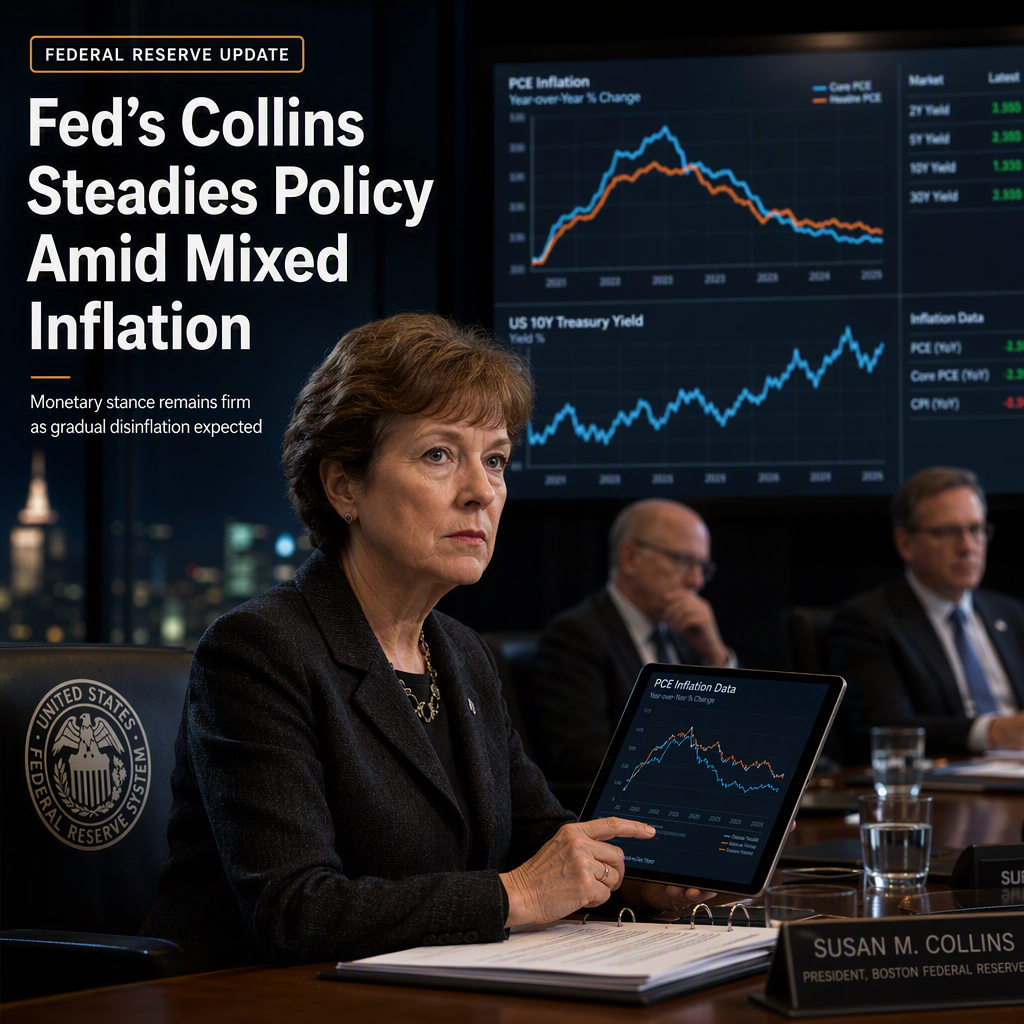
Boston Federal Reserve President Susan Collins stated that the recent Personal Consumption Expenditures (PCE) inflation report does not alter her view that current monetary policy remains restrictive and is expected to result in gradual disinflation [1]. Collins highlighted that portfolio management fees had a significant impact on the headline inflation figure, while market-based prices are more closely aligned with the Federal Reserve's inflation target [1].
Collins described the latest inflation data as 'mixed,' noting that while the headline figure was stronger than anticipated, there are 'promising signs' within the details of the report [1]. She emphasized that the recent rise in US bond yields is still consistent with price stability and does not indicate increasing inflation expectations [1].
Looking ahead, Collins suggested that, barring new shocks such as tariffs or oil price increases, there are reasons to believe inflation will continue to ease [1]. She also reiterated in a Wall Street Journal interview that a rate hike would be warranted if inflation data disappoints [1]. Collins is monitoring bond yields but declined to comment on Bessent's intervention [1].
CONCLUSION
Fed President Collins reaffirmed that current monetary policy is sufficiently restrictive and expects inflation to gradually decline, despite mixed signals in the latest PCE report. The market reaction is moderate, with Collins signaling a cautious but steady approach unless inflation data worsens. No immediate policy changes are anticipated based on the current data.