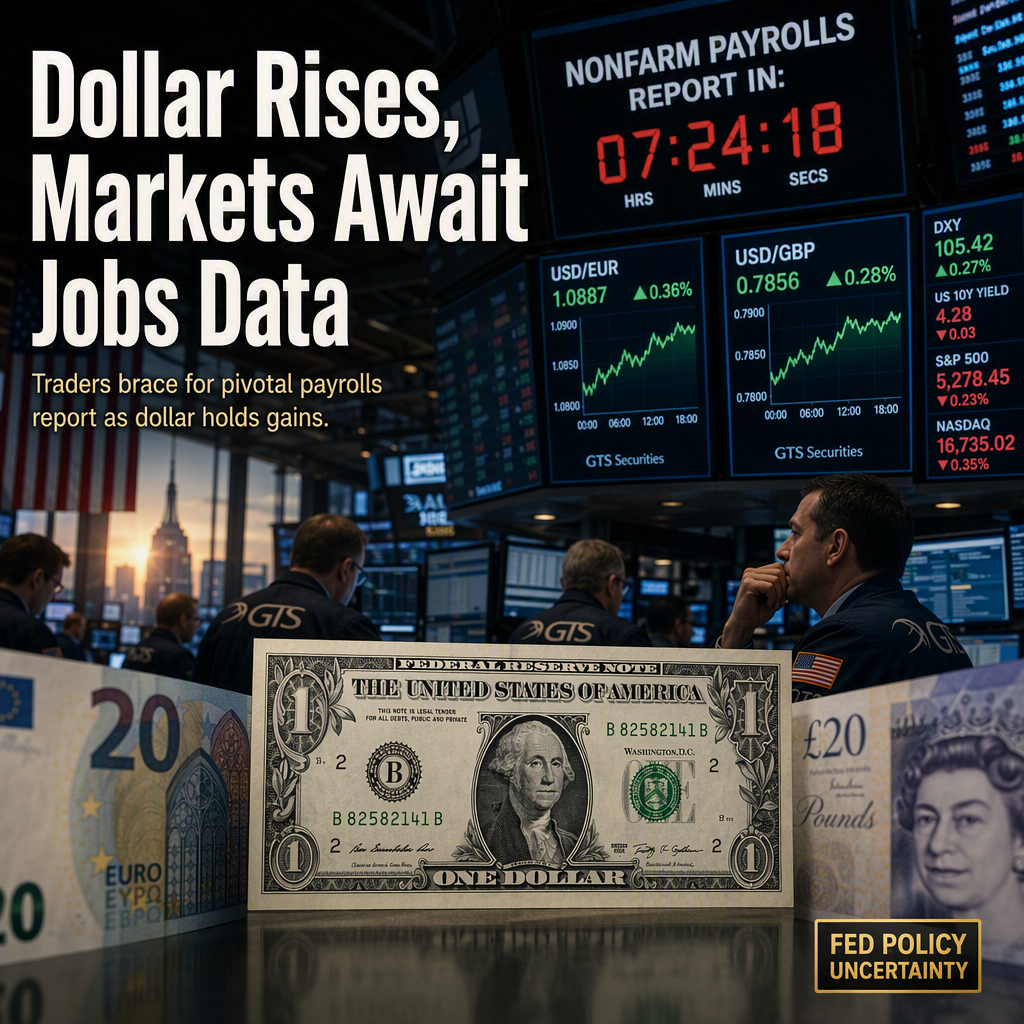
The US Dollar (USD) has seen a modest recovery against major currencies, including the Euro (EUR) and British Pound (GBP), as market participants shift their focus to the upcoming US Nonfarm Payrolls (NFP) data release, which is expected to significantly influence Federal Reserve (Fed) monetary policy expectations [1][2][3]. The Euro trades marginally lower at around 1.1545 against the USD, while the US Dollar Index (DXY) is slightly higher near 99.73, though still close to its two-day low of 99.63 [1]. The British Pound holds marginal losses against the USD, trading at 1.3460, with the GBP/USD pair remaining within a 100-pip range and bulls capped below 1.3500 [2].
Market attention is firmly on the US NFP report, with consensus estimates pointing to 80,000 new jobs created in July, up from 57,000 in June, and the Unemployment Rate expected to remain steady at 4.2%. Average Hourly Earnings are anticipated to grow by 0.3% month-on-month and 3.5% year-on-year [1]. However, a weaker-than-expected ADP Employment Change report for July, which showed only 44,000 new private sector jobs versus estimates of 70,000 and a prior reading of 98,000, has established a cautious tone ahead of the official employment data [1][2].
Strategists at Scotiabank describe the Pound’s tone as “neutral/bullish,” noting that a solid rise last week and bullish-leaning trend oscillators suggest some upside potential for GBP/USD, with resistance seen at the low 1.35 zone and support at 1.3390/00 [2]. Meanwhile, the US Dollar remains under pressure due to fading expectations of further Fed tightening, with traders dialing down the probability of a September rate hike to 54% from 67% earlier in the week [2]. Analysts at MUFG highlight that concerns over Fed independence, following reports of repeated meetings between President Donald Trump and Fed Chair Kevin Warsh, are also weighing on the USD [2].
According to Brown Brothers Harriman’s Elias Haddad, the USD has recouped some losses as concerns over the Fed’s credibility have eased, but relief rallies are expected to remain shallow. The US labor market is described as balanced, with wage growth consistent with the Fed’s 2% inflation target and strong productivity growth supporting a disinflation outlook [3]. The Employment Cost Index (ECI) for Q2 showed wages and salaries rising 3.2% year-on-year, aligning with the Fed’s target given average annual labor productivity growth of 2.1% [3]. Fed funds futures imply about a 60% probability of a September rate hike, though analysts see limited scope for a more hawkish repricing [3]. Upcoming Q2 non-farm productivity data is also expected to influence near-term rate expectations [3].
Technical analysis for EUR/USD shows the pair trading at 1.1540, holding above the 20-day EMA at 1.1470, with a bullish near-term bias. The Relative Strength Index (14) at 61.37 indicates constructive upside momentum, with initial support at 1.1470 and potential for an advance toward the May 29 high at 1.1686 if the pair stabilizes above the downtrend resistance line at 1.1537 [1].
CONCLUSION
Markets are in a holding pattern ahead of the US Nonfarm Payrolls release, with the US Dollar showing modest strength but facing headwinds from mixed employment data and uncertainty over Fed policy. While technical and fundamental indicators suggest limited upside for the USD, the outcome of the NFP report will be pivotal in shaping near-term market direction and Fed rate expectations.