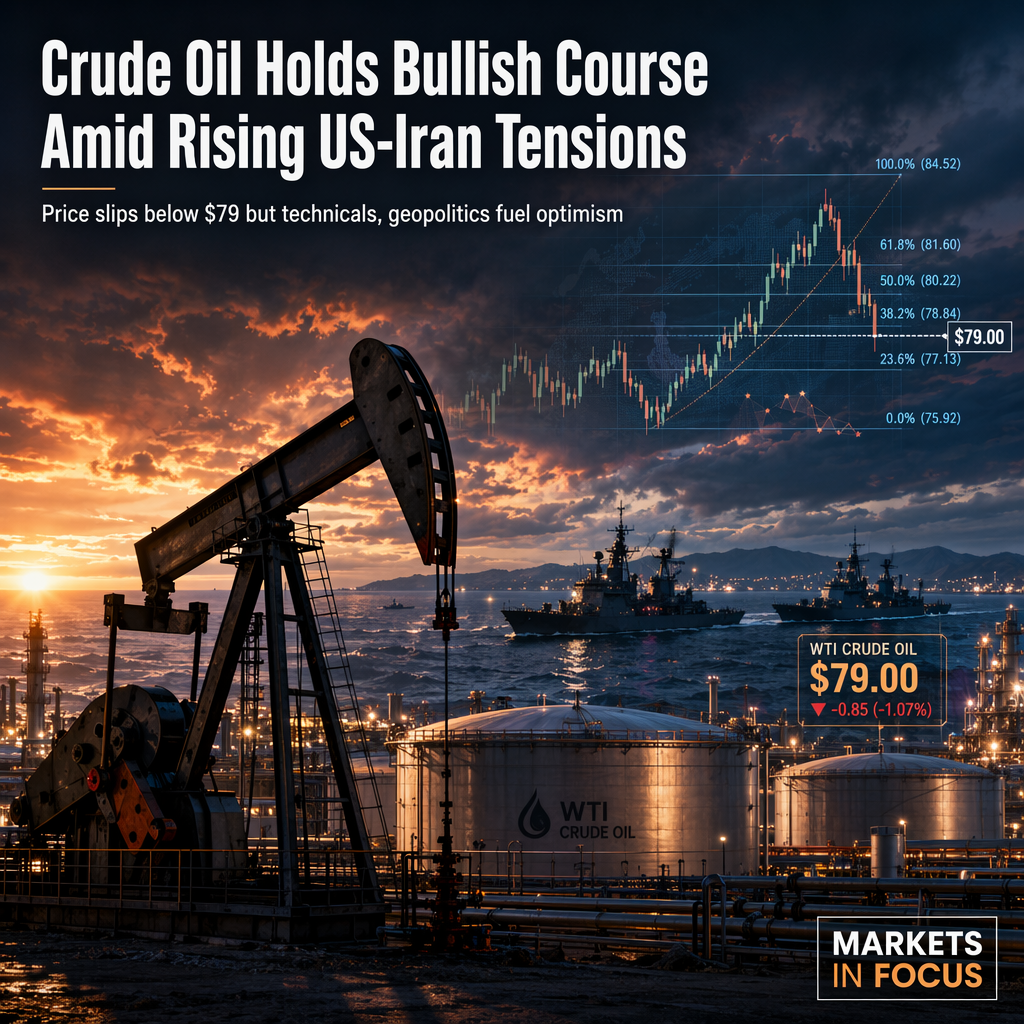
West Texas Intermediate (WTI), the benchmark US crude oil price, slipped below the $79.00 mark during the Asian session on Thursday, declining over 1% for the day. Despite this pullback, WTI remains close to the over one-month high reached earlier in the week, as market participants await further developments in the ongoing Middle East crisis before making new bets [1].
The escalation of the US-Iran conflict has been a key driver of recent price action. US forces launched a new wave of airstrikes targeting Iranian missile and drone infrastructure, while Tehran retaliated with drone and missile attacks on US-linked military facilities across the region. Additionally, the US naval blockade of Iranian ports and the closure of the Strait of Hormuz are cited as factors that could continue to support crude oil prices, suggesting that any significant corrective pullback may be met with renewed buying interest [1].
From a technical standpoint, WTI's breakout this week above the 23.6% Fibonacci retracement level of the April-July decline and the 200-day Exponential Moving Average (EMA) have been identified as key triggers for bullish traders. The Relative Strength Index (RSI) stands at 54.36, indicating moderately positive momentum, while the Moving Average Convergence Divergence (MACD) is positive at 1.85, both suggesting that bullish momentum is rebuilding after the recent recovery from the $67.07 cycle low [1].
Immediate support is noted at the 200-day EMA of $77.28, followed by the 23.6% retracement at $76.59. A deeper pullback toward the $67.07 anchor would threaten the current bullish bias. On the upside, resistance is seen at the 38.2% Fibonacci level at $82.47, with further barriers at the 50.0% retracement near $87.23. A daily close above these levels could expose the 61.8% retracement at $91.98, with subsequent upside targets at $98.75 and $107.38 [1].
CONCLUSION
WTI crude oil prices have retreated slightly but maintain a bullish outlook amid heightened US-Iran tensions and technical signals supporting further gains. Market participants are closely monitoring geopolitical developments, with key technical levels likely to guide near-term price action.