
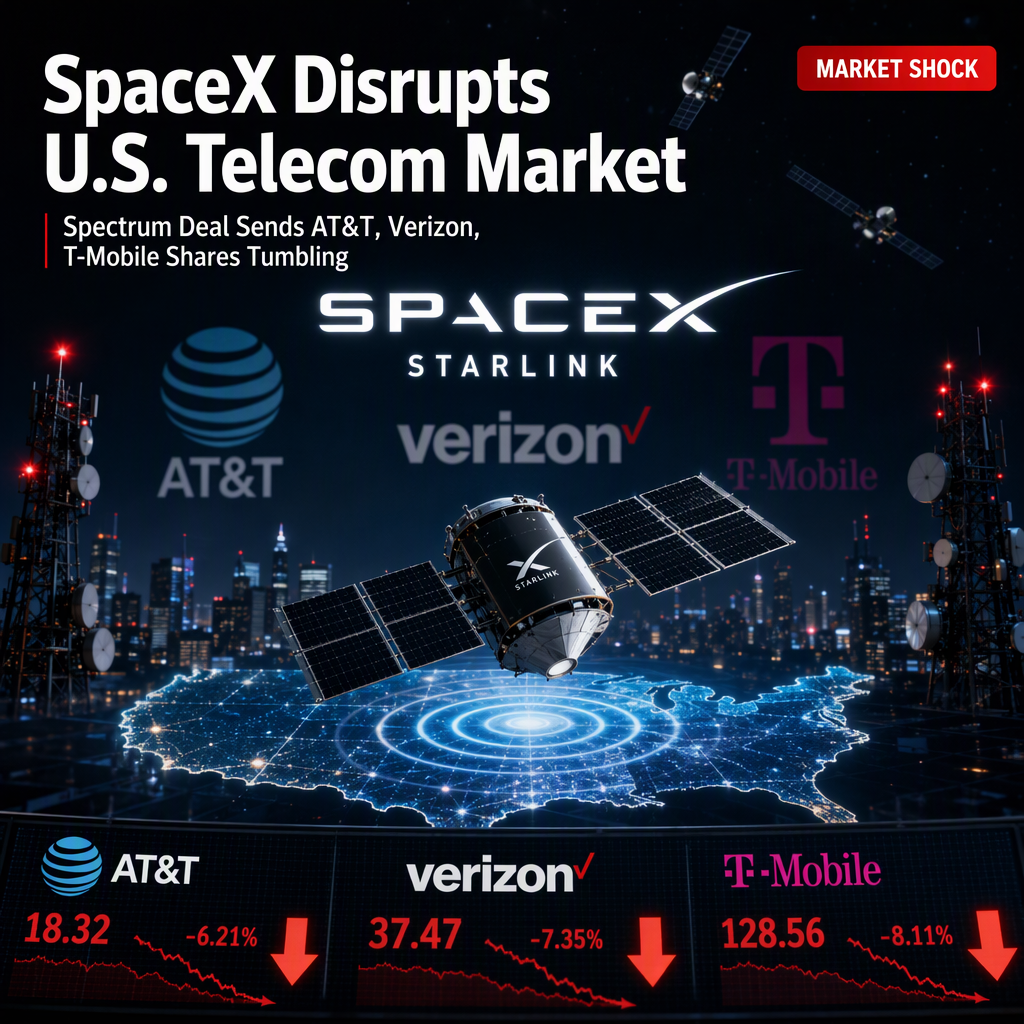
SpaceX announced an agreement to acquire a nationwide spectrum portfolio from Grain Management, a firm specializing in digital infrastructure, marking a significant push for its Starlink service into the U.S. telecommunications market [1]. The deal, which involves up to 14 megahertz of paired spectrum in the 800 MHz band, is subject to approval by the Federal Communications Commission (FCC) [1]. SpaceX described this low-band spectrum as addressing a key technical gap, paving the way for Starlink Mobile to become a major mobile carrier in the United States [1]. CEO Elon Musk called the agreement a 'very big deal' in a post on X [1].
The market reacted swiftly, with shares of AT&T, Verizon, and T-Mobile tumbling in extended trading following the announcement [1]. This move comes amid broader regulatory developments, as the FCC recently announced it would vote on proposals to auction 25 megahertz of 'prime spectrum' for direct-to-device (D2D) satellite-to-smartphone services and to consider making an additional 482 MHz of spectrum available for supplemental coverage from space [1]. These regulatory changes could benefit both SpaceX and Amazon, which is also developing satellite network services [1].
Last week, AT&T, Verizon, and T-Mobile formed a joint venture to expand coverage in underserved areas using satellite and D2D services, notably excluding Starlink from their collaboration [1]. T-Mobile has also removed references to Starlink from its T-Satellite promotions [1]. Industry expert Tim Farrar noted that while the acquisition intensifies competition between SpaceX and established mobile operators, the spectrum acquired is still limited, and reliable urban coverage would require SpaceX to deploy ground towers [1].
SpaceX, which went public in June in a record IPO and is now valued at over $2 trillion, continues to rely on Starlink as its primary profitable business segment [1]. The company is also investing in other ventures, including cloud computing and orbital data centers, though these units are currently unprofitable [1]. SpaceX did not provide further details on when its new services might launch [1].
CONCLUSION
SpaceX's acquisition of nationwide spectrum marks a bold step into the U.S. telecom market, triggering a negative reaction in shares of major incumbents AT&T, Verizon, and T-Mobile. While the move intensifies competition and could reshape the industry, the immediate market impact is significant, and the timeline for new Starlink Mobile services remains unclear.