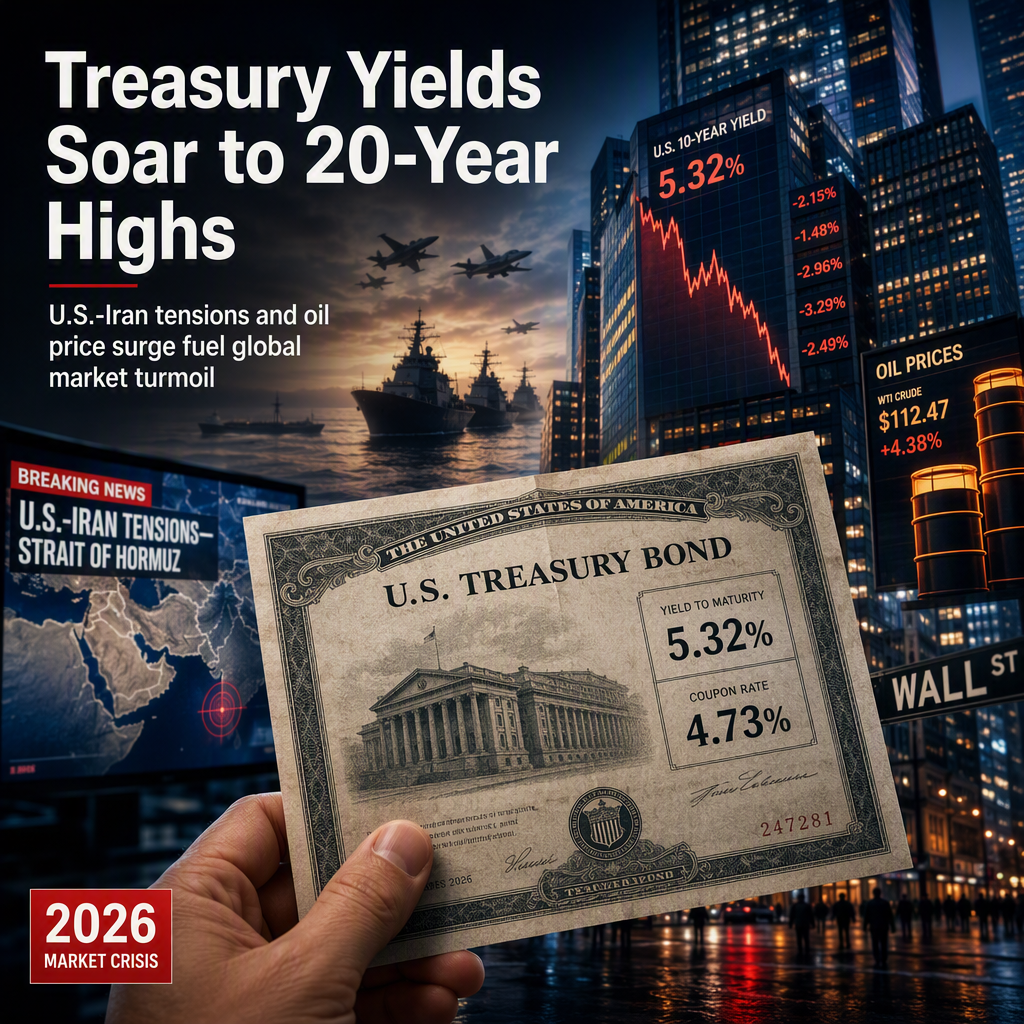
On August 18, 2026, U.S. Treasury yields surged to levels not seen in over two decades, driven by escalating tensions between the United States and Iran and a rise in oil prices [1]. The 30-year Treasury yield increased by more than 1 basis point to approximately 5.322%, just below its highest point since 2002, while the 10-year Treasury note yield rose by more than 1 basis point to 4.736% [1]. The 2-year Treasury note yield remained flat at 4.186% [1]. These movements reflect a broader trend, with long-term Treasury yields trading at multi-decade highs and global government borrowing costs rising, including Japan's long-dated bonds near 40-year highs, Germany's 30-year bond yield at its highest since 2011, and French 30-year yields reaching post-2008 highs [1].
The surge in yields coincided with the expiration of a 60-day deadline for the U.S. and Iran to secure a peace deal, which ended on Monday. Iran ruled out the possibility of an extension, and a senior Iranian official indicated Tehran would adopt an offensive stance if diplomacy fails [1]. This geopolitical uncertainty has contributed to market weakness, with both bonds and equities slipping. Deutsche Bank's Jim Rid noted that "markets have seen growing weakness over the last 24 hours, with bonds and equities slipping thanks to negative geopolitical headlines from the Middle East," and highlighted that the lack of progress in U.S.-Iran negotiations led investors to price in a more extended closure of the Strait of Hormuz [1].
Resurging inflation fears are also playing a role in driving government borrowing costs higher globally, as investors react to the prospect of prolonged geopolitical instability and its impact on energy prices [1]. Market participants are awaiting key economic data releases, including July import and export pricing figures, housing starts, and pending home sales, which may further influence market sentiment [1].
CONCLUSION
Escalating U.S.-Iran tensions and rising oil prices have pushed Treasury yields to multi-decade highs, reflecting heightened inflation fears and global market uncertainty. The lack of progress in diplomatic negotiations and the potential for extended disruption in the Strait of Hormuz are weighing on both bond and equity markets. Investors remain cautious, awaiting further economic data to gauge the broader impact.