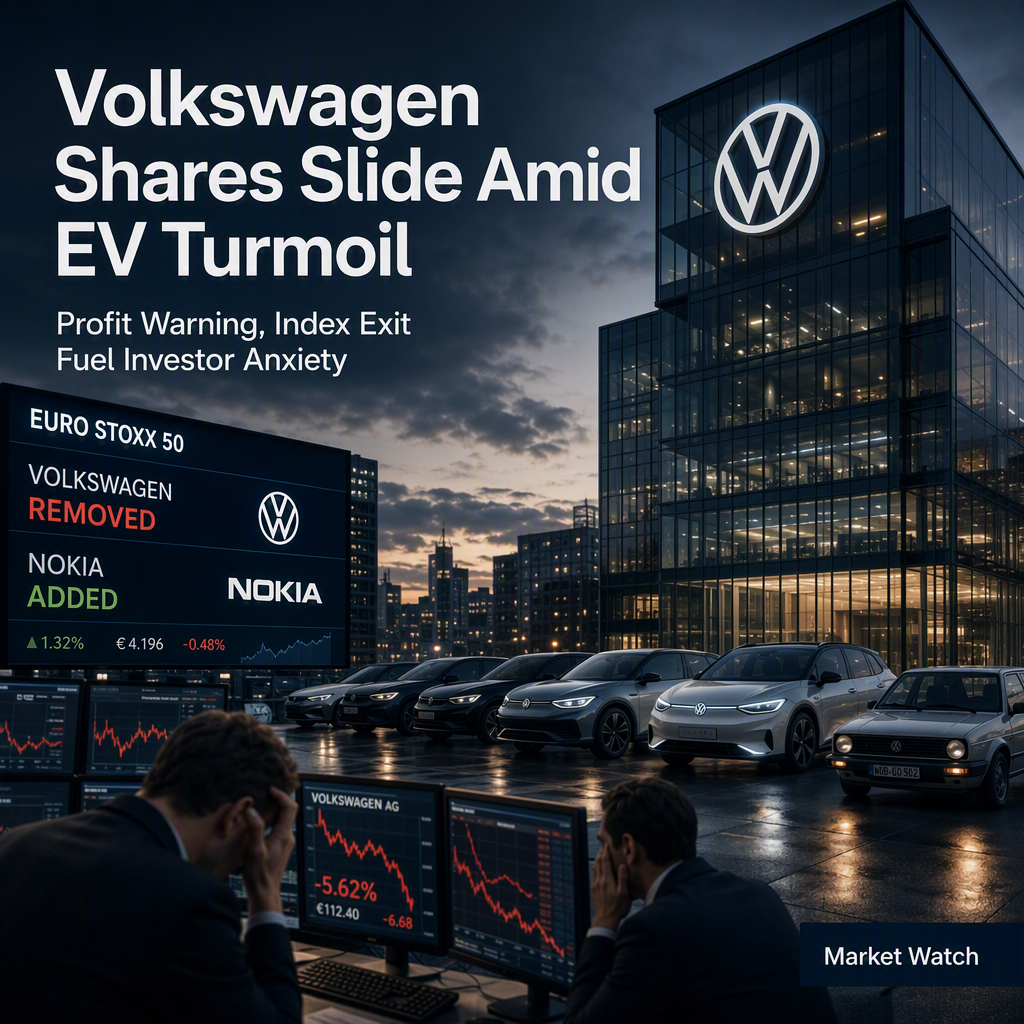
Volkswagen extended its losses on Monday after issuing a profit warning and being removed from the Euro Stoxx 50 index, with Nokia taking its place due to its AI-driven growth in data center connectivity [1]. The German automaker downgraded its annual operating return on sales forecast to 1%, a significant reduction from its previous guidance of 4% to 5.5% [1]. This revision was attributed to an impairment related to its Porsche holding, a further deterioration in the market environment—particularly in China—and restructuring expenses [1].
Volkswagen shares fell 0.5% on Monday, extending Friday's sharp 8.3% decline following the profit warning. The company's share price has dropped 27.5% year-to-date and is currently near its lowest level since 2010 [1]. The company cited an accelerated shift in demand toward battery-electric vehicles, which has led to results falling short of expectations, especially for the Audi and Volkswagen Passenger Cars brands [1].
Despite these challenges, Volkswagen recently approved the next stage of a major restructuring and streamlining effort, which will cut 100,000 jobs as it contends with declining profits, increased competition from Chinese automakers, tariff issues, and the ongoing transition to electric vehicles [1]. Deutsche Bank analysts noted that while the profit warning appears severe, it includes 10 billion euros in one-off effects impacting this year's earnings. They emphasized that underlying margins remain around 4% and cash generation is intact [1].
Volkswagen's removal from the Euro Stoxx 50 highlights the broader struggles of Europe's automotive sector, which has faced rising costs, intensifying global competition, and rapidly changing consumer demand for EVs and hybrids. Stellantis, the maker of Jeep and Dodge, was also dropped from the index a year ago amid similar challenges [1].
CONCLUSION
Volkswagen's profit warning and exit from the Euro Stoxx 50 underscore the significant pressures facing the company and the broader European auto sector. While the headline figures are negative, analysts suggest the underlying business remains more resilient than the profit warning implies. The market reaction has been sharply negative, reflecting investor concerns about the pace of the EV transition and competitive pressures.