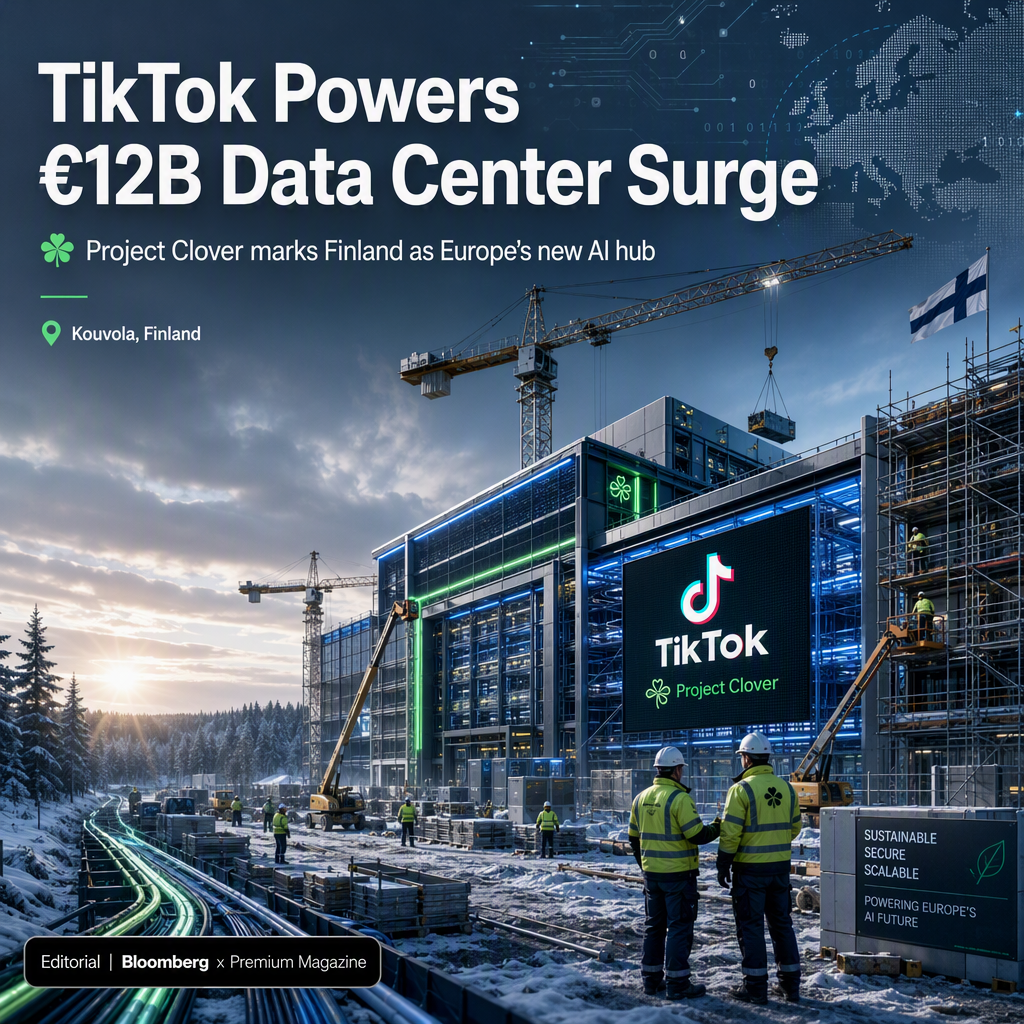
TikTok has announced plans to expand its data center capacity in Finland as part of its €12 billion Project Clover, which aims to strengthen protections for European user data. According to an economic impact report commissioned by TikTok and Hyperco, the company will take roughly 150 megawatts of capacity at a data center site in Kouvola, Finland. Construction for the first phase, providing 50 megawatts, began in September 2025 and is expected to be completed in 2027. The second phase will add another 100 megawatts, bringing the total to 150 megawatts. TikTok will become a tenant of the facility once it is operational, and the data center will form part of Project Clover [1].
TikTok, owned by Beijing-based ByteDance, previously announced a €1 billion investment in the Kouvola data center but did not disclose capacity details at that time. In April, the company committed an additional €1 billion to another data center in Lahti, Finland, also under Project Clover. The expansion comes as hyperscalers, neoclouds, and AI labs race to secure digital infrastructure in the Nordics, leveraging the region's available land and power, which are scarce in much of Europe [1].
Finland has become a hotspot for data center development amid the AI boom. Recent announcements include Pure DC's €1.5 billion investment in a 110-megawatt campus with potential to scale beyond 550 megawatts, Arcem's plans for a 500-megawatt site, and Nebius's project to build one of Europe's largest AI factories in the country. Additionally, Nvidia is reportedly working to connect companies needing GPUs with Nordic data center operators capable of deploying them [1].
The market implications of TikTok's expansion are significant, as it underscores the growing demand for digital infrastructure to support AI workloads and data protection in Europe. The influx of major investments from global tech firms is likely to further position Finland as a leading hub for data centers and AI development [1].
CONCLUSION
TikTok's substantial investment in Finnish data center capacity highlights the strategic importance of the Nordics for AI infrastructure and data protection. The move is expected to accelerate Finland's emergence as a key European data center hub, attracting further industry investment and innovation.