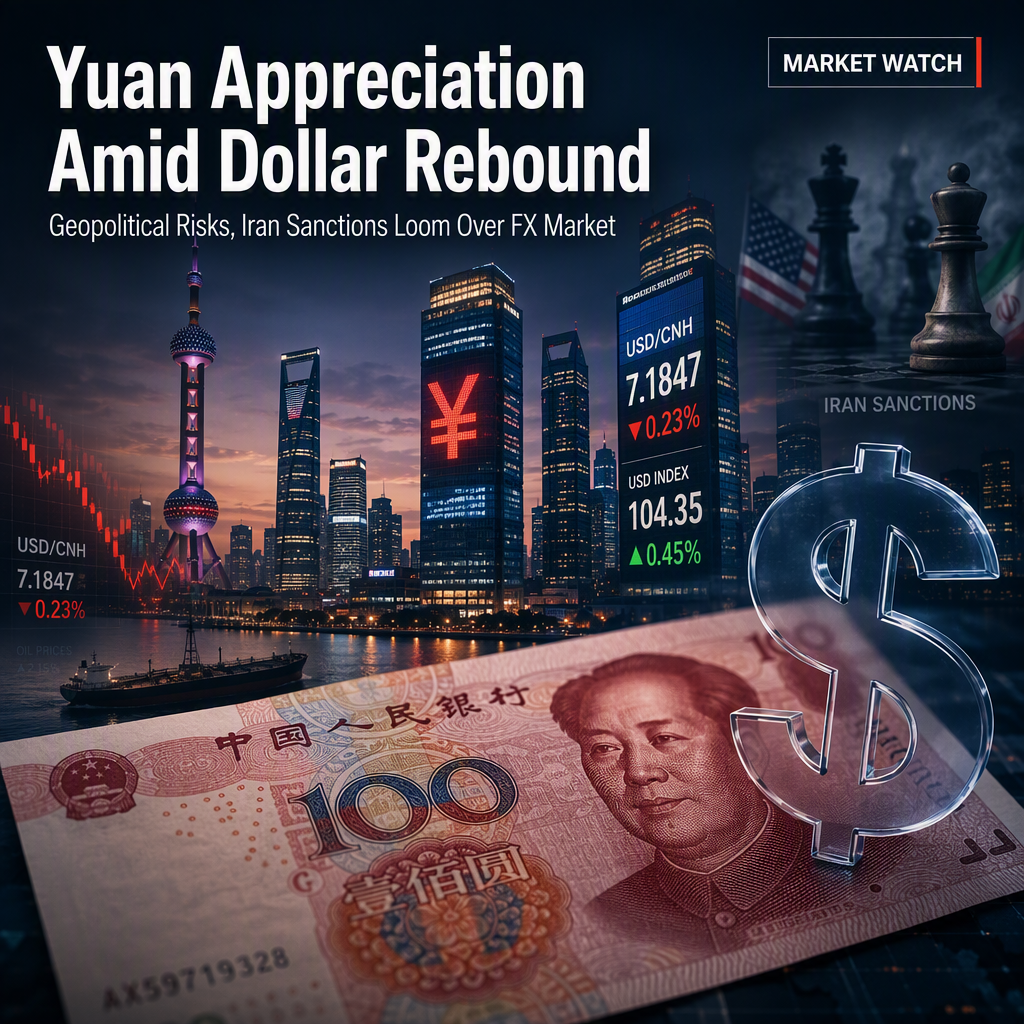
OCBC Bank strategists Sim Moh Siong and Christopher Wong report that the USD/CNH currency pair has edged higher, reflecting a broader rebound in the US Dollar and firmer US Treasury yields, while the People's Bank of China (PBoC) maintains a preference for a gradual appreciation of the Renminbi (RMB) [1]. The strategists note that mild bearish momentum persists for the RMB, but a modest rebound in USD/CNH cannot be ruled out, with resistance levels identified at 6.7410–6.75 and support at 6.72–6.70 [1].
Geopolitical risks, particularly renewed US pressure on Iran and the potential for secondary sanctions, are highlighted as sources of uncertainty for the RMB, given China's significant role as a buyer of Iranian oil [1]. The strategists emphasize that the immediate foreign exchange impact should remain limited unless measures escalate to directly target major Chinese financial institutions. However, any escalation in secondary sanctions towards Chinese firms or banks could negatively affect sentiment and introduce increased volatility in the RMB [1].
The PBoC is observed to be signaling a preference for a measured pace of RMB appreciation, as evidenced by a sizeable fix-versus-expectation gap, indicating that policymakers are cautious about allowing the RMB to strengthen too rapidly [1]. Technical indicators show that while the daily chart maintains mild bearish momentum, the RSI is showing tentative signs of turning higher from oversold conditions, suggesting that a modest rebound in USD/CNH is possible [1].
CONCLUSION
The Chinese Yuan is experiencing measured appreciation, with the PBoC maintaining control amid external pressures such as a stronger US Dollar and geopolitical risks related to Iran. While immediate FX impact is expected to be limited, any escalation in US sanctions could increase RMB volatility and weigh on market sentiment.