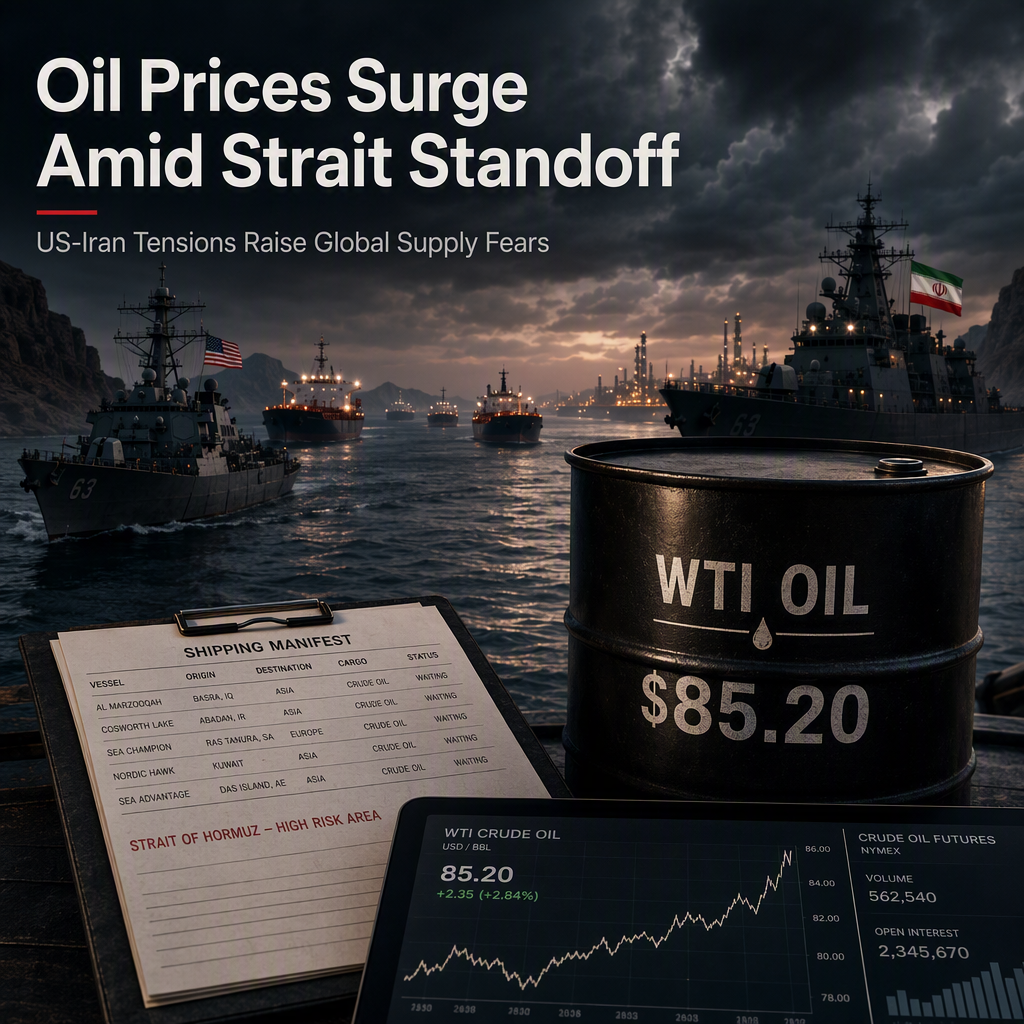
West Texas Intermediate (WTI) Oil prices climbed on Wednesday, trading near their highest level in over three weeks as geopolitical tensions between the United States and Iran heightened concerns about Middle East supply risks [1]. At the time of reporting, WTI was priced around $85.20 per barrel, marking an increase of nearly 1% for the day [1].
The latest data from the US Energy Information Administration (EIA) revealed that US crude oil inventories rose by 4.405 million barrels for the week ending August 14, contrary to market expectations of a 0.6 million barrel decline. This increase represents the third consecutive weekly build in US crude stocks [1].
The expiration of a 60-day memorandum of understanding between the US and Iran on Monday has left the Strait of Hormuz closed, with Tehran insisting it will remain so until US conditions are met. Separate talks between Iran and Oman regarding joint management of the Strait have not yielded progress toward reopening the waterway [1].
US President Donald Trump stated on Truth Social that there are currently no talks or scheduled conversations with Iran, and that the US naval blockade remains in effect. However, he indicated to reporters that negotiations with Iran may occur in the future and noted that many vessels had passed through the Strait overnight. Despite these remarks, actual shipping activity remains subdued, with Kpler data showing only six commodity vessels crossing the Strait on Tuesday, down from nine on Monday and below the recent daily average of eleven [1].
From a technical perspective, WTI maintains a bullish near-term outlook, trading above the 21-day and 200-day Simple Moving Averages (SMA) at $82 and $76, respectively, and facing resistance at the 100-day SMA near $86. The Relative Strength Index (RSI) at 58 and a positive MACD reading suggest constructive upside momentum, with a potential move toward the July high of $92.25 if resistance is cleared. Initial support is seen at the 21-day SMA, with stronger support at the 200-day SMA should a pullback occur [1].
CONCLUSION
WTI oil prices are being driven higher by ongoing US-Iran tensions and the resulting supply risks in the Middle East, despite rising US crude inventories. Technical indicators point to continued bullish momentum, with traders closely watching developments around the Strait of Hormuz and potential negotiations. Market sentiment remains positive but cautious amid geopolitical uncertainty.