
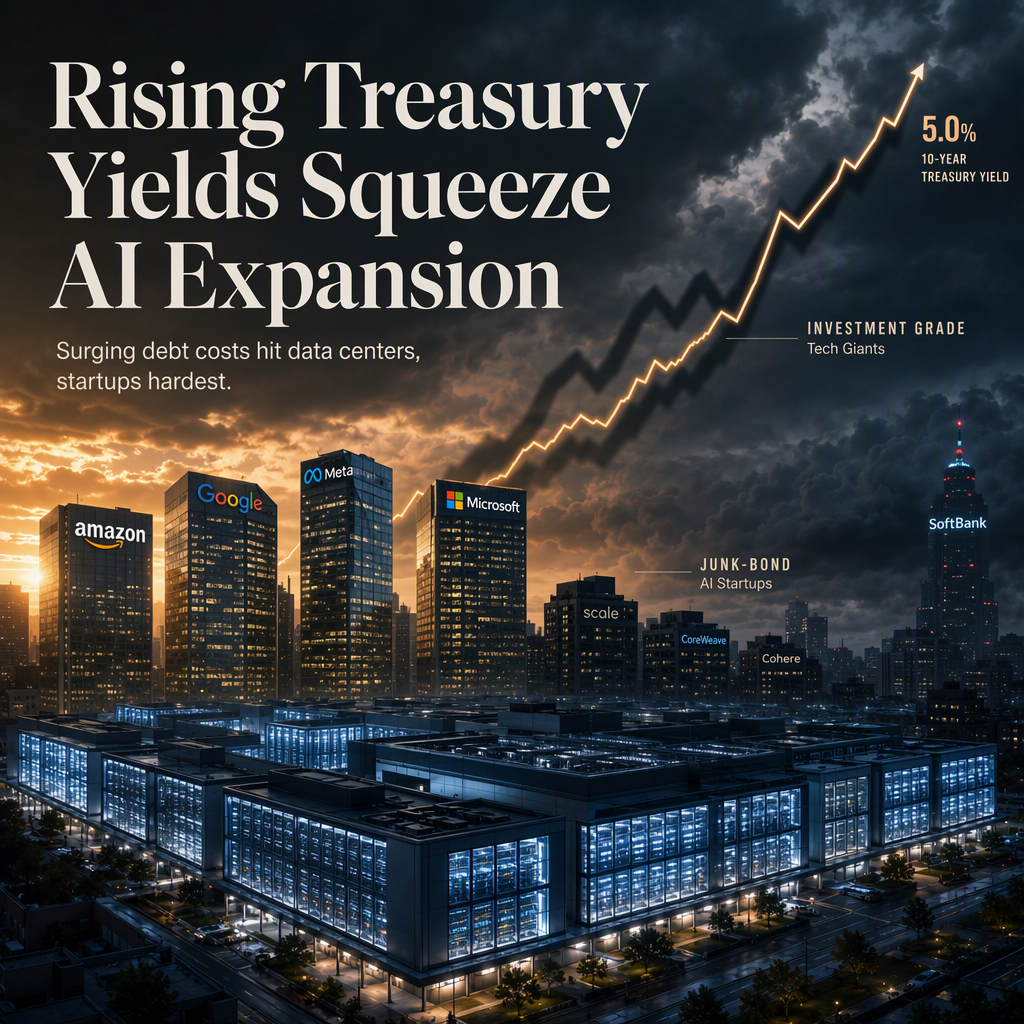
The surge in Treasury yields to their highest levels since 2007 is significantly increasing borrowing costs for companies involved in the AI infrastructure buildout, particularly data center firms and those tied to the artificial intelligence boom [1]. JPMorgan Chase estimated in June that $4.1 trillion in AI-related debt will be issued through 2030 as companies race to expand capacity to meet growing demand for AI services [1]. The 10-year Treasury yield now sits near 5.17%, up about 1 percentage point since the start of the year, forcing companies issuing debt to offer more attractive rates to entice investors [1].
Despite the rising costs, some companies have continued to absorb higher debt expenses. For example, shares of debt-heavy neocloud CoreWeave rose almost 8% this week, indicating resilience, while Oracle, which relies on debt for its AI expansion, saw its shares fall 7% for the week and about 30% year-to-date, reflecting investor concerns [1]. Japan's SoftBank, a major capital provider for AI projects, raised $11.1 billion in a junk-bond sale this week, with yields reaching as high as 9.75% for the 7-year tranche, demonstrating the elevated cost of capital for non-investment grade borrowers [1].
At the heart of the AI boom are leading model developers OpenAI and Anthropic, each valued at close to $1 trillion in the private market [1]. To support their advanced models and those from other companies, tech giants such as Amazon, Google, Meta, and Microsoft have committed hundreds of billions of dollars in capital expenditures this year, with expectations for increased spending in 2027 [1]. These hyperscalers benefit from investment grade credit ratings, granting them cheaper access to capital, whereas smaller or less established firms face greater challenges as borrowing costs rise [1].
According to Mark Malek, chief investment officer at Siebert Financial, many companies are 'price insensitive' to debt raises, needing to secure as much capital as possible to remain competitive in the AI race [1]. However, some investors are beginning to worry about future financings, especially for companies without investment grade ratings, as the cost of debt continues to climb [1].
CONCLUSION
The spike in Treasury yields is making AI infrastructure expansion more expensive, particularly for companies without investment grade credit ratings. While tech giants remain insulated due to their strong credit profiles, smaller firms and major capital providers like SoftBank are facing higher borrowing costs. The market is not in panic mode yet, but investor concerns about future financings are growing as debt costs rise.