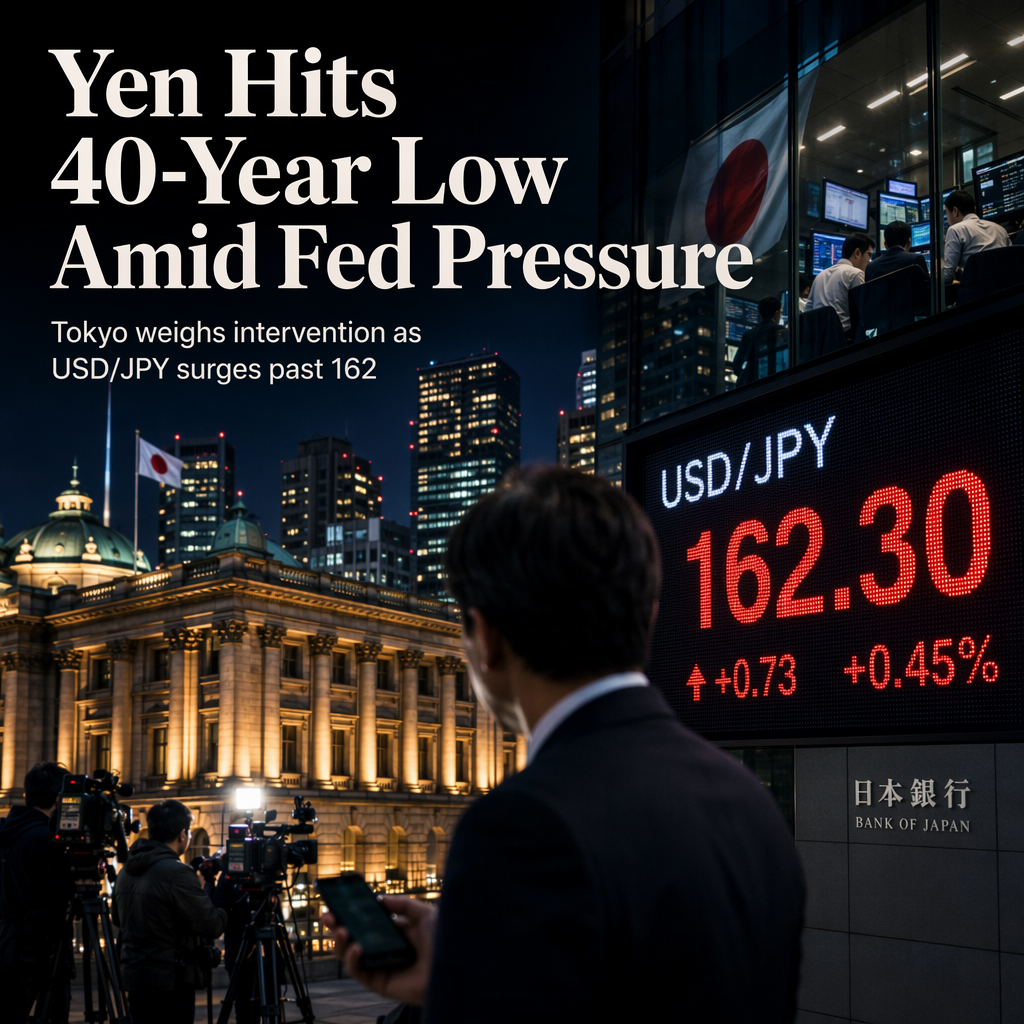
The Japanese Yen (JPY) has continued its decline, with the USD/JPY pair trading around 162.30 during the European session, near a four-decade high reached earlier on Tuesday [2]. This weakness is attributed to the wide interest rate differential between Japan and the United States, with the Bank of Japan (BoJ) having raised policy rates to 1% in June—the highest since 1995—while the US Federal Reserve (Fed) maintains its target range at 3.5% to 3.75%, resulting in a gap of approximately 250 basis points [2]. The persistent carry trade, where investors borrow in low-yielding currencies like the Yen to invest in higher-yielding assets, continues to pressure the JPY [2].
The US Dollar (USD) has attracted renewed buying interest, supported by expectations of further Fed rate hikes amid inflationary concerns, partly fueled by renewed US-Iran hostilities [2]. According to the CME Group's FedWatch Tool, traders are currently assigning an 80% probability of a Fed rate move by the end of this year [2]. MUFG’s Lee Hardman notes that USD/JPY has broken above its July 2024 high of 161.95, with the recent Yen weakness primarily focused against the US Dollar, while other Yen crosses have remained relatively stable [3].
Japanese authorities have reiterated their readiness to intervene in the currency markets. Chief Cabinet Secretary Minoru Kihara stated during a press conference that he is always ready to take necessary action on forex, and Finance Minister Satsuki Katayama echoed that the government will respond appropriately to currency moves as needed [2][3]. However, MUFG observes that previous record interventions only briefly strengthened the Yen and failed to reverse its weakening trend for long, suggesting Japan may tolerate gradual Yen weakness in the near term as long as the pace remains moderate [3]. The heightened risk of intervention has helped slow the pace of Yen depreciation, but has not reversed the trend [3].
Despite the BoJ's recent hawkish tilt and signs of rising inflation in Japan, these measures have not impressed JPY bulls or provided significant support to the currency [2]. The BoJ's June meeting summary revealed debates over mounting inflation risks, with some members advocating for faster rate hikes to levels considered neutral for the economy [2]. Market participants are now focused on upcoming US economic data, including the Conference Board's Consumer Confidence Index, JOLTS Job Openings, and the Nonfarm Payrolls (NFP) report, as well as Fed Chair Kevin Warsh's appearance at the ECB Forum in Sintra, all of which could influence the USD/JPY pair's direction [2].
CONCLUSION
The Japanese Yen remains under significant pressure due to a persistent interest rate gap with the US and strong expectations for further Fed tightening. While Japanese officials have reiterated their readiness to intervene, past efforts have had limited and temporary effects. Market participants are closely watching upcoming US economic data and Fed commentary for further cues, with the risk of intervention helping to slow but not reverse the Yen's decline.