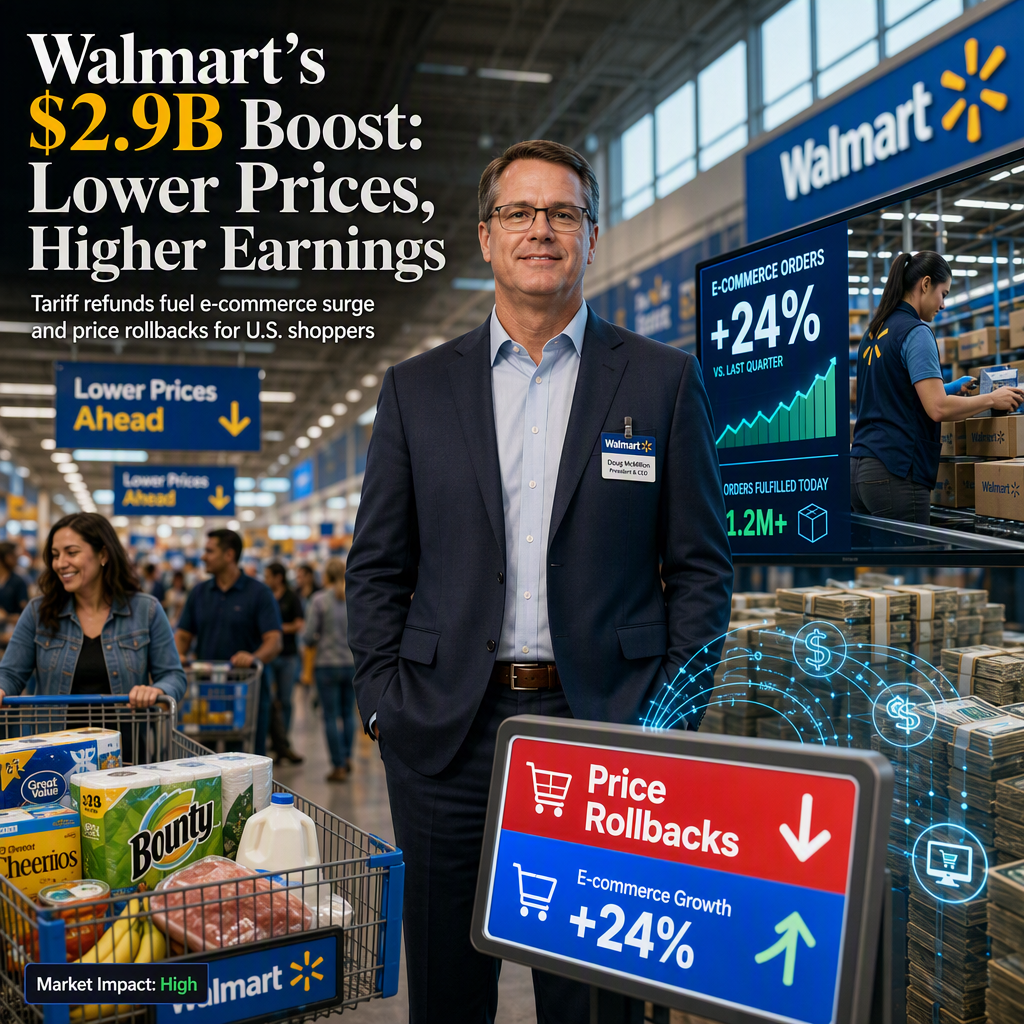
Walmart reported a robust fiscal second quarter, driven by a significant tariff refund and strong e-commerce growth across its global operations [1][2][3]. The company received nearly $3 billion in tariff refunds, with CFO John David Rainey specifying the amount as roughly $2.9 billion, noting that less than $100 million remains to be collected [1][3]. Walmart stated it will use these funds to keep prices low for shoppers, prioritizing investment in price and rolling back prices on more than 11,000 items in its U.S. stores during the quarter [1][3]. Rainey confirmed that the impact of these refunds on consumer prices will be seen in the third quarter [3].
The tariff refunds provided a substantial boost to Walmart’s quarterly earnings, contributing a 750-basis-point net benefit to adjusted operating income, which rose approximately 17% on a constant-currency basis [1]. Excluding this benefit, underlying operating income growth still reached the top end of Walmart's previous 7% to 10% second-quarter guidance [1]. For the three-month period ending July 31, Walmart reported net income of $6.37 billion, or 80 cents per share, compared to $7.03 billion, or 88 cents per share, in the year-ago period [3]. Adjusted earnings per share were 81 cents, though it was not immediately clear if this compared to the 74 cents expected by analysts [3].
Sales continued to rise, with total revenue increasing 5.9% to $187.94 billion, beating Wall Street expectations of $186.77 billion [1][2][3]. U.S. comparable sales grew 2.6%, excluding fuel, though this was below the 3.5% increase expected by Wall Street [1][3]. Global e-commerce sales surged 23%, with U.S. e-commerce up 24% and Sam’s Club U.S. up 26% [1][2][3]. Store-fulfilled delivery at Walmart U.S. jumped 40%, and marketplace net sales increased more than 50% [1][2]. Walmart International also saw e-commerce sales rise 19% [2].
Walmart raised its outlook for the fiscal year, now expecting net sales to increase between 4% and 5%, compared to its previous guidance of 3.5% to 4.5% growth [3]. Adjusted earnings are anticipated to be between $2.80 and $2.87 per share, up from prior guidance of $2.75 to $2.85 per share [3]. For the third quarter, Walmart expects net sales growth between 3% and 3.75% and adjusted earnings per share between 62 cents and 64 cents [3].
Despite higher fuel prices, which are expected to add over $2 billion in incremental cost headwinds this year, Walmart remains confident in its ability to deliver value to consumers [3]. CEO John Furner and CFO Rainey both emphasized the company's strong business model and resilience, noting that real wage growth is keeping pace and consumers remain resilient despite economic pressures [2][3]. Walmart generated $19.7 billion in operating cash flow and $5.5 billion in free cash flow during the period [1].
Market reaction was mixed, with Walmart's stock (WMT) closing at $114.30, down $0.90 (-0.78%) on the day of the earnings release [2].
CONCLUSION
Walmart's receipt of nearly $3 billion in tariff refunds has significantly boosted its earnings and enabled further price reductions for consumers, reinforcing its value proposition. Strong e-commerce growth and improved guidance signal confidence in continued performance, despite headwinds from higher fuel costs. The market impact is high, as Walmart's actions and outlook are likely to influence both consumer behavior and retail sector dynamics.