
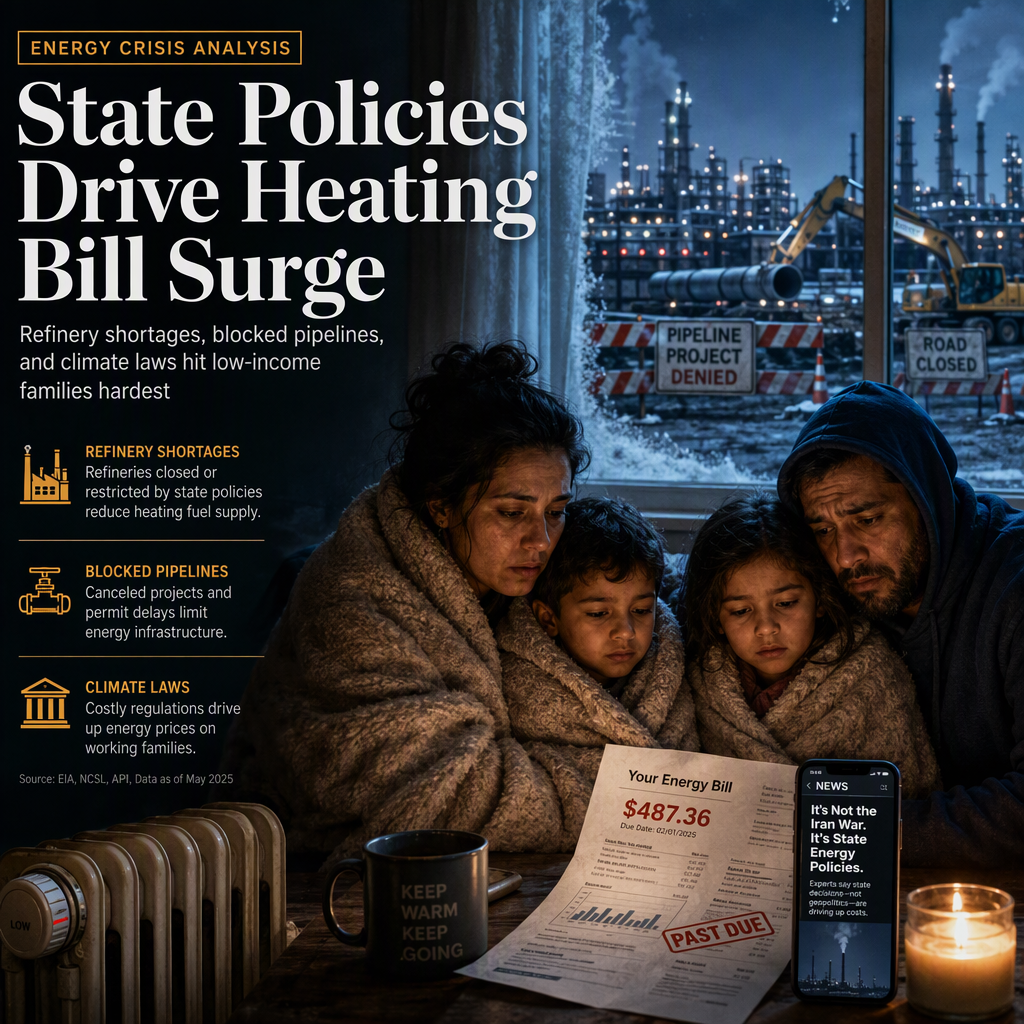
The recent rise in U.S. heating bills has been attributed by some to the ongoing Iran war, but according to the article, the core issue lies in state-level energy policies rather than international conflict [1]. While the Iran war may explain the timing of price increases due to oil's status as a globally traded commodity, the article argues that domestic vulnerabilities stem from policy decisions that restrict the full utilization of America's substantial oil and gas resources [1].
A significant factor highlighted is the shortage of refineries in the United States. The country currently has 130 operable refineries, a sharp decline from 301 in 1982, and no major new refinery has been built since 1976. The closure of the Philadelphia Energy Solutions plant resulted in the loss of approximately 335,000 barrels per day in refining capacity [1].
The article also points to New York's blockade of natural gas pipelines, specifically referencing the decade-long struggle to build the Constitution Pipeline, which would have transported natural gas from Pennsylvania to New York. The pipeline was ultimately denied a water permit in 2016, with subsequent attempts to revive the project failing due to incomplete applications [1].
Further compounding the issue are state climate laws, such as New York City's Local Law 97, which imposes fines on large buildings that exceed emissions limits, with stricter limits set for 2030. The costs of compliance or penalties are expected to be passed on to tenants, co-op owners, and small businesses. The closure of nuclear reactors and coal plants has also reduced the availability of reliable and cost-effective energy sources, disproportionately affecting low-income families [1].
The article concludes that limiting energy supply while demand remains steady inevitably leads to higher prices, a situation exacerbated during winter when alternative energy sources become more expensive. The impact is felt most acutely by families on fixed incomes, who are forced to reduce their energy usage to cope with rising costs [1].
CONCLUSION
The article contends that state-level energy policies, rather than international events like the Iran war, are the primary drivers of rising heating bills in the U.S. Key factors include refinery shortages, blocked pipeline projects, and restrictive climate laws. These policies have led to higher energy costs, particularly impacting low-income and fixed-income households.