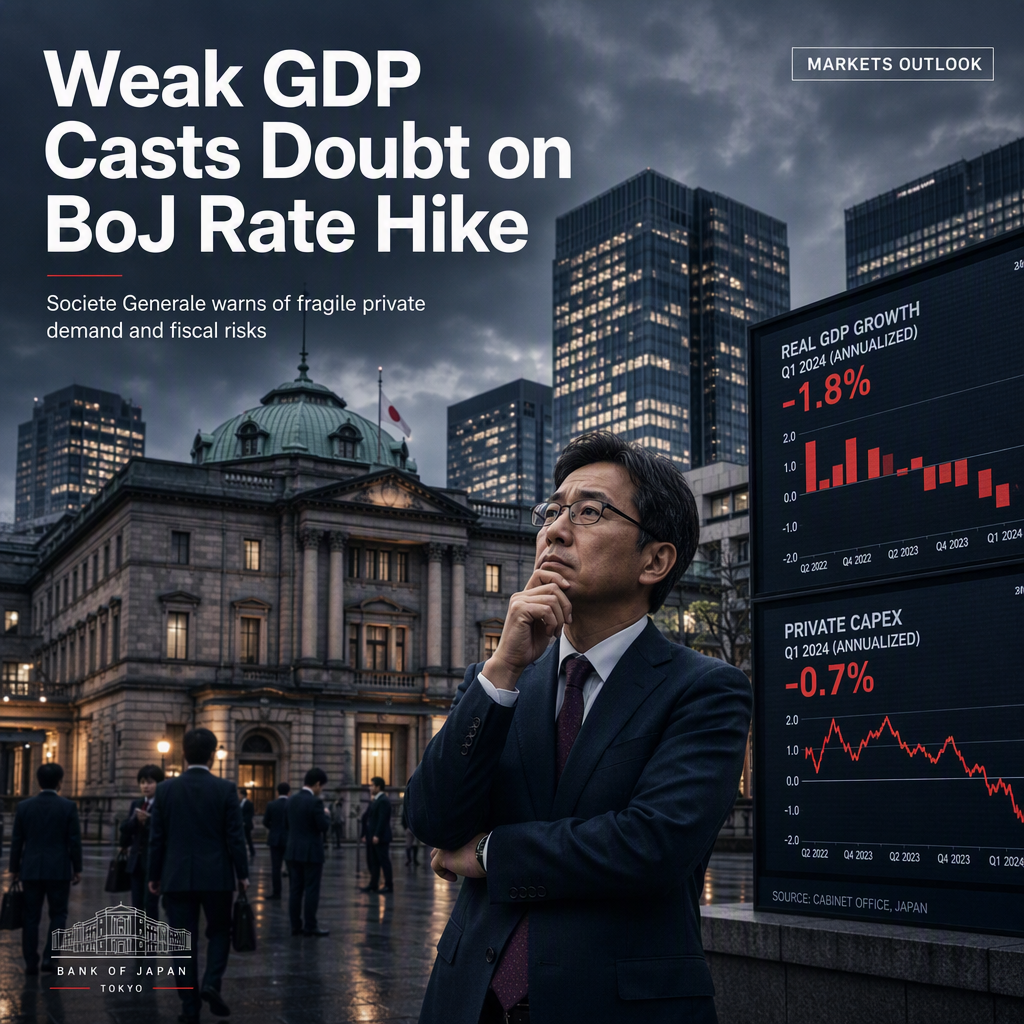
Societe Generale economists Reo Sakida and Jin Kenzaki have highlighted that Japan's second quarter GDP data came in weaker than expected, with both consumption and capital expenditure (capex) underperforming relative to forecasts [1]. The economists noted that these two components, which were anticipated to drive growth, instead disappointed, leading to a miss in headline growth versus consensus expectations [1].
Despite a higher GDP deflator, which could bolster near-term expectations for a Bank of Japan (BoJ) rate hike, the persistent weakness in private demand—particularly in consumption and capex—raises concerns about the feasibility of a faster and higher rate-hike path by the BoJ [1]. Societe Generale warns that ongoing softness in services consumption would serve as a cautionary signal for the central bank, potentially prompting a more cautious approach to monetary tightening [1].
The report also discusses fiscal policy implications, noting that investment-focused government spending could be implemented ahead of a recovery in private investment and potential growth. This front-loaded fiscal approach may temporarily worsen Japan's debt-to-GDP ratio, which is considered a negative factor for Japanese Government Bonds (JGBs) [1].
Overall, the economists suggest that the BoJ's policy trajectory remains uncertain, with sustained weakness in private demand and services consumption representing key risks to a more aggressive rate-hiking cycle [1].
CONCLUSION
Japan's weaker-than-expected GDP data and disappointing consumption and capex figures have cast doubt on the Bank of Japan's ability to pursue a faster and higher rate-hike path. Persistent private demand weakness and potential fiscal risks suggest a cautious outlook for monetary policy and Japanese Government Bonds.