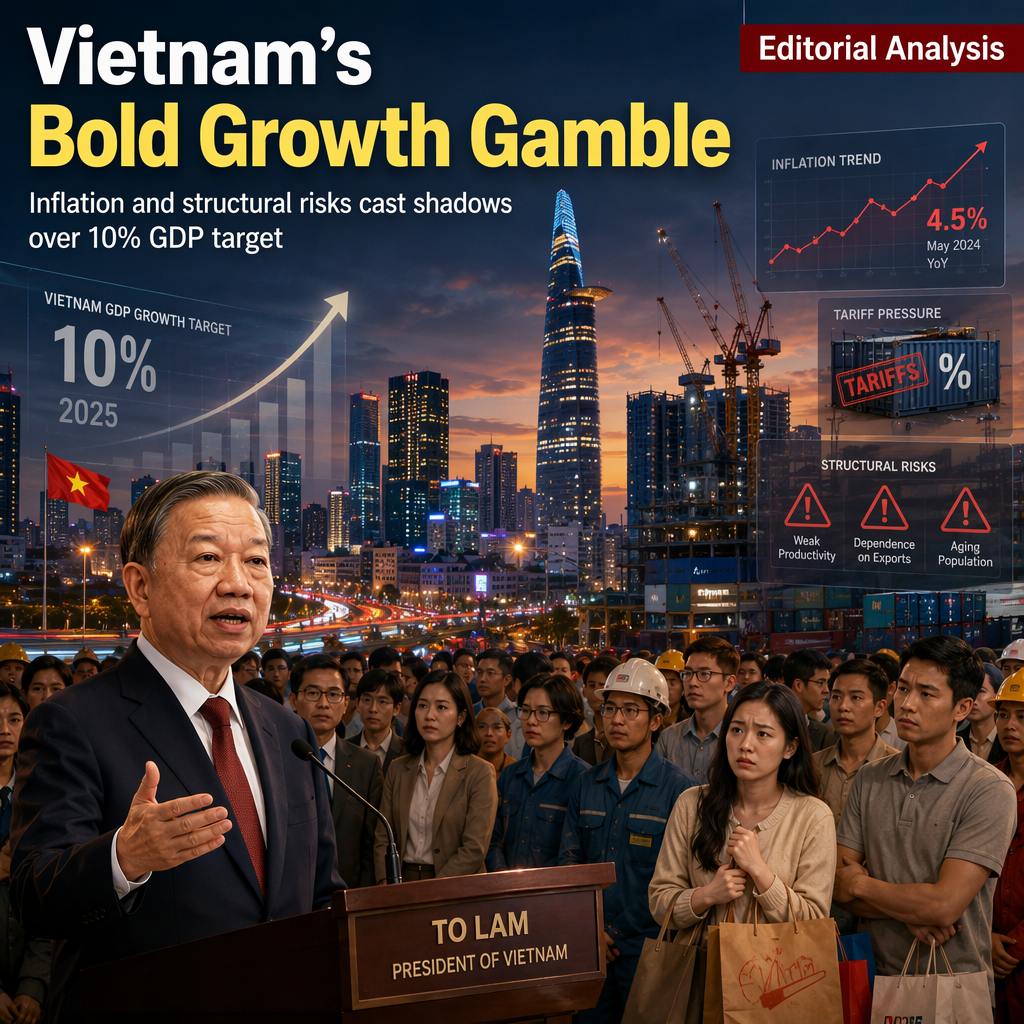
Vietnam reported robust economic performance, with gross domestic product (GDP) growing by 8.2% in the first half of 2026, an acceleration from the 7.5% growth recorded in the same period of the previous year [1]. President To Lam has announced an ambitious plan for the country to achieve at least 10% GDP growth annually during the 2026-2030 period [1].
Despite these strong figures, economists have raised concerns that such rapid expansion could lead to inflation and highlight structural weaknesses within the Vietnamese economy [1]. There are reports that Vietnamese consumers are tightening their budgets, indicating relatively weak domestic consumption even as the country remains a strong production base facing external pressures such as U.S. tariffs [1].
President To Lam has called for policies to boost spending by foreign visitors and encourage Vietnamese citizens to holiday domestically, aiming to support domestic demand [1]. However, analysts caution that without significant structural reforms, the pursuit of double-digit growth could expose the economy to vulnerabilities, including overreliance on external demand [1].
External risks, such as the ongoing Iran war, are also cited as potential threats to Vietnam's economic objectives. Additionally, Southeast Asia is expected to experience increasing divergence in economic performance following a mixed 2025, further complicating Vietnam's growth outlook [1].
CONCLUSION
Vietnam's impressive GDP growth and ambitious targets are tempered by warnings from economists about inflationary pressures and structural vulnerabilities. The government's ability to implement reforms and address both domestic and external risks will be crucial for sustaining high growth rates in the coming years.