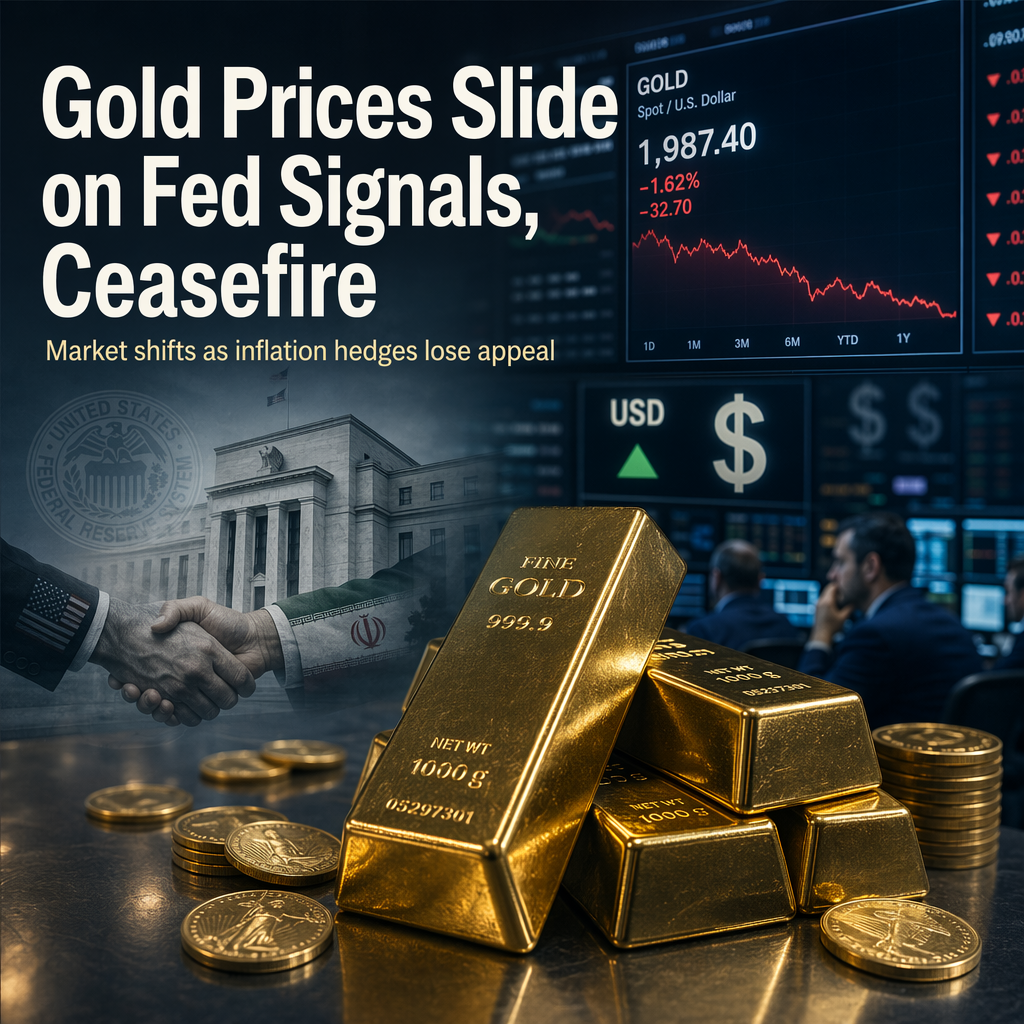
Gold prices declined as hawkish policy signals from the Federal Reserve and a stronger US dollar exerted downward pressure on the precious metal, according to UOB Global Economics & Markets Research [1]. Spot gold slipped 0.6% to $4,232.01 per ounce, while US gold futures dropped 3.1% to settle at $4,245.90 per ounce [1]. The decline in gold was further influenced by an interim ceasefire agreement between the US and Iran, which reduced inflation concerns and led to softer oil prices, diminishing gold's appeal as an inflation hedge [1].
US Treasuries advanced on Thursday, particularly at the longer end of the curve, in a bull flattening move that partially reversed the previous day's post-Fed slide. Meanwhile, equities pushed higher, supported by the easing of inflationary fears following the US-Iran ceasefire [1].
The combination of a hawkish Fed stance, a stronger dollar, and reduced geopolitical risk contributed to gold's underperformance, as investors shifted focus away from safe-haven assets [1].
CONCLUSION
Gold prices retreated due to hawkish signals from the Federal Reserve, a stronger US dollar, and reduced inflation fears following the US-Iran ceasefire. The market reaction included gains in US Treasuries and equities, while gold lost ground as a safe-haven asset.