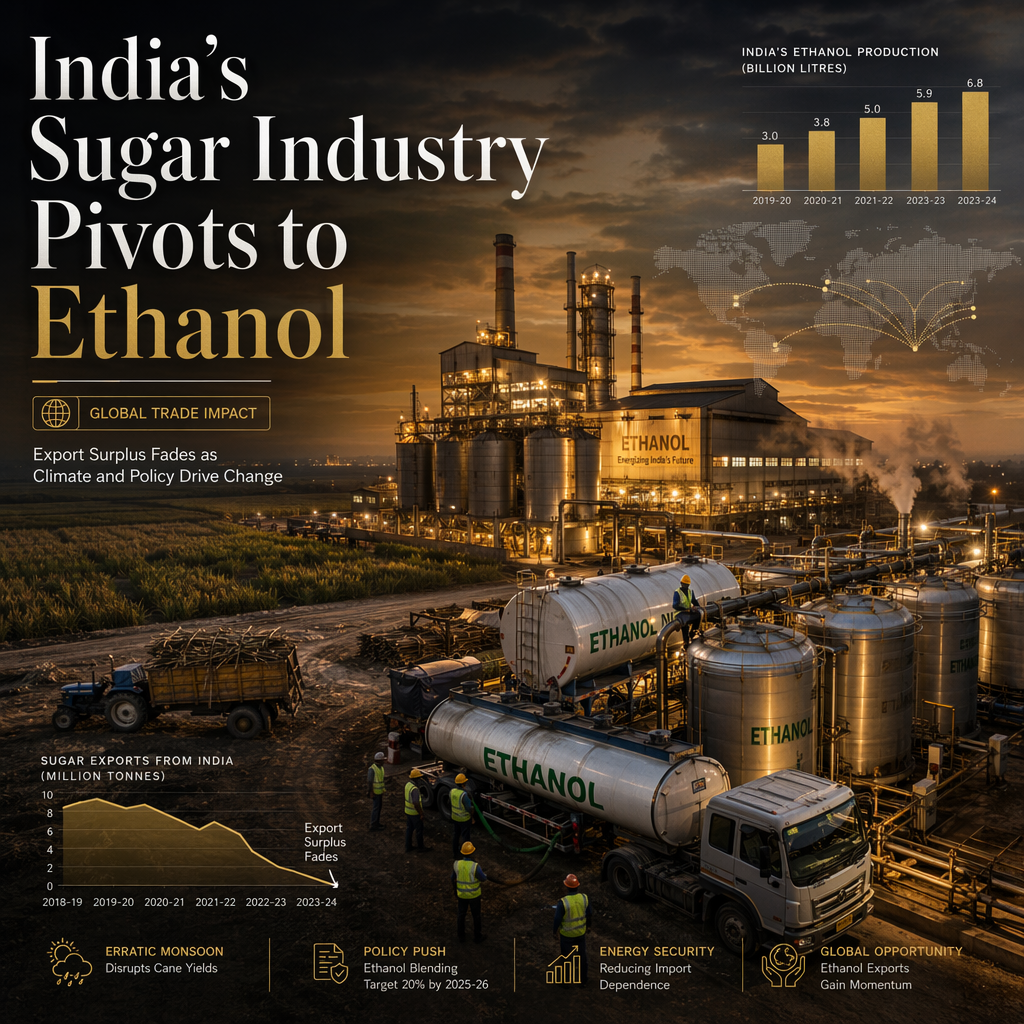
India's sugar industry is undergoing a fundamental transformation as mills increasingly invest in ethanol production, driven by government targets and climate-related challenges. According to multiple industry sources, India, once the world's second-largest sugar exporter, is expected to have little or no exportable sugar surplus for at least the next several production seasons, with the shift likely to persist until at least the 2027-2028 production seasons [1]. The government’s ethanol blending target of 20% in petrol by 2025 is a key driver, prompting mills to divert more cane juice and molasses toward ethanol rather than sugar for export markets [1].
Industry executives and analysts highlight that ethanol production has become a more reliable and profitable revenue stream for mills, supported by favorable government policies and incentives. A senior industry official stated, "Ethanol production is now a more reliable and profitable stream for mills compared to sugar exports, which are subject to global price fluctuations and export restrictions" [1]. The shift is also influenced by erratic monsoon rains and droughts, which have impacted cane yields, as well as volatility in the global sugar market [1].
India’s domestic demand for sugar remains robust, but export volumes are expected to decline sharply. International traders and analysts are closely monitoring India's domestic policy, as the absence of Indian sugar exports could tighten global supply and support higher prices on international markets [1]. Market participants warn that benchmark prices in New York and London could rise, especially if weather disruptions affect other major producers like Brazil or Thailand [1]. Technical analysts note that sugar futures could find support at recent highs, with resistance levels likely to be tested if supply tightens further [1].
This strategic realignment marks a significant reshaping of India's role in the global sugar trade, with ripple effects anticipated across global commodity markets for years to come [1].
CONCLUSION
India's pivot from sugar exports to ethanol production is expected to reduce exportable sugar surplus for several years, tightening global supply and potentially supporting higher international prices. The move, driven by government policy and climate challenges, is reshaping both domestic and global sugar markets. Analysts anticipate continued volatility and elevated prices as the industry realigns its priorities.