
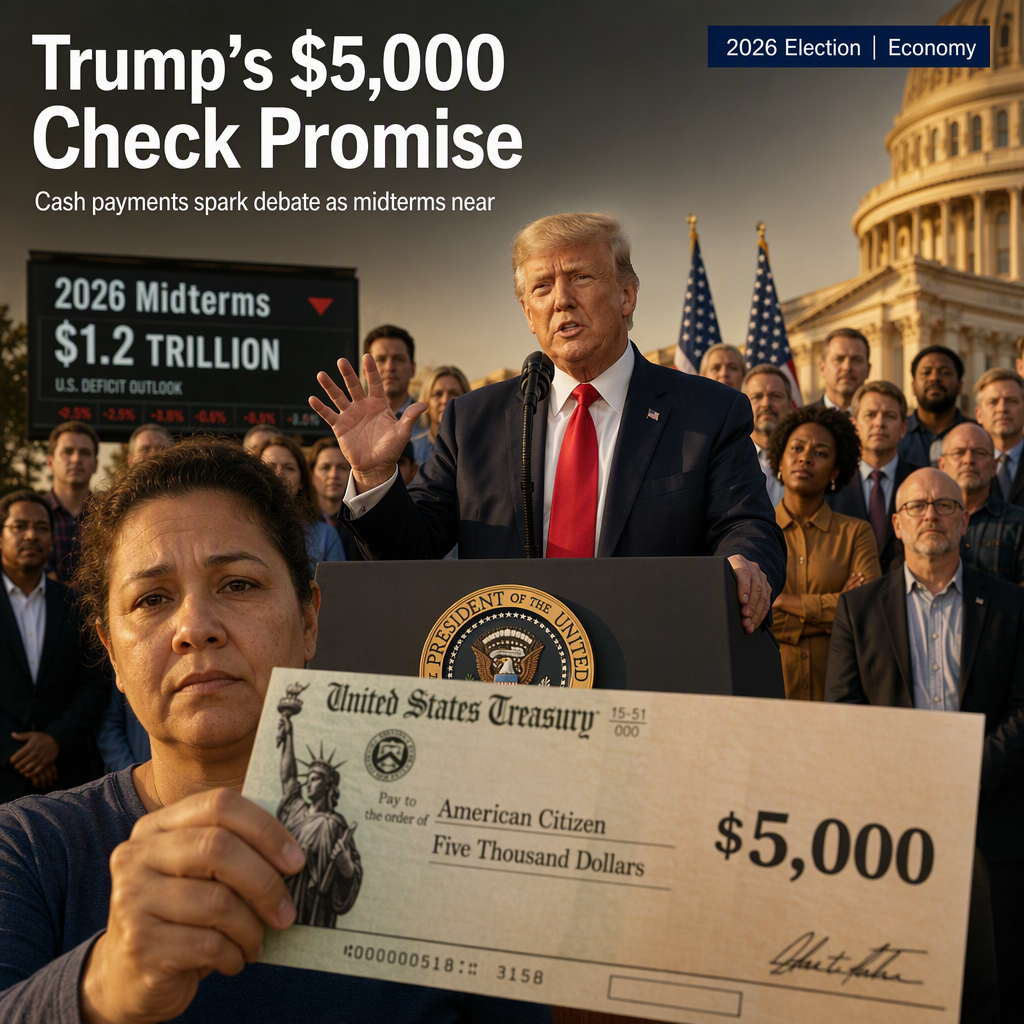
President Donald Trump has announced two federal cash payment programs and renewed a much larger $5,000 check promise as Republicans approach the 2026 midterm elections, which are dominated by concerns about prices and the economy [1]. On October 4, Trump publicized one-time $90 payments to 20.8 million Medicare beneficiaries, scheduled to arrive this month and funded through the Medicare Improvement Fund [1]. Additionally, $500 Affordable Care Act 'refund' checks began distribution last week to roughly 950,000 people who purchased unsubsidized coverage through the federal marketplace, with 71% of the $339 million allocated going to residents in 13 states with competitive Senate and gubernatorial races, though eligibility is based on insurance status [1].
On Saturday, Trump revived his earlier pledge to give every adult U.S. citizen $5,000, contingent on Republicans retaining control of Congress in November. He stated, 'If Republicans win the House of Representatives and the Senate in the 2026 Midterm Elections, I'm going to give all Adult Citizens in the United States of America, $5,000,' via a Truth Social video post [1]. However, Trump has not provided details on who would authorize the payments or the funding source. Sending $5,000 to every adult citizen would cost roughly $1.2 trillion and require congressional approval [1].
Some Republican lawmakers have voiced concerns about the proposal's impact on the federal deficit and inflation. Rep. David Schweikert, R-Ariz., stated he would 'throw everything of my heart and soul' into stopping the proposal, warning it could push interest rates higher [1]. Rep. Jamie Raskin, D-Md., called the plan a 'political bribe' and emphasized that Congress controls federal spending [1].
Polling data indicates mixed public reception. A Rasmussen Reports survey found likely voters split, 47% to 48%, on the $5,000 check proposal, with only 15% saying it would affect their vote. A Marquette Law School poll in Wisconsin showed 70% opposition to the payments [1].
CONCLUSION
Trump's cash payment promises, including the $5,000 check contingent on Republican congressional victories, have sparked debate over their fiscal impact and political effectiveness. While smaller payments are already being distributed, the larger proposal faces skepticism from lawmakers and the public, with polling showing divided opinions and concerns about inflation and deficit. The market impact is medium, as the proposals could influence consumer sentiment and spending if enacted.