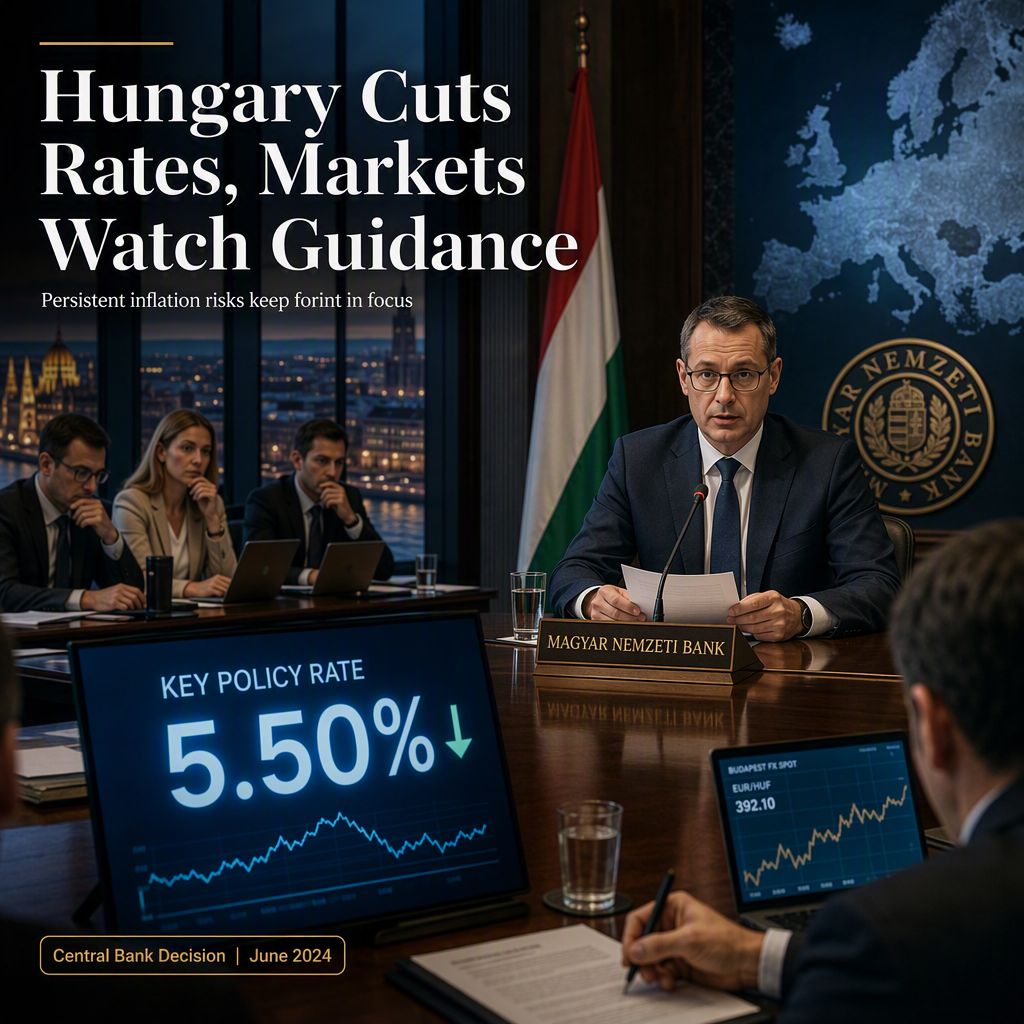
Commerzbank’s Tatha Ghose anticipates that Hungary's central bank, the Magyar Nemzeti Bank (MNB), will cut its base rate by 25 basis points to 5.50% this afternoon, a move that is unanimously expected by analysts [1]. However, Ghose emphasizes that the market's attention will be more focused on the MNB's forward guidance rather than the rate cut itself, as the decision is not expected to provide new information about the outlook [1].
While headline inflation in Hungary has recently surprised on the downside, core and services inflation pressures, as well as energy risks, continue to persist [1]. Notably, month-on-month core inflation (adjusted for tax changes and seasonality) accelerated noticeably in July to above the central bank's target, indicating that the disinflation trend is no longer clear-cut [1].
Ghose notes that the MNB is currently in a rate-cutting cycle despite ongoing regional inflation risks, which has already impacted the Hungarian Forint (HUF) [1]. The analyst suggests that a less dovish tone and conditional guidance on future rate cuts could support the forint, especially if the MNB adopts more realistic policy guidance in the event of adverse price shocks [1]. Conversely, if policymakers, such as Mihaly Varga, signal that further cuts remain available in September without conditions, the market may interpret this as an unconditional easing stance, potentially keeping the forint under pressure [1].
The report also highlights that the forint could benefit marginally if the euro rallies further and overall risk sentiment improves, but a more substantial recovery would require a shift in the MNB's policy communication [1].
CONCLUSION
The market is widely expecting a 25bp rate cut from Hungary's central bank, but the focus will be on the tone and guidance provided for future policy moves. Persistent inflation risks mean that overly dovish signals could keep the forint under pressure, while more cautious guidance may help stabilize the currency.