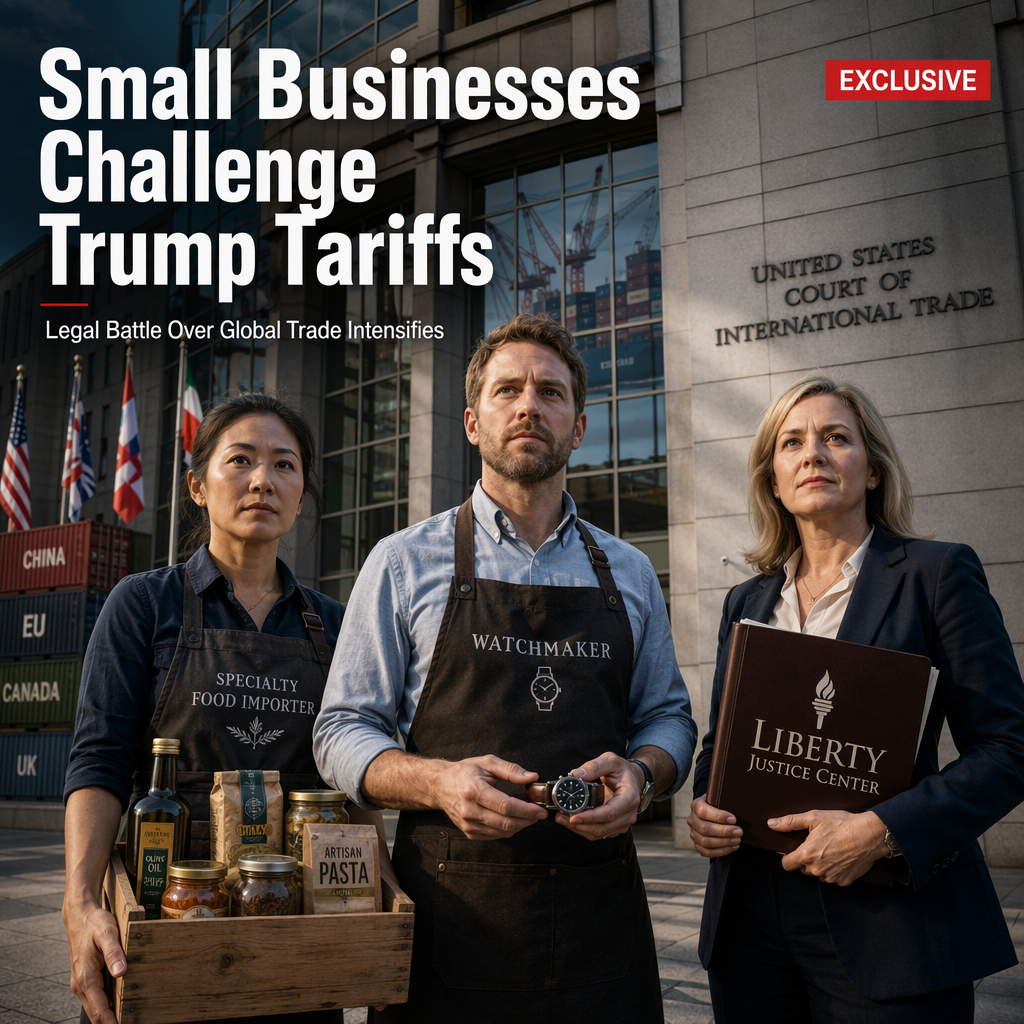
A group of small businesses, represented by the Liberty Justice Center, has filed a lawsuit against the Trump administration in the Court of International Trade in New York, seeking to halt the enforcement and collection of the latest wave of tariffs imposed on 60 U.S. trade partners under Section 301 of the Trade Act of 1974 [1]. The suit was filed less than a day after the tariffs were enacted and comes after the expiration of Trump’s temporary global 10% tariff at midnight, which was replaced by new duties ranging from 10% to 12.5%, with exceptions for some foods, fuels, automobiles, and certain metals [1].
The Liberty Justice Center, which previously won a Supreme Court ruling against tariffs enacted under the International Emergency Economic Powers Act, is representing New York-based Burlap & Barrel and California-based Collective Horology in this case [1]. The complaint alleges that the U.S. Trade Representative (USTR) acted "arbitrarily and capriciously" by imposing near-uniform tariffs across 60 materially different economies without providing a reasoned, record-based explanation for how the tariffs would address the identified practices, specifically the alleged failure to prohibit the importation of goods produced with forced labor [1].
The lawsuit does not dispute the need to combat forced labor but challenges the USTR’s authority to impose sweeping tariffs without meeting Section 301’s country-specific findings and remedial requirements [1]. Jeffrey Schwab, director of litigation at the Liberty Justice Center, stated that this is the third attempt by the administration to implement a global tariff policy without adhering to statutory limits, emphasizing that Section 301 is not a broad authorization to tax nearly all imports from nearly all countries at preestablished rates [1].
Major trading partners, including China, the European Union, Canada, and the U.K., have quickly rejected the Trump administration’s accusations regarding forced labor [1]. The market implications are significant, as the tariffs affect a wide range of goods and trading partners, and the legal challenge could impact the administration’s ability to enforce these duties or collect related revenues [1].
CONCLUSION
The lawsuit by small businesses against the Trump administration’s new tariffs highlights ongoing legal and international challenges to U.S. trade policy. With major trading partners rejecting the forced labor accusations and the legal process underway, the outcome could have substantial implications for U.S. importers and global trade relations.