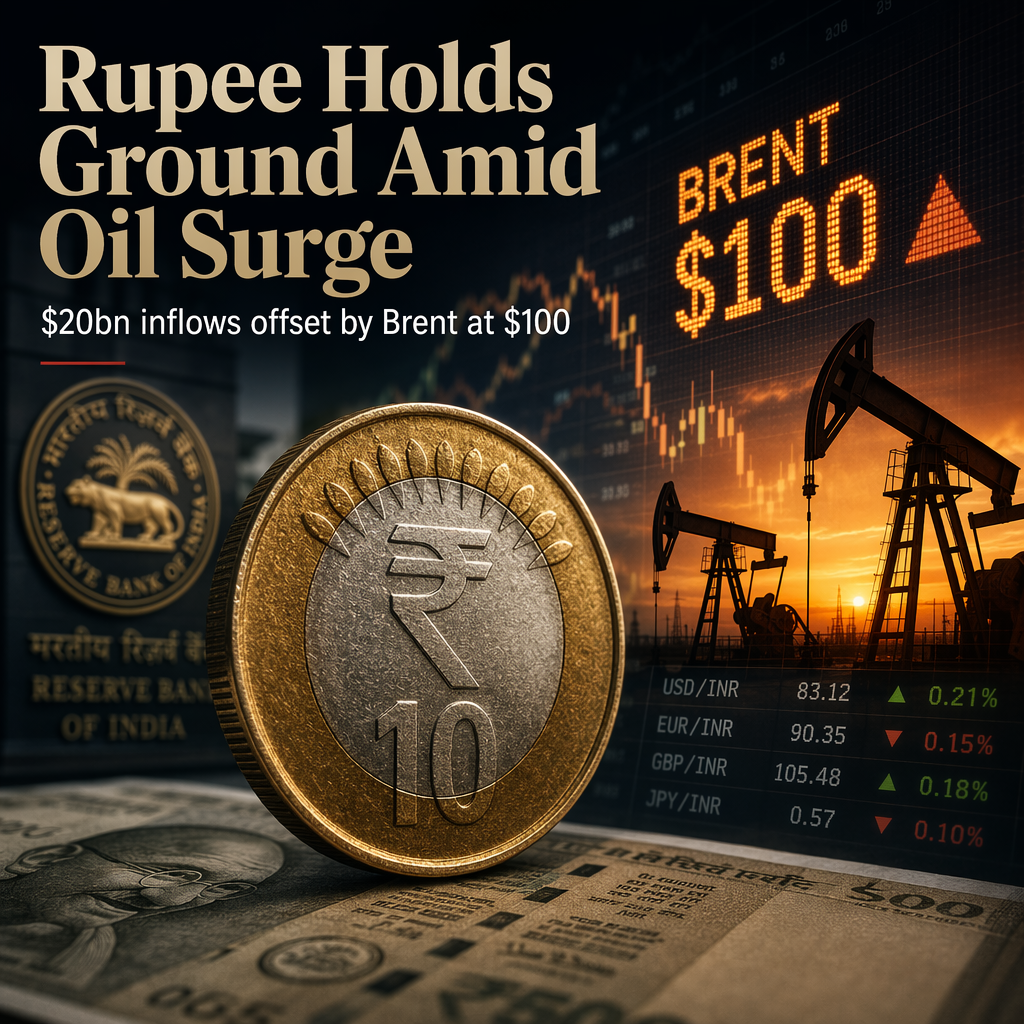
Societe Generale strategists report that the Indian Rupee (INR) has remained defensive despite recent policy measures by the Reserve Bank of India (RBI) aimed at attracting capital inflows, as a surge in Brent Oil prices to $100 per barrel has offset these supportive factors [1]. The RBI intervened in both onshore and offshore markets as the USD/INR exchange rate approached record highs last seen in May [1].
The central bank indicated that measures announced alongside the June Monetary Policy Committee (MPC) meeting resulted in approximately $20 billion of inflows, primarily through FCNR deposits, external commercial borrowings, and overseas foreign currency funding [1]. However, the positive impact of these inflows has been overshadowed by rising oil prices, which have exerted renewed pressure on the rupee [1].
Additionally, the 1-year INR Overnight Index Swap (OIS) rate has rebounded to 6.05%, retracing nearly 25 basis points from the lows observed after the RBI's policy actions, reflecting the shift in market sentiment due to higher oil prices [1].
CONCLUSION
Despite attracting $20 billion in capital inflows through recent policy measures, the Indian Rupee remains under pressure as surging oil prices and rising rates dominate market sentiment. The RBI's interventions have so far been unable to fully counteract the negative impact of higher energy costs.